Ofrezca Brass Bulletin en su universidad, conservatorio o biblioteca Descubra el acceso institucional

18 min de lectura

The trombone: changing times, changing slide positions

From Virgiliano to Praetorius and Eisel, early sources reshape long-held assumptions about trombone tuning, slide positions and historical playing practice.
The trombone: changing times, changing slide positions

Howard Weiner was born 1952 in Chicago (USA). Initial trombone study with Richard Schmitt, followed by studies at Northwestern University with Frank Crisafulli and at the Schola Cantorum Basiliensis with Heinrich Huber. Member of Edward Tarr Ensemble (U.S. concert tour, 1979).

In 1975 there appeared in these pages an article by Heinrich Huber entitled, The Trombone: Changing Times, Changing Slide Positions,² to which this is intended as a sequel. Huber reviewed three early sources by Daniel Speer, Marin Mersenne and Michael Praetorius in addition to introducing one previously unknown source by Aurelio Virgiliano. The article systematically presented and compared each source to modern practice.

Since Huber's article was published, I have found additional information from Praetorius, and several more sources that deal with the trombone and with slide positions in particular: J.F.B. Caspar Majer, Johann Gottfried Walther, Johann Philipp Eisel, Johann Mattheson, Joh. Christoph and Joh. David Stössel, Heinrich Christoph Koch and F.J. Fröhlich. While some of these new sources add little to our knowledge of the early trombone, information contained in all of them taken together necessitates a review and réévaluation.

Previously it had been assumed (and Huber continues this assumption) that these early writers were describing just the diatonic positions and that the basic pitches³ of the instruments themselves were the same as our modern trombones⁴. However, all of the sources reviewed herein (with the exception of Mersenne, who doesn't give specific pitches) seem to indicate that tenor and bass trombones in A and alto and quint-trombones in D, rather than instruments in B-flat and E-flat (or F) respectively, were the norm until around 1800.

Daniel Speer (Grund-richtiger Unterricht der musikalischen Kunst, Ulm 1687⁵ and 1697⁶) gives four positions for the tenor trombone (Illustration 1). According to Huber the instrument is in B-flat with the modern first, second, fourth, sixth and seventh positions corresponding to the harmonic series of B-flat, A, G, F and E respectively. The first position with the B-flat harmonic series is omitted, Huber states, because "Speer took for granted that his 'first' position began a half a tone lower than the basic pitch of the instrument."⁷
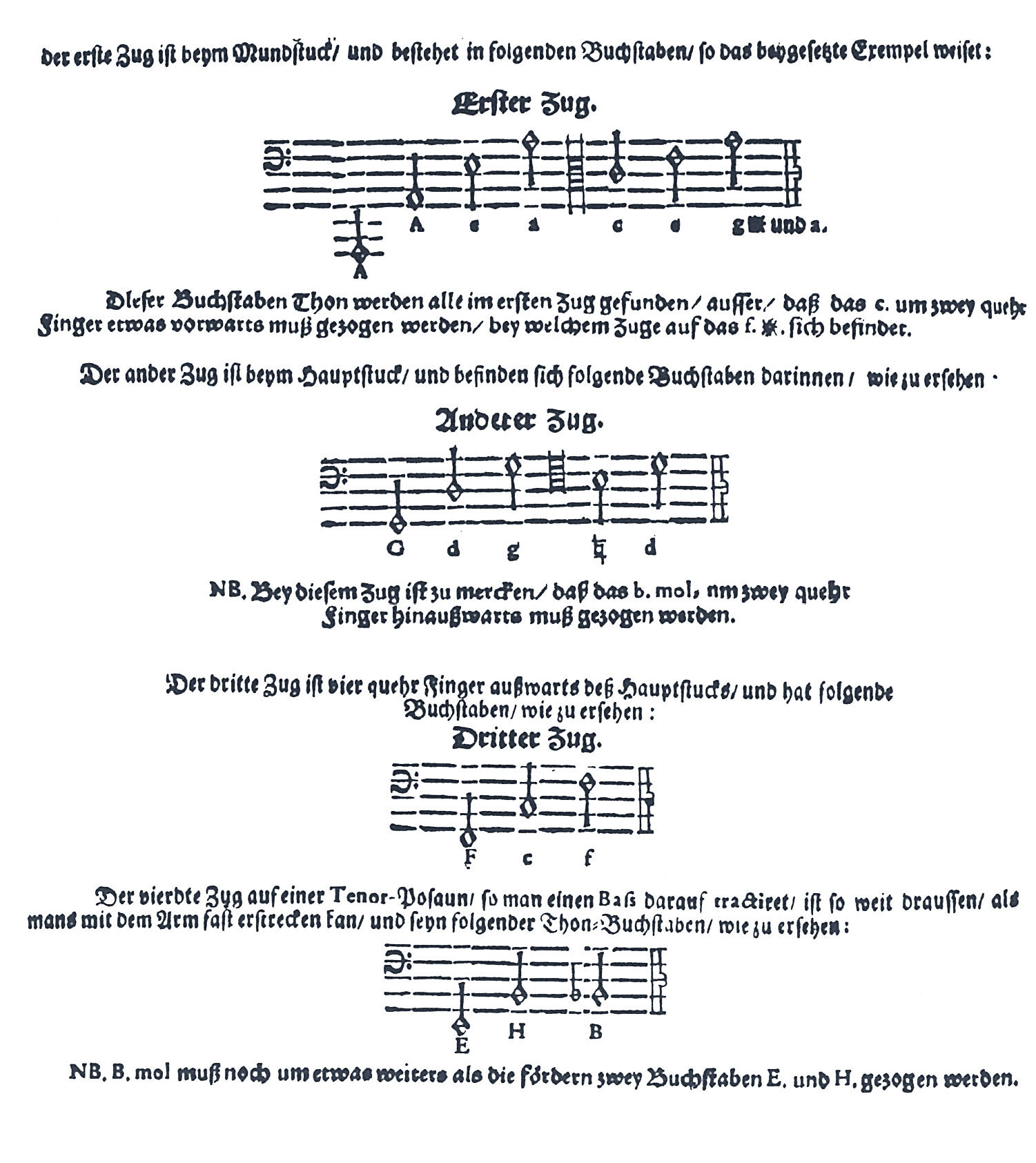
Illustration 1

Illustration 1

However, Speer himself states that first position is "by the mouthpiece" and gives the harmonic series AA A e a c' e' g'-sharp a'. Speer also notes that the c' must be played about two Querfinger8 further out and that f'-sharp9 will also be found there. Second position for Speer is "by the bell" and has the harmonic series G d g b d'. Speer notes here that b-flat is played about two Querfinger further out from this second position and not in first position as Huber's table would indicate.

The harmonic series of F c f is given by Speer for the third position which is "4 Querfinger past the bell." Fourth position is "almost as far as one can reach" with the tones E B B-flat. Here Speer notes that the "B-flat must be played with the slide extended somewhat further past the E and B." Speer explains, moreover, in a following paragraph, that the sharp-notated semitones are played with the slide drawn in from their natural tones, but the flat-notated semitones must be played about two Querfinger further out.

Three positions are given by Speer for the alto and quint-trombones. The positions are the same for both with the quint-trombone sounding an octave lower than the alto. First position is once again "by the mouthpiece" with the harmonic series of D A d' f-sharp a' c". Second position, "by the bell", has C g c' e' g' b'. Third position, with the tones F and B, is "a few finger widths past the bell."

Continue reading

Accede a la edición digital completa.

Brass Bulletin 36, IV / 1981 páginas 52–63

Todo el contenido está protegido por derechos de autor © Brass Bulletin 1981–2026

Compartir este artículo

Facebook LinkedIn
Cargando…

Preguntas y respuestas

Cómo funciona la edición digital

¿Qué incluye la edición digital?

La edición digital reúne los artículos ya digitalizados como textos legibles y consultables en línea —no simplemente como escaneos o archivos PDF— junto con sus ilustraciones originales, notas, autoría, información del número y traducciones disponibles. Las sugerencias de artículos relacionados incluyen actualmente solo este material digitalizado.

¿Los artículos digitales son idénticos a los originales?

Conservamos con la mayor fidelidad posible el texto original, el idioma, las ilustraciones, los pies de imagen, las notas y el contexto editorial. La presentación se adapta para facilitar la lectura en línea y pueden corregirse errores evidentes de transcripción o escaneado. El contenido y el carácter del artículo publicado permanecen inalterados.

¿Qué idiomas están disponibles?

Brass Bulletin se publicó en inglés, francés y alemán a lo largo de toda su historia. Las traducciones al italiano y al español se añadieron a partir del número 60. Por este motivo, en los sitios italiano y español los artículos de los números 1 a 59 se muestran en inglés de forma predeterminada.

¿Con qué frecuencia se añaden nuevos artículos?

Se añaden nuevos artículos casi a diario, con aproximadamente un número completo digitalizado cada semana. El ritmo puede variar según el trabajo de preparación, tratamiento de imágenes y revisión editorial necesario.

¿Por qué no están disponibles todos los artículos en formato digital?

La colección completa de Brass Bulletin contiene 1.246 artículos publicados entre 1971 y 2003. El índice completo ya está disponible en línea y permite descubrir todos los artículos de la colección, incluidos aquellos cuyo texto íntegro todavía no ha sido digitalizado.

La digitalización comenzó en febrero de 2026. Cada artículo se prepara cuidadosamente para la lectura en línea, se revisa y se vincula con su número, sus autores, sus temas y sus ilustraciones. Al ritmo actual de digitalización, se prevé que la colección completa esté disponible en línea en febrero de 2028.

¿Por qué algunas referencias mencionan artículos que todavía no están disponibles?

Las referencias de los artículos originales se conservan aunque el material al que remiten aún no haya sido digitalizado. De este modo se mantiene intacto el contexto histórico y editorial. A medida que se incorporen más números a la edición digital, un número creciente de estas referencias conducirá a artículos que podrán leerse en línea.

¿Puedo sugerir un artículo o informar de un error de transcripción?

Sí. Si hay algún artículo que le gustaría especialmente ver digitalizado, o si detecta un posible error de transcripción o algún dato que falta, póngase en contacto con nosotros. Los comentarios de los lectores nos ayudan a mejorar la edición digital y a establecer prioridades útiles dentro del archivo.

¿Cómo puedo apoyar a Brass Bulletin?

Su apoyo ayuda a financiar la preparación, verificación y publicación en línea de la colección completa.

Suscríbase a la Edición Digital

¿Prefiere apoyarnos sin suscribirse?

Haga una donación

¿Cómo avanza la digitalización?

Estamos poniendo Brass Bulletin a disposición de los lectores en línea, artículo por artículo. Pueden leer los artículos recién digitalizados en cuanto estén listos, incluso antes de que se complete un número entero.

Consulten nuestro calendario de digitalización para descubrir las últimas novedades y las fechas estimadas de disponibilidad de los próximos números. Estas estimaciones se basan en nuestro ritmo reciente y pueden cambiar.

Busca en Brass Bulletin.