Explore institutional access Explore institutional access

6 min. read

The posthorn of the 19th-century Royal Post Office in the service of folk music
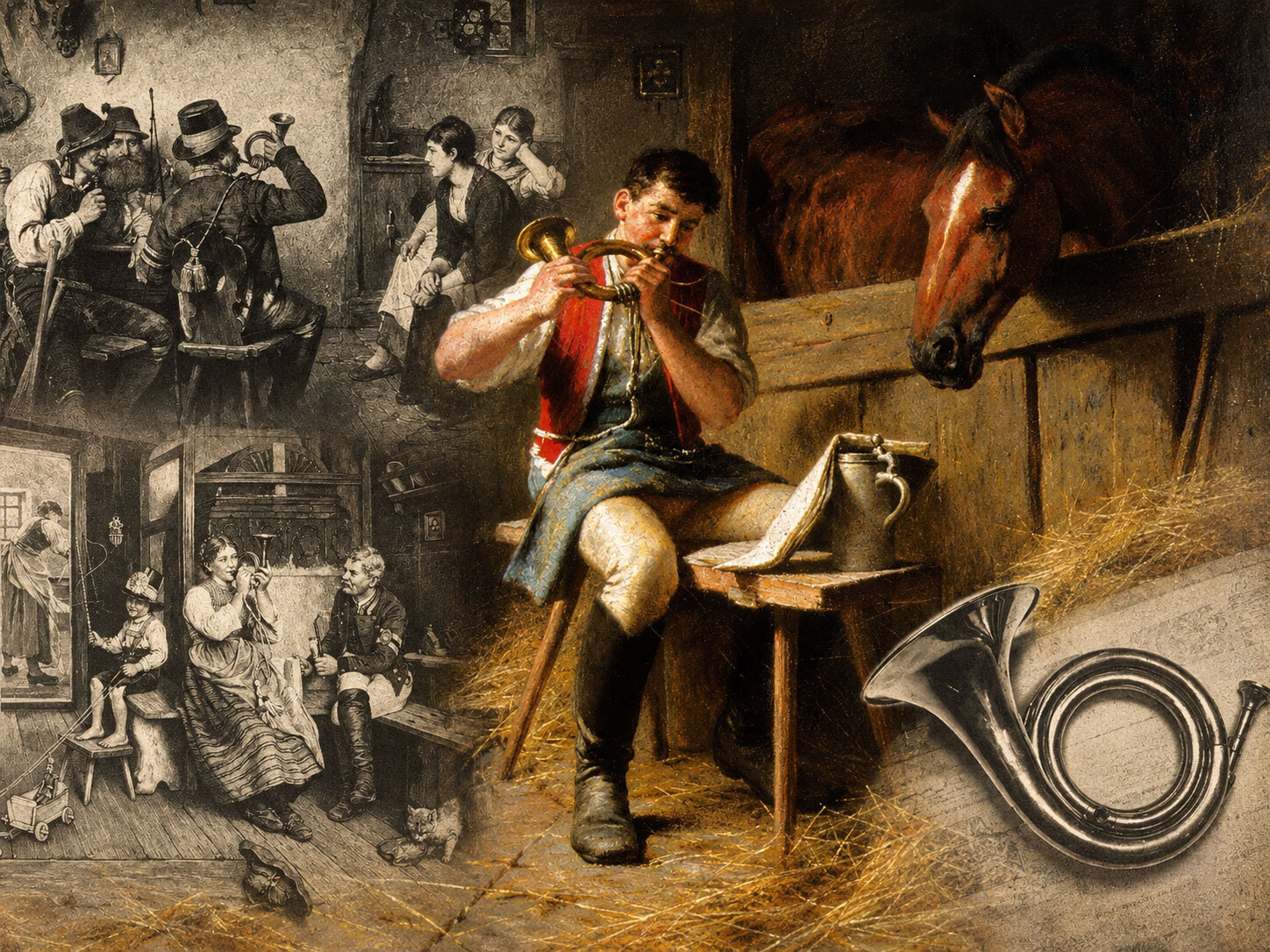
Once a tool of postal signalling, the posthorn became part of Bavaria’s popular musical life, caught between official regulation, practical invention and folk tradition.
The posthorn of the 19th-century Royal Post Office in the service of folk music

When postilions drive their charges
Safely over hill and dale,
Hours and miles fly sweetly by
With the horn call’s merry note.

C. Hildebrandt
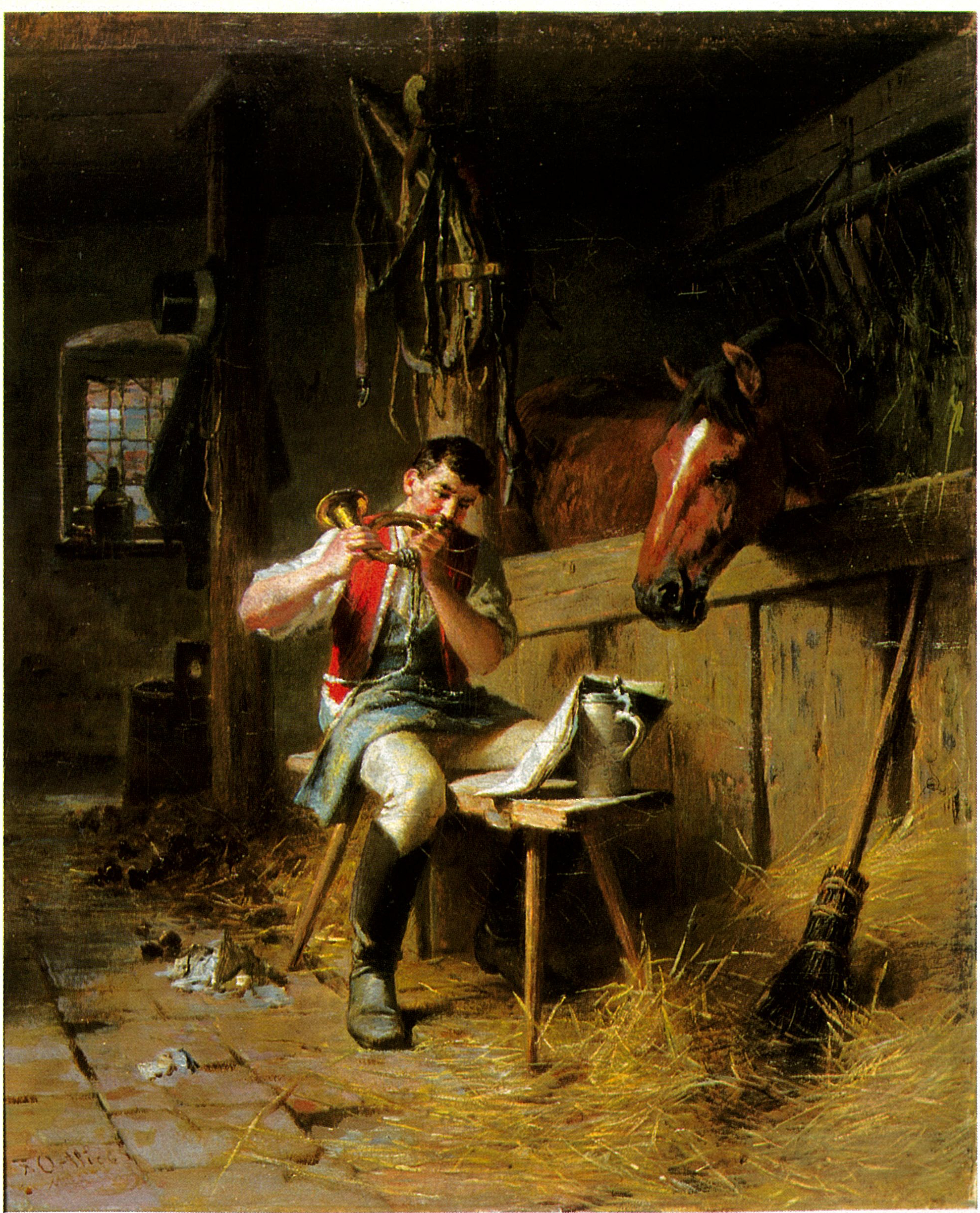
“Posthornklänge” (Bavarian postilion practising). Painted in oils (1890) by Friedrich Ortlieb. In the possession of the Bundespostmuseum, Frankfurt-am-Main.
“Posthornklänge” (Bavarian postilion practising). Painted in oils (1890) by Friedrich Ortlieb. In the possession of the Bundespostmuseum, Frankfurt-am-Main.

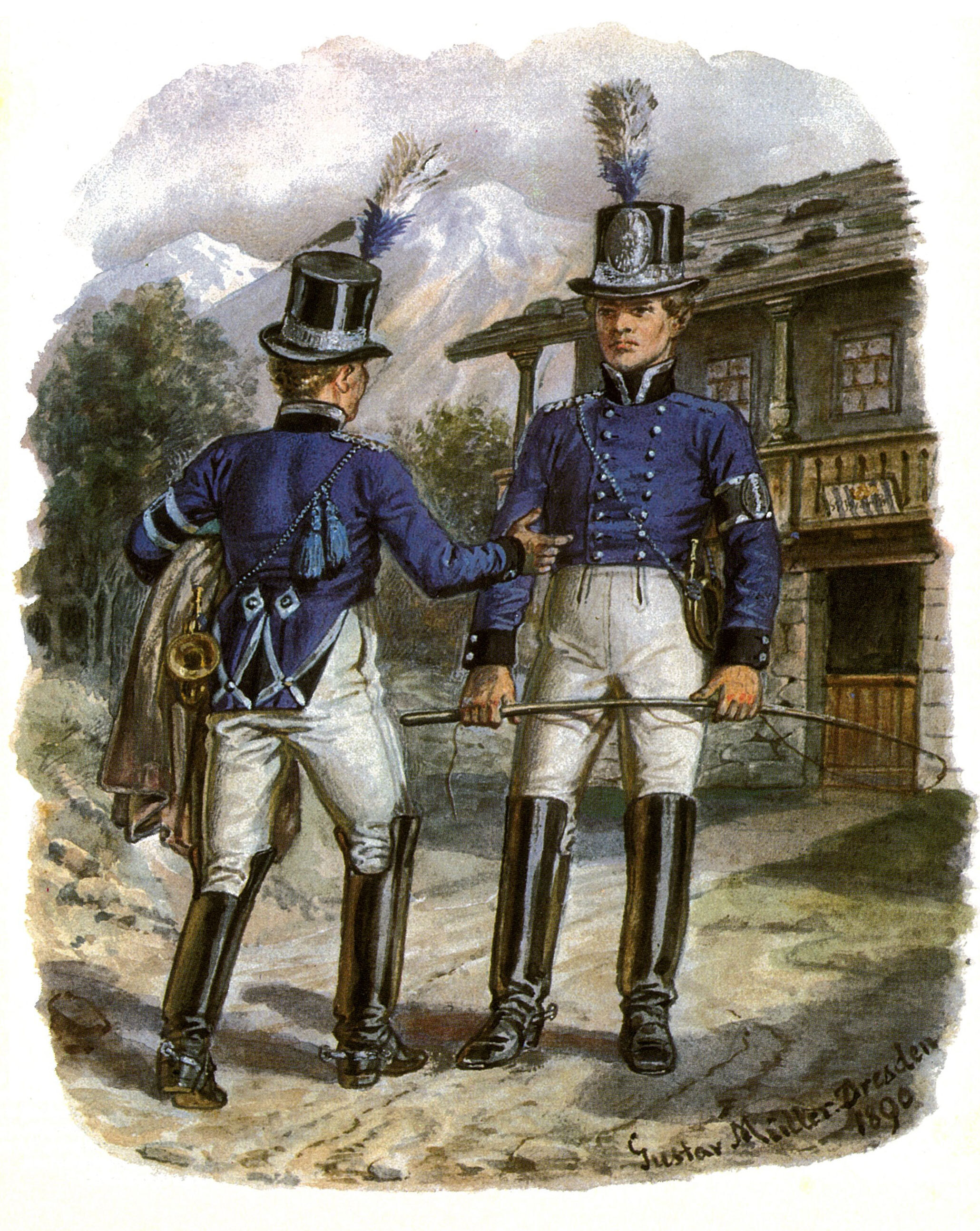
“Bavarian postilions around 1850”. Watercolour (1890) by Gustav Müller. Original in Bundespostmuseum, Frankfurt-am-Main, FRG.

“Bavarian postilions around 1850”. Watercolour (1890) by Gustav Müller. Original in Bundespostmuseum, Frankfurt-am-Main, FRG.

The main purpose of the posthorn, we read in the “Instruction of the use of the posthorn for the Royal Hanover Postilions” of 1832, is to signal the approach of postal conveyances and thus secure them unhindered and speedy attention... The posthorn also serves to increase the amenities of postal traffic in that it is most appropriate to the performance of attractive melodies. In the age of Romanticism, therefore, the posthorn was seen as no longer simply a signalling instrument, but also as a significant melodic instrument; this — the 1820’s — was the golden age of the art of the posthorn.

Until about 1830 two or three-coil posthorns in C or B♭ with a cup mouthpiece were in use in Bavaria; these had only a limited range:

As written in C

As written in C

After 1830 the Bavarian postilions were equipped with lower-pitched four-coil posthorns in F with a more funnel-shaped mouthpiece; these were in use until the present century. On these instruments the following notes were available:

As written in C

As written in C

Actual sounds in F

Actual sounds in F

This made the following calls, used between 1839 and 1903, easy to play:

No. 1 - Call before departure

No. 1 - Call before departure

No. 2 - Call on giving way

No. 2 - Call on giving way

No. 3 - Call before arrival at the station / Lively

No. 3 - Call before arrival at the station / Lively

In order to increase the range of notes available on the basic signalling posthorn, the service instrument was equipped with a tone hole situated two thirds of the way along the length of the tube, which, by shortening the tube when opened, raised the natural notes of the horn by a fourth:

° = tone hole open

° = tone hole open

This gives us the following fingering chart for a posthorn with one tone hole:

As written in C

As written in C

Even though the notes produced by using the tone hole did not match the principal notes in sound quality, this innovation constituted a substantial improvement in the Bavarian posthorn. From around 1830 there were even — for use in salon orchestras and wind bands (then known in German as Harmoniemusik) — fully chromatic posthorns with four or five tone holes closed by keys or with the still very expensive valves. Apart from their cost these instruments were too delicate for service use and had to be bought privately by posthorn virtuosos. Many postilions also used a cornet (then called in German Piston) for their musical performances.

Continue reading

Access the full Digital Edition.

Brass Bulletin 50, II / 1985 pages 52–65

All content is protected by copyright © Brass Bulletin 1985–2026

Share this article

Facebook LinkedIn
Loading…

Questions & Answers

How the Digital Edition works

What does the Digital Edition include?

The Digital Edition brings together the articles already digitized as searchable online texts—not simply as scans or PDF files—along with their original illustrations, notes, authorship, issue information, and available translations. Related-article suggestions currently include only this digitized material.

Are the digital articles identical to the originals?

We preserve the original text, language, illustrations, captions, footnotes, and editorial context as faithfully as possible. The presentation is adapted for comfortable online reading, and obvious transcription or scanning errors may be corrected. The substance and character of the published article remain unchanged.

Which languages are available?

Brass Bulletin was published in English, French, and German throughout its history. Italian and Spanish translations were added from issue No. 60 onward.

On the Italian and Spanish sites, articles from issues 1–59 are therefore shown in English by default.

How often are new articles added?

New articles are added almost daily, with approximately one complete issue digitized each week. The pace may vary depending on the preparation, image work, and editorial checking required.

Why aren’t all articles available digitally?

The complete Brass Bulletin collection contains 1,246 articles published between 1971 and 2003. The full index is already available online, allowing readers to discover every article in the collection, including those whose complete text has not yet been digitized.

Digitization began in February 2026. Each article is carefully prepared for online reading, checked, and connected to its issue, authors, subjects, and illustrations. At the current pace of digitization, the complete collection is expected to be available online by February 2028.

Why do some references mention articles that are not available yet?

References in the original articles are preserved even when the material they point to has not yet been digitized. This keeps the historical and editorial record intact. As more issues are added to the Digital Edition, an increasing number of these references will lead to articles that can be read online.

Can I suggest an article or report a transcription error?

Yes. If there is an article you would particularly like to see digitized, or if you notice a possible transcription error or missing detail, please contact us. Reader feedback helps us improve the Digital Edition and prioritize useful connections within the archive.

How can I support Brass Bulletin?

Your support helps fund the preparation, verification, and online publication of the complete collection.

Subscribe to the Digital Edition

Prefer to support us without subscribing?

Make a donation

Search Brass Bulletin.