Explore institutional access Explore institutional access
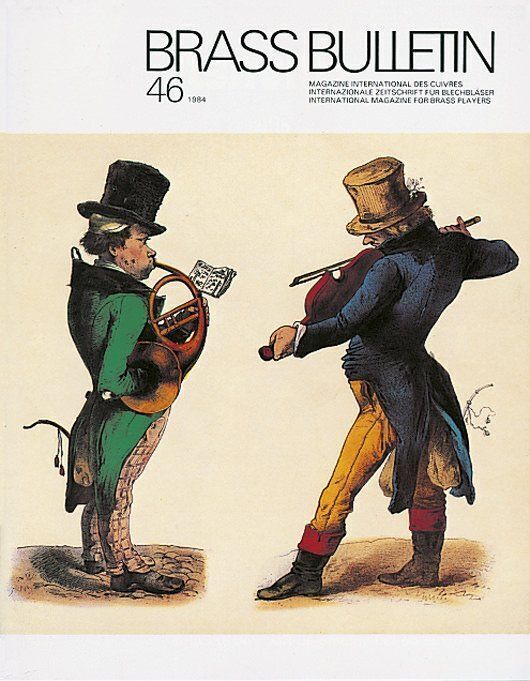
Brass Bulletin 46 - 2 / 1984
Issue
Brass Bulletin No. 46
Date
II / 1984
Pages
100
Contents
11 articles

This issue is still available in print.

English / French / German

CHF 15.00
All issues

Brass Bulletin No. 46

II / 1984

Contents

11 articles

Editorial

Jean-Pierre Mathez

pp. 9–11 Society

An international brass congress exposes a deeper tension between global exchange, American influence and the need for musical cultures to preserve their identity.

On the Cornett and Serpent

From Pierre Trichet’s Traité des Instruments de Musique (c. 1640)

Pierre Trichet

pp. 12–15 Cornett Serpent History Equipment

Written around 1640, Pierre Trichet’s Traité des Instruments de Musique preserves a firsthand account of the cornett and serpent in musical life and construction.

Melvyn Poore

Tuba britannica

Thomas Aitken

pp. 16–22 Tuba Encounters

A tuba becomes a laboratory for circular breathing, reeds, strange mutes and music theatre as Melvyn Poore pushes beyond the orchestral role assigned to it.

The Trumpet and the Cornet in Jazz and in Popular Music

Part 5

Breathing

Michel Laplace

pp. 23–30 Trumpet Cornet à pistons Technique

Breathing, Valsalva, mouthpiece position and daily practice collide with received wisdom as trumpet technique is reconsidered from the body outward.

The Trombone in the Sacred Works of W. A. Mozart

Benny Sluchin

pp. 31–35 Trombone Repertoire History

In Mozart’s sacred music, the trombone moved beyond choral reinforcement to striking solo roles that preserve the sound and practice of eighteenth-century Salzburg.

Meir Rimon

Portrait and conversation

Jeffrey Agrell

pp. 36–41 Horn Encounters Professional life

Orchestral discipline, solo freedom and an endless appetite for learning shaped Meir Rimon’s horn playing across Israeli, European and American traditions.

A modern corno da caccia

Werner Wolf

pp. 42–48 Horn Trumpet Equipment Instrument Makers

Bach’s highest horn parts expose a divide between historical sound and modern technique, prompting Friedbert Syhre and Ludwig Güttler to rethink the instrument itself.

Clément Perrin (1876-1970)

He lived at the turn of the 20th century...

Jean-Pierre Mathez

pp. 49–56 Trumpet History

An extraordinary brass life links Belle Époque Algiers, two world wars and Saint-Saëns, with Clément Perrin still performing as solo trumpet at 81.

The Pitch Finder

Jack Holland

pp. 58–61 Trumpet Equipment Technique

A 1980 attempt to make trumpet intonation mechanical shifts familiar pitch corrections from the embouchure to the fingers, with striking consequences for playing.

Johann Ernst Altenburg (1736-1801)

The last representative of the heroic art of the trumpeter and drummer

Arno Werner

pp. 63–77 Trumpet History

A trumpeter caught between a fading guild tradition and a changing musical world left a 1795 treatise that became an essential witness to a disappearing art.

Mantzaros Philharmonic Society

Corfou, Greece

Gerassimos Ioannides

pp. 96–97 Report

A Corfu musical society founded in 1890 connects European influence, amateur tradition and a trumpet school that trained some 1,200 players.

Loading…

Questions & Answers

How the Digital Edition works

What does the Digital Edition include?

The Digital Edition brings together the articles already digitized as searchable online texts—not simply as scans or PDF files—along with their original illustrations, notes, authorship, issue information, and available translations. Related-article suggestions currently include only this digitized material.

Are the digital articles identical to the originals?

We preserve the original text, language, illustrations, captions, footnotes, and editorial context as faithfully as possible. The presentation is adapted for comfortable online reading, and obvious transcription or scanning errors may be corrected. The substance and character of the published article remain unchanged.

Which languages are available?

Brass Bulletin was published in English, French, and German throughout its history. Italian and Spanish translations were added from issue No. 60 onward.

On the Italian and Spanish sites, articles from issues 1–59 are therefore shown in English by default.

How often are new articles added?

New articles are added almost daily, with approximately one complete issue digitized each week. The pace may vary depending on the preparation, image work, and editorial checking required.

Why aren’t all articles available digitally?

The complete Brass Bulletin collection contains 1,246 articles published between 1971 and 2003. The full index is already available online, allowing readers to discover every article in the collection, including those whose complete text has not yet been digitized.

Digitization began in February 2026. Each article is carefully prepared for online reading, checked, and connected to its issue, authors, subjects, and illustrations. At the current pace of digitization, the complete collection is expected to be available online by February 2028.

Why do some references mention articles that are not available yet?

References in the original articles are preserved even when the material they point to has not yet been digitized. This keeps the historical and editorial record intact. As more issues are added to the Digital Edition, an increasing number of these references will lead to articles that can be read online.

Can I suggest an article or report a transcription error?

Yes. If there is an article you would particularly like to see digitized, or if you notice a possible transcription error or missing detail, please contact us. Reader feedback helps us improve the Digital Edition and prioritize useful connections within the archive.

How can I support Brass Bulletin?

Your support helps fund the preparation, verification, and online publication of the complete collection.

Subscribe to the Digital Edition

Prefer to support us without subscribing?

Make a donation

Search Brass Bulletin.