7 min. read
Playing and singing simultaneously on brass instruments
5. Acoustical explanation
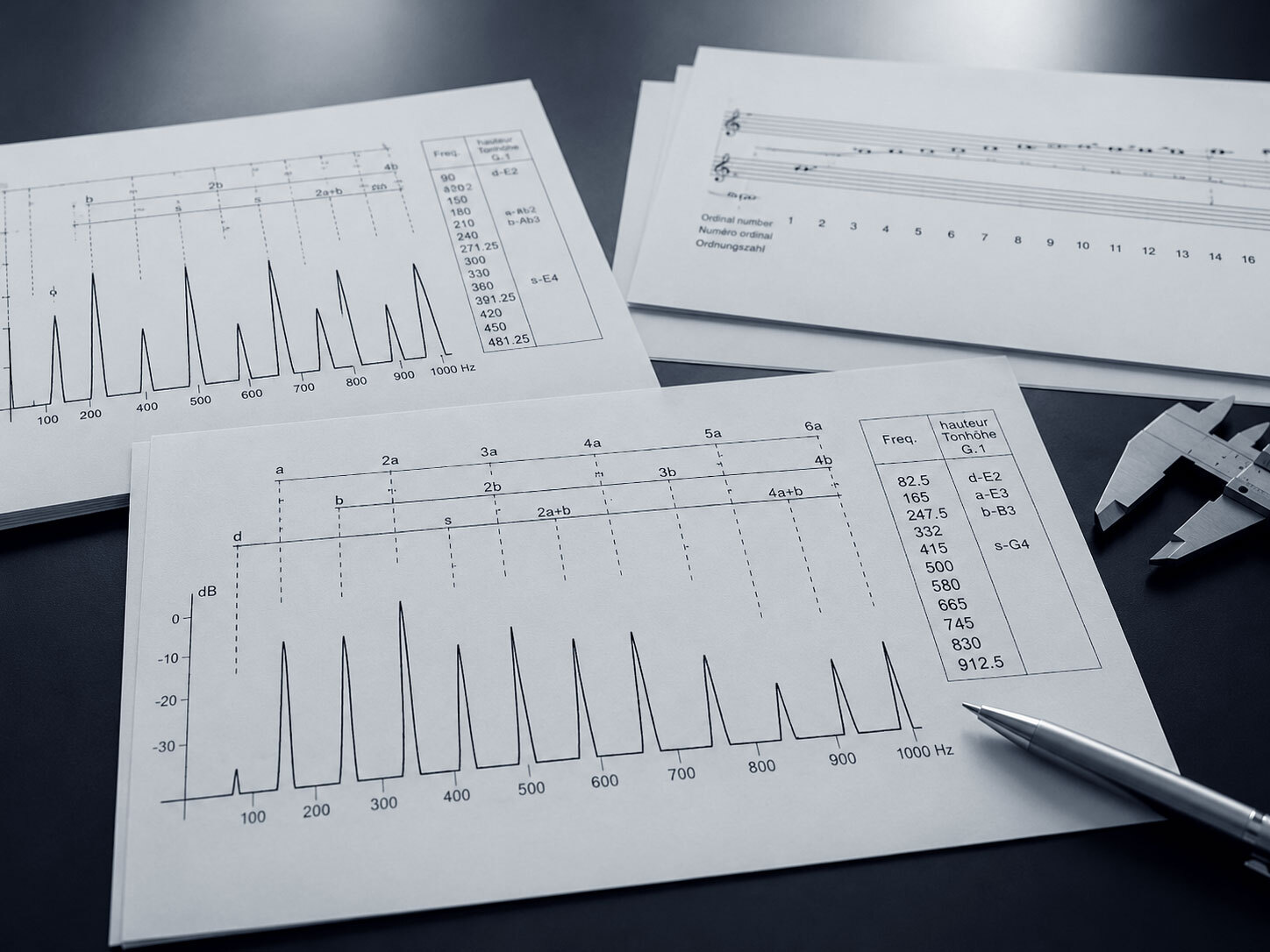
In this section we shall give a brief acoustical explanation of the phenomenon without any claim to scientific accuracy. A brass player should know more about the way his instrument functions in general, and how it behaves in particular instances such as playing and singing simultaneously. There is no mystery (cf. 1 §) as to how complete chords can be heard while the player produces only two pitches. In fact, any two sounds, especially of similar tone colour (similar combination of harmonics), of similar intensity and close together will produce combination tones. This physical theory was observed in the last century by the distinguished scientist H. Helmholtz²⁷, and it is reflected in Hindemith's treatise²⁸ showing that intervals have roots.
There is some old literature in connection with brass instruments. H. Kling gave a practical explanation²⁹ ³⁰ regarding the problem of horn chords (probably because of the Weber Concertino). However, more valuable articles by P. R. Kirby³¹ and W. F. H. Blandford³² appeared more than fifty years ago and B. Coar³³ gave a theoretical analysis of some intervals in relation to the Weber cadenza. More recent publications on the subject are found in the text-books by R. Gregory³⁴ ³⁵ and some dissertations (cf. refs).
As stated before, two simultaneously produced notes create combination notes: a summation-note — "s" — whose frequency is the sum of the frequencies of the generators, and a difference-note — "d" — whose frequency is the difference between the corresponding frequencies. Both s and d will be called first-order resultant-notes. Second-order resultant notes are obtained in the same way from the generators and their harmonics. We can summarize the resultant-notes of two frequencies a and b by the following:
Brass Bulletin 37, I / 1982 pages 20–28
All content is protected by copyright © Brass Bulletin 1982–2026