Brass Bulletin 33, I / 1981 (page 69–) · 1 min. read
All content is protected by copyright © Brass Bulletin 1981–2026

Harmonics or partials?

Search in this article
Harmonics or partials?

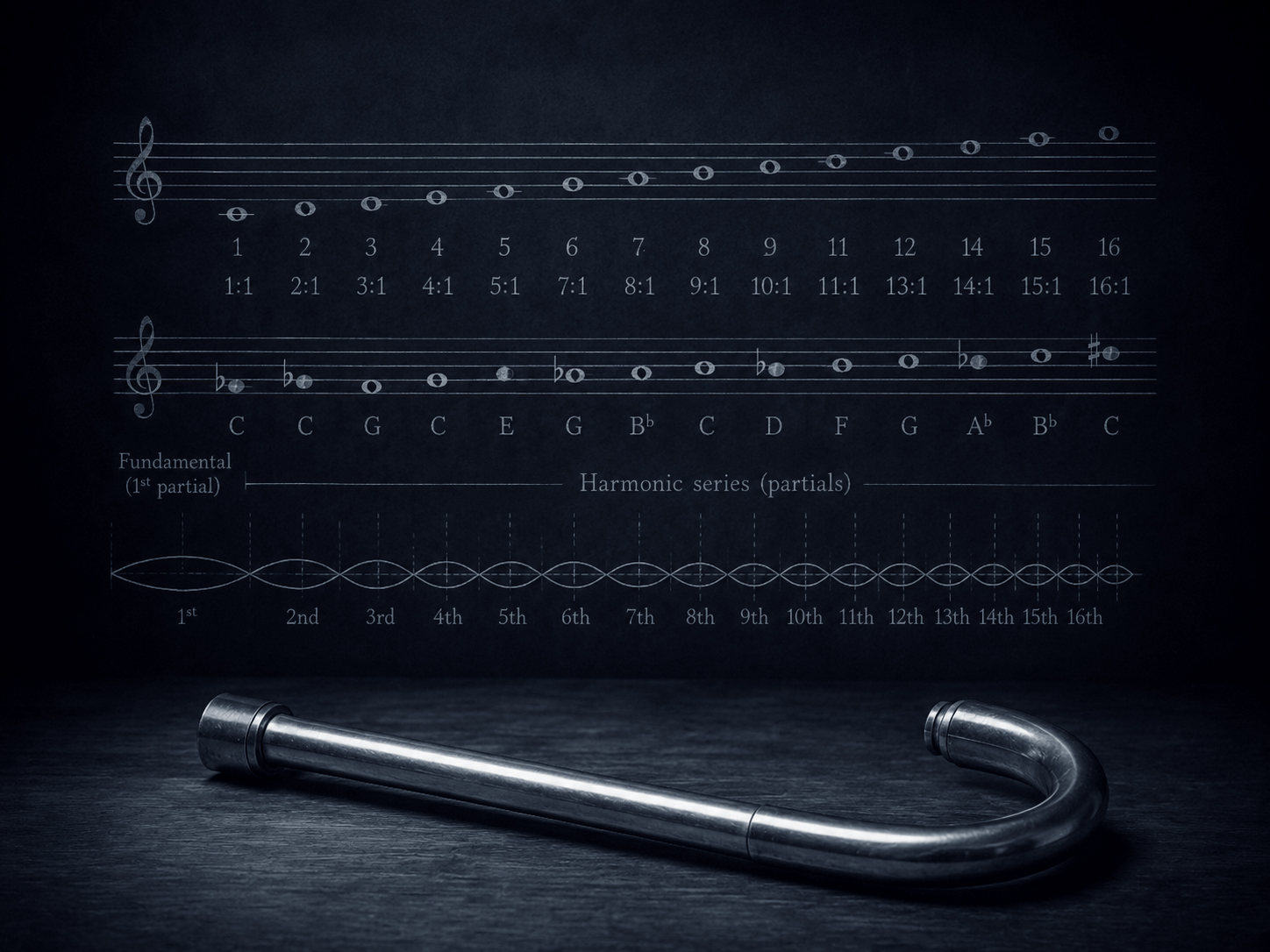
Theory tells us that the different notes produced when the air column inside a sounding tube is vibrated follow the "natural" harmonic progression.

This progression is governed by Fourier's Law, which states: "The harmonics of a sound include only whole multiples of the fundamental frequency, either the complete series of multiples or else only a certain number of them."

These are the "Fourier series", well known to electro-acousticians.

Being multiples of the fundamental, the harmonics are by definition in tune. Thus one cannot in any circumstances talk about out-of-tune harmonics.

Any frequency which does not correspond to this mathematical progression is not a harmonic but a partial.

In fact the different notes emitted by a sounding pipe will approximately follow the harmonic progression only if the maker has given the pipe a suitable shape, and makers spend their lives in search of this ideal.

If the pipe shape is poor, the succession of possible notes is also poor.

With a pipe of a given length, for example, one can, by changing its shape, make the fundamental rise progressively by a whole octave without displacing the other notes in the same proportions.

So where are our "natural" harmonics?

The different notes emitted by a sounding pipe are not harmonics but partials.

Each one is separately tunable and behaves like a new fundamental with its own timbre which is itself made up of harmonics.

These few reflections will help instrumentalists to understand their instruments' tuning faults better and should clear up a particularly grey area in musicians' knowledge.

Share this article

Loading…