11 min. read
Brass instrument research at Surrey University
By John Goodwin
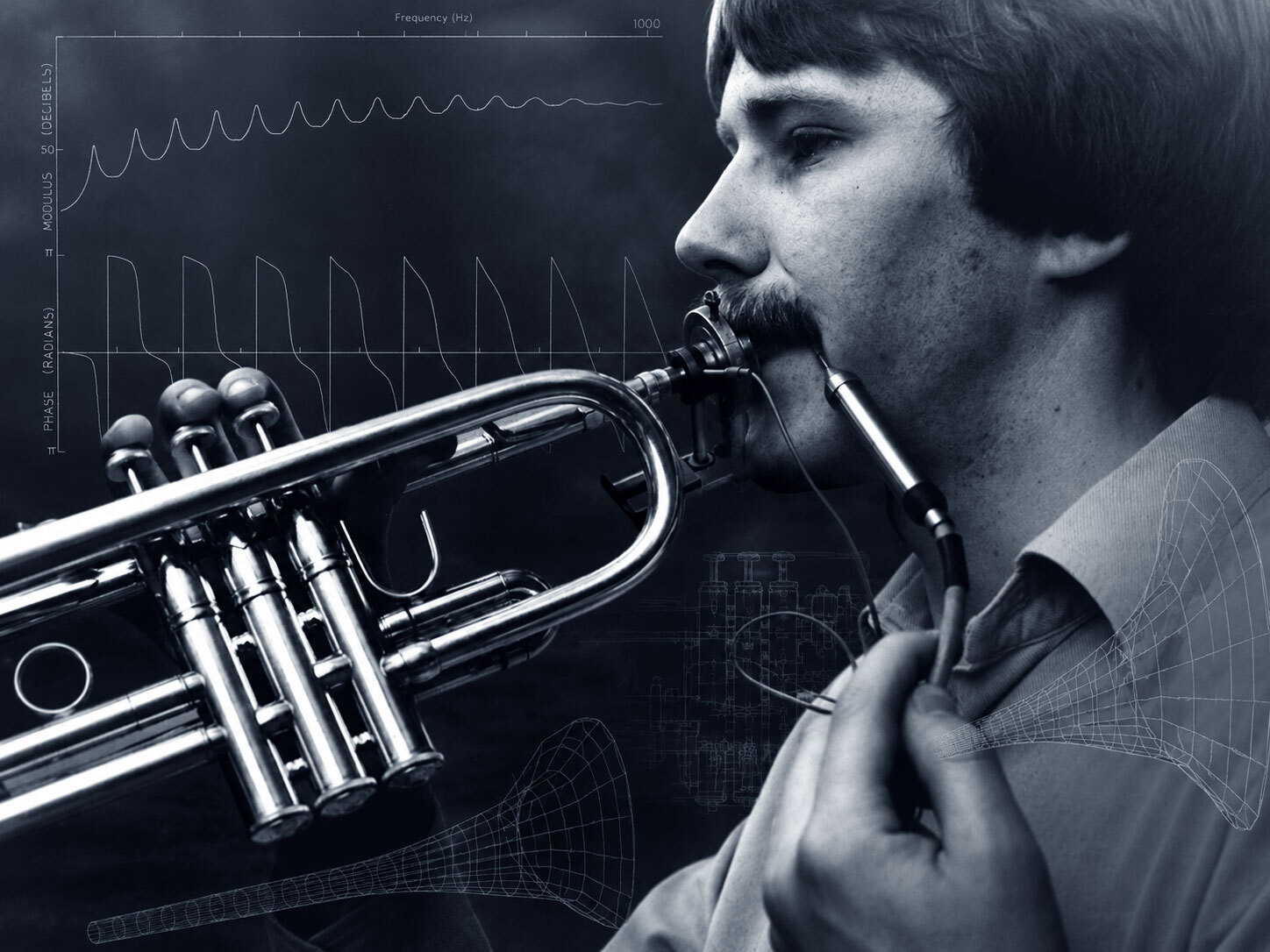
The author with probe microphones during a lip-motion experiment
The Musical Acoustics group at Surrey University was formed in 1974 and is the only group of its kind in the country. In collaboration with industrial sponsors such as Boosey and Hawkes Ltd., Paxmans Ltd., and the Science Research Council, we are at present investigating the acoustics of French Horns, Trumpets and Trombones.
The group, at present 5 in number, is split between the Physics and Psychology departments, and is by no means a set of "Back room boys", as we are keen players too; Dr. John Bowsher is a bass trombonist who has played professionally in Canada and, as well as co-ordinating the work of the group and teaching at the University, somehow finds time to play in many semi-professional and other orchestras. Peter Watkinson is a cornet player who is involved in local Brass Banding. I am a trumpet player involved in orchestral, ensemble, and pit work with professional ballet orchestras, and can be found in a big band on the odd occasion!
Dr. Peter Simpson and Dr. Richard Shepherd are working in the Psychology department on the perception of musical sound and players' assessment of instruments. Many past members have also been involved in playing in one way or another.
Making sense of the relationship between a player's skill and instrument quality demands a combination of the two disciplines. Understanding the acoustic behaviour of the brass instrument family, for example, involves investigating the effects of shape, material of construction, and the air flow within the tubing. Psychological factors enter when we investigate how the player develops and evaluates his own performance, and how he appraises an instrument.
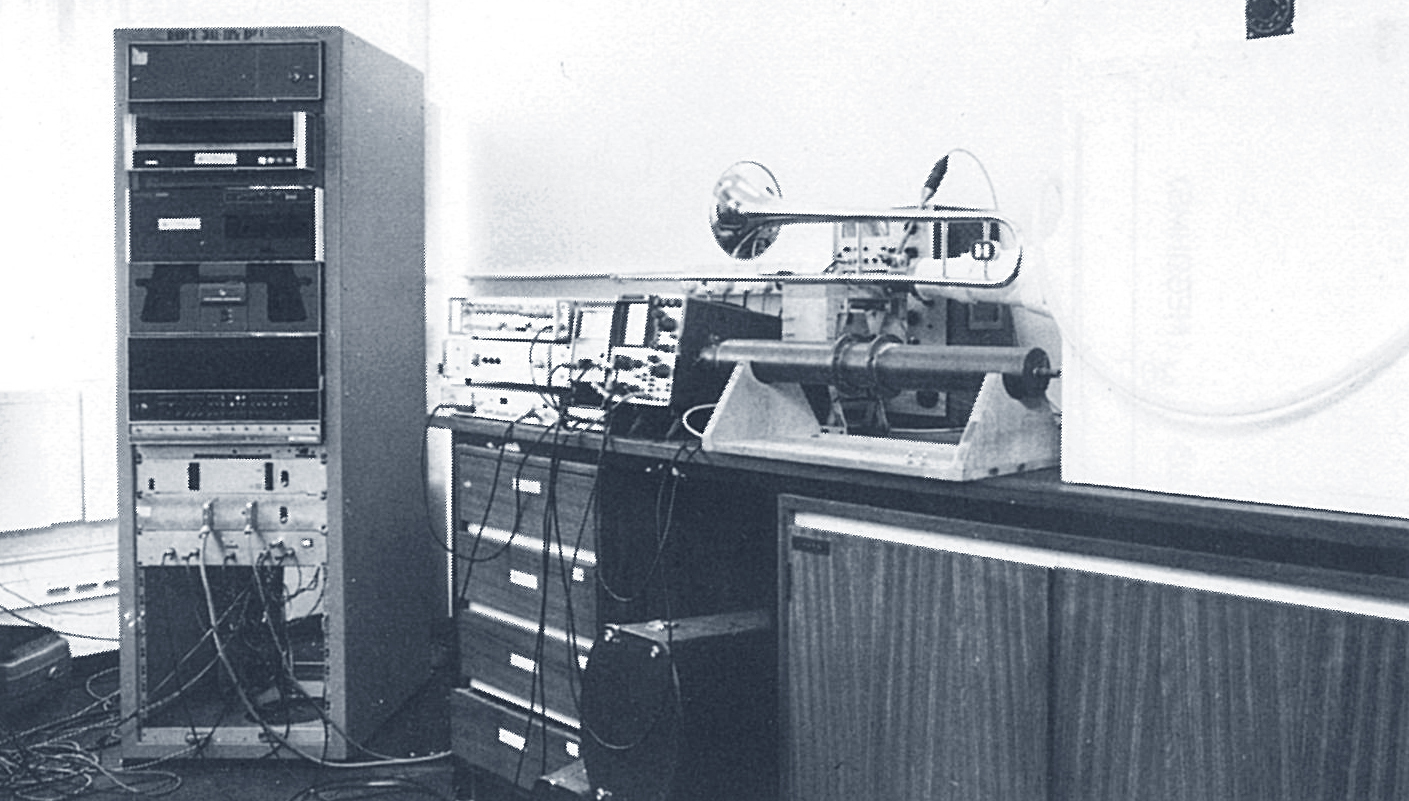
Part of the computer-controlled instrument measurement device
The amount of research already done is considerable. One of the first things that was done was to send a questionnaire to every trombonist in the London area. This gave us valuable insight into the type and numbers of the different makes of instrument being used in the different spheres of music-making. Many players contributed useful comments about their own instruments.
Following up the information sent back to us, tests were devised and tried using professional players as subjects. For these, we had to ask the "victim" to wear a blindfold and thick gloves so that his preconceptions about an instrument would not colour his judgement about the things we were interested in — the "feel" and the sound. Similar work, based on our ideas, is just being started in Czechoslovakia.
From these tests, a set of rating scales evolved which enabled us to describe the characteristics of an instrument in a scientific way.
From a scientific viewpoint, the group also wanted to know about the instruments as an acoustic system, without the player attached. Was there anything repeatably measurable about the instrument? Some work by Conn Ltd., and others, in the 1940's and 1950's suggested that the measurement of the acoustic input impedance could be useful as far as intonation, sound and feel were concerned. This work was severely limited by the technology available at the time, and the results were fairly crude.
The group at Surrey decided that if any useful work was to be done, a great number of instruments had to be measured far more accurately than ever before.
The concept of acoustic input impedance was first introduced in 1919 by A. G. Webster, who originally used it to study the properties of the air column inside phonograph horns. It is a useful measurement, as it gives precise information about the resonance frequencies of the instrument, which in turn can be used to calculate the frequencies (or pitches) that the instrument plays at.
Brass Bulletin 36, IV / 1981 pages 8–17
All content is protected by copyright © Brass Bulletin 1981–2026