6 min. read
An Introduction to "In Tune"
the Scale of Just Intonation
By Jack Holland
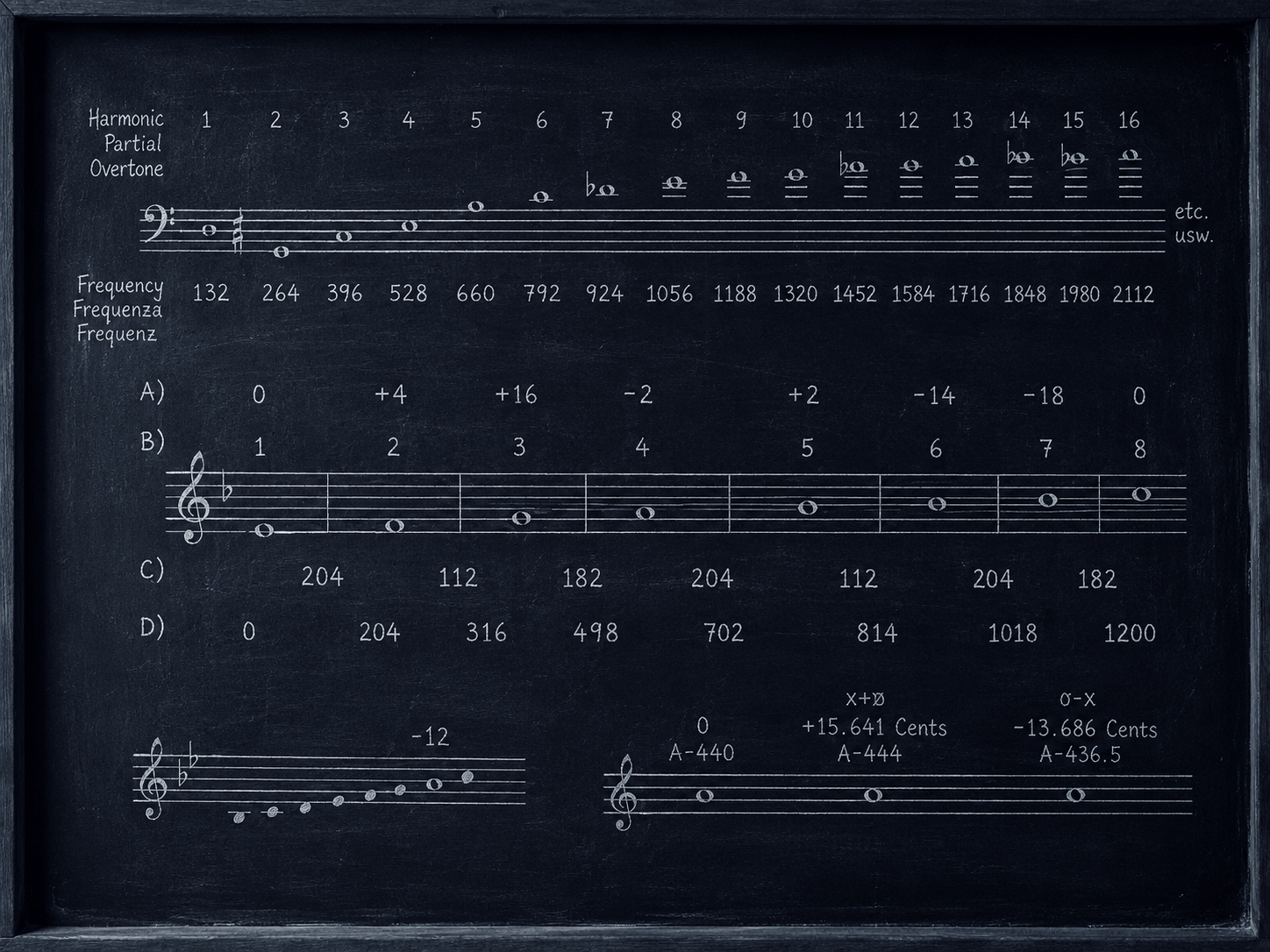
All musical instruments as well as the voice produce complex tones. A complex tone is a blended mixture of many tones of different frequencies of varying degrees of loudness all sounding simultaneously. These various tones comprising the musical tone are called partial tones, as each is only part of the complete sound.
The terms, “partial tones”, “harmonics”, and “overtones” are often used interchangeably, and although each does have a slightly different meaning, they all refer to the series of sounds resulting from the acoustical phenomenon of vibrating bodies... the “harmonic scale”.
Vibrating bodies produce tones corresponding not only to their basic length, but to 1/2, 1/3, etc., of their length. These partial tones are numbered 1, 2, 3, etc., beyond the range of human hearing. Tone no. 1 is the fundamental tone and the fundamental frequency. The frequencies of partials 2, 3, 4, etc. are obtained by multiplying their number times the frequency of the fundamental. The harmonic scale is shown in Illustration 1.

Illustration 1
The Harmonic Scale (Partial Tone)
An interval is the distance between two notes (tones) of different frequencies. There are two kinds of intervals.
- Melodic Interval — Two notes of different frequencies sounded one after the other. The ear will readily accept slightly imperfect melodic intervals.
- Harmonic Interval — Two notes of different frequencies sounded simultaneously. The ear demands correctness of harmonic pitch (Illustration 2).

Illustration 2
Musical Intervals
The cent is the unit for measuring the interval between notes of different frequencies. The interval of an octave is 1200 cents. The unit of the cent remains constant in all octaves regardless of the number of frequencies the octave contains (Illustration 3).
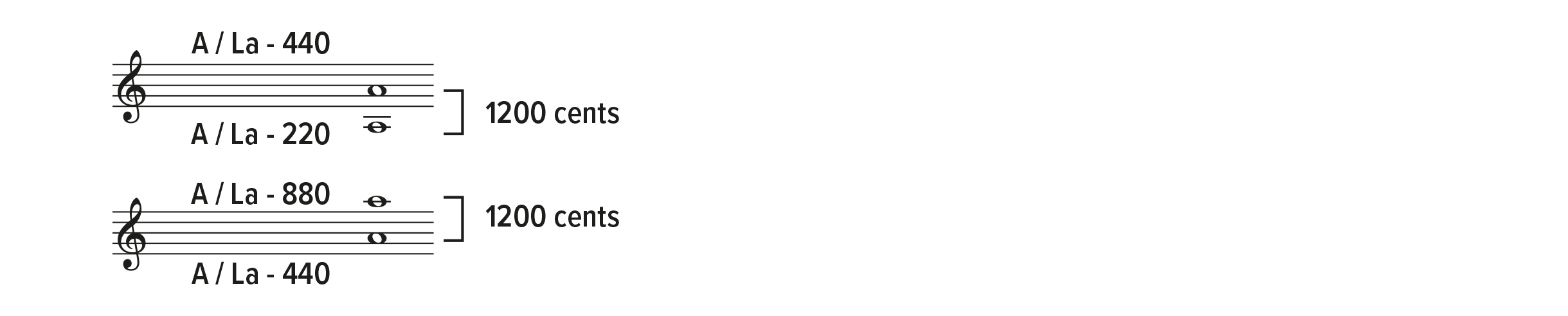
Illustration 3
The cent... The Unit for Measuring Musical Intervals
Within the octave of 1200 cents, notes are assigned to various positions (frequencies), resulting in musical scales. Throughout history there have been numerous systems for tuning the various notes of the scale. However, the musician of today is concerned with but two of these systems:
- The Scale of Equal Temperament.
- The Scale of Just Intonation.
These systems are exactly as their names state:
Scale: a tonal ladder (or staircase) comprised of a definite series of sounds ascending and/or descending from a key-note (or starting point) selected for the purposes of musical composition.
Equal: of the same size, quantity, number, value, etc.; evenly proportioned.
Temperament: denotes those systems of tuning in which the intervals deviate from the “pure” or acoustically correct intervals.
Just: harmonically pure and acoustically correct; sounding perfectly in tune.
Intonation: the exactness of pitch or relation to the key or harmony of musical tones produced by the voice or instruments. In musical performance intonation denotes singing or playing either as good (true) or bad (false).
Brass Bulletin 40, IV / 1982 pages 58–64
All content is protected by copyright © Brass Bulletin 1982–2026