Explore institutional access Explore institutional access

5 min. read

Pyotr Naumovich Volkov (1877-1933)

First trombone professor at St. Petersburg Conservatory
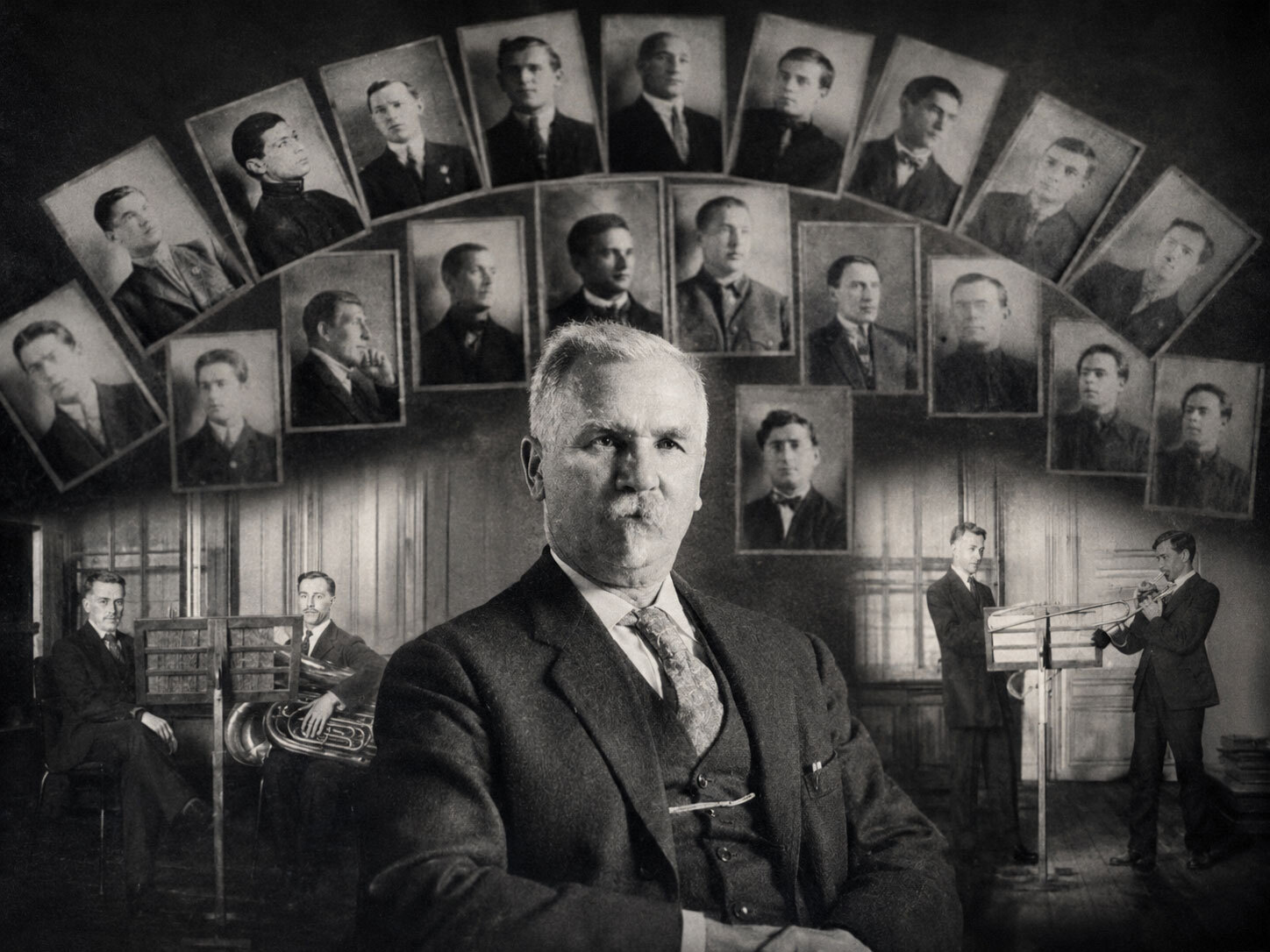
From imperial St. Petersburg to Soviet Leningrad, Volkov shaped a distinctive Russian trombone tradition through performance, teaching and generations of pupils.
Pyotr Naumovich Volkov (1877-1933)

Pyotr Naumovich Volkov

Pyotr Naumovich Volkov, who was Professor of trombone at the first conservatoire in Russia—then St. Petersburg, now Leningrad—was both an ordinary and an extraordinary figure. In order to understand more clearly the significance of this distinguished teacher's work we must consider it in its historical context in the musical life of Russia.

The trombone first appeared in Russia during the reign of Tsar Peter I (Peter the Great). As Yakob Shtelin writes in his book Music and the Ballet in 18th-century Russia, Peter was very fond of the solemn sound of trombones and the now obsolete cornetti which he had probably heard on his first trip to Holland and Germany. He sent for such a group from Riga and this was kept for playing at banquets.

Later trombones became established in military music. Lukashov, from the orchestra of Prince Yusupov, and Kegel from Moscow are two of the gifted Russian military trombone players from those days whose names we know. In 1876–77 Rimsky-Korsakov wrote his concerto for trombone and wind band. It was played for the first time in Kronstadt on 16th March 1878 by an NCO, Leonov, with the composer conducting, and again by a private, Aksyonov, in Nikolaev on 21st June 1882.

Trombones did not appear in opera orchestras in Russia until the first quarter of the 19th century, nor in symphony orchestras until even later. The trombonists in the professional orchestras of the imperial theatres at that time were foreigners.

The second half of the 19th century is notable for the rapid development of musical life in Russia. In 1859 was founded in St. Petersburg the Russian Musical Society whose principal task was to set up an organisation of wide-ranging concert activity and to make music popular amongst the general public. This raised the question of creating a body of Russian musicians and the need for instituting some kind of musical education and so the first Russian conservatoire was opened in St. Petersburg in 1862 on the initiative of Anton Rubinstein.

Since at that time there were no Russian musicians to fill the teaching posts, these were taken by foreigners. The first trombone teacher at the St. Petersburg Conservatoire was Franz Josef Türner (1831–1909), Austrian by birth and musical education. He became a teacher there in 1870 and professor in 1879, while also working as an artist in the orchestras of the St. Petersburg Imperial Theatres and also as director of the wind band of the Life Guards' Regiment.

Pyotr Volkov was one of Türner's pupils. This distinguished trombonist, founder of the Leningrad branch of the Russian school of trombone playing, thus received his training in the old St. Petersburg Conservatoire. He was born on 12th January 1877 in the village of Golovchino in the government of Kursk, son of Naum Volkov, a former military musician and a well known horn player in Russia.

Continue reading

Access the full Digital Edition.

Brass Bulletin 37, I / 1982 pages 15–18

All content is protected by copyright © Brass Bulletin 1982–2026

Share this article

Facebook LinkedIn
Loading…

Questions & Answers

How the Digital Edition works

What does the Digital Edition include?

The Digital Edition brings together the articles already digitized as searchable online texts—not simply as scans or PDF files—along with their original illustrations, notes, authorship, issue information, and available translations. Related-article suggestions currently include only this digitized material.

Are the digital articles identical to the originals?

We preserve the original text, language, illustrations, captions, footnotes, and editorial context as faithfully as possible. The presentation is adapted for comfortable online reading, and obvious transcription or scanning errors may be corrected. The substance and character of the published article remain unchanged.

Which languages are available?

Brass Bulletin was published in English, French, and German throughout its history. Italian and Spanish translations were added from issue No. 60 onward.

On the Italian and Spanish sites, articles from issues 1–59 are therefore shown in English by default.

How often are new articles added?

New articles are added almost daily, with approximately one complete issue digitized each week. The pace may vary depending on the preparation, image work, and editorial checking required.

Why aren’t all articles available digitally?

The complete Brass Bulletin collection contains 1,246 articles published between 1971 and 2003. The full index is already available online, allowing readers to discover every article in the collection, including those whose complete text has not yet been digitized.

Digitization began in February 2026. Each article is carefully prepared for online reading, checked, and connected to its issue, authors, subjects, and illustrations. At the current pace of digitization, the complete collection is expected to be available online by February 2028.

Why do some references mention articles that are not available yet?

References in the original articles are preserved even when the material they point to has not yet been digitized. This keeps the historical and editorial record intact. As more issues are added to the Digital Edition, an increasing number of these references will lead to articles that can be read online.

Can I suggest an article or report a transcription error?

Yes. If there is an article you would particularly like to see digitized, or if you notice a possible transcription error or missing detail, please contact us. Reader feedback helps us improve the Digital Edition and prioritize useful connections within the archive.

How can I support Brass Bulletin?

Your support helps fund the preparation, verification, and online publication of the complete collection.

Subscribe to the Digital Edition

Prefer to support us without subscribing?

Make a donation

Search Brass Bulletin.