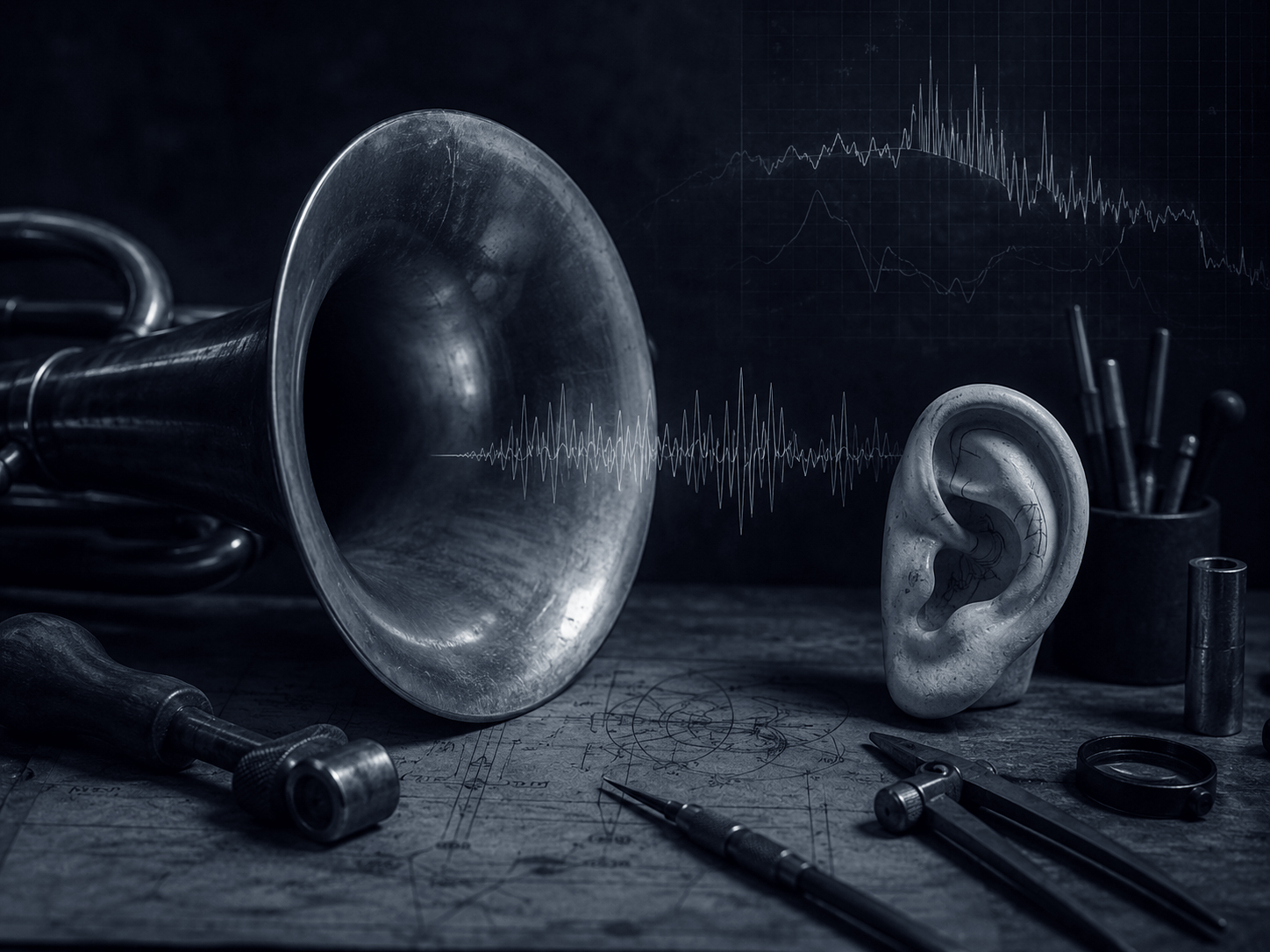
Plenty of debates, and indeed disagreements, arise in this very way, since no-one hears exactly the same thing as his neighbour. The situation is further complicated by the fact that an individual does not hear exactly the same thing, or hear it at the same time, with his left ear as with his right!
To prove this to yourself you only have to plug one ear with your finger: pull your finger out quickly, and you will hear a sound corresponding to that ear's own frequency. The sound is not the same for the right ear as for the left and a musician can judge the interval for himself.
This peculiarity gives all heard sounds a natural reverberation very favourable to the quality of musical perception. A musician can appreciate sounds lasting a few milliseconds and can distinguish discrepancies of 1/300th of an octave.
In intensity the ear's powers of separation are less, as musicians use only a reduced and somewhat imprecise scale going from ppp to fff. Fechner's Law tells us that "sensation varies as the logarithm of excitation". So two trumpets do not play twice as loud as one trumpet. The intensity increases only by the logarithm of 2, that is to say by 0.3. It takes 10 trumpets to double the intensity.
Just as, when you put one sugar in your coffee, you can taste the sugar, but if you put in three sugars the sweetness of your coffee will not increase by three times, but only by the logarithm of 3, or 0.47!
The perception of frequencies also varies with tessitura. High notes have to be played sharper and low notes flatter than their theoretical frequencies in order to sound in tune. This observation justifies the practice of violinists, piano tuners and organ builders, who always tune the high notes sharper and the low notes flatter.
Moreover a piano tuner worthy of the name never uses a stroboscope, the use of which can only be justified within the zone that the ear can perceive. The best tuner is the one who can hear like the pianist who is going to use the instrument.
Those interested in the problems of hearing in all its forms will benefit from reading Professor Leipp's eminent study, La Machine à écouter ("The Listening Machine"; published by Masson).
In short, the human auditory system is an unstandardised sensor, varying between one individual and another and, for the same individual, varying with age, state of health, alertness, etc.
Faced with such diversity of performance in the organ towards which his work is directed, amidst such uncertainty, how and for whom is the maker to build his instruments?
The importance of psycho-physiological elements in adjusting wind instruments is the problem that instrument testers pose makers. They are all chosen from among the most eminent virtuosos and their talent is disputed by no-one.
If the tester's physiology corresponds statistically to that of the average user, the instrument will be a commercial success. If not, the instrument will have been built for him alone.
Clearly, in ideal circumstances, an instrument should be personalised, built for one artist with regard to his physiology, the acuity of his hearing (which he ought to know from an audiogram), the kind of music he plays, the acoustics of the hall he usually plays in, where he usually sits in the hall, etc. Not a simple problem!
A good musical instrument should be as well in tune as possible, taking account of the phenomena of focussing the partials on the harmonics. The sound quality and ease of emission depend greatly on this.
But a good musical instrument should also allow the artist to do what he wants as far as intensity, sound and pitch are concerned as the ability to do so will enable him to adapt immediately to specific interpretative and acoustic conditions.
Wind instruments are expressive, singing instruments which should be able to follow the inflections of the human voice. Synthesizers and electronic organs, frozen in their mathematical structures, give only "dead" sounds.
On the other hand electronics has for some time supplied makers with some extremely sophisticated checking equipment: sonographs, spectrographs, tracing tables, spectral density integrators, realtime analysers, etc.
This equipment enables one to know all the parameters of a sound: number and relative intensity of harmonics, inharmonicity, transient slopes in attacking, slurring and releasing notes; they provide standard charts in decibels-Hertz, logarithmic and linear, and sonograms of amplitude, frequency or time, of exponential or other means, the digital counter giving you an immediate reading of what you are interested in.
The present author has in his workshop equipment of this kind, adapted for instrument-making. It enables me to discover the position and importance of formants connected with the mouthpiece, with the volume of the mouth cavity and with the bell frequency, to save time, to examine sound phenomena in the greatest detail and to select materials and assembly.
But in spite of all these possibilities the equipment is only a tool, an extra tool, to add to those which every maker already has, but which cannot replace skill and experience.
The aim of solving the problems of instrument-making by mathematics alone will not work in practice.
Some knowledge of this field, as also of acoustics, is indispensable nowadays but it must always come second to the experience acquired by generations of skilled, intelligent, observant, intuitive craftsmen.
A musical sound is a living thing in sound. It is never the same twice; it is born, it lives and it dies.
That is why, in the last analysis, everything depends on the artist's ear since, after all, it is the artists who make the music!