7 min. read
A study of musical intonation
Balance
It is most important to "balance" chords when tuning; by this I mean assuring that each instrument produces a sound energy level correctly proportioned to its adjacent voices. These proportions are, to some extent, a matter of personal taste, depending upon the texture desired.
George Szell is reputed to have insisted that, with a pair of instruments playing a passage in octaves, the second, lower instrument should play "one dynamic" louder, probably implying a 2:1 ratio of sound energy. Following this concept, the higher instrument "fits into" the lower one, much as the harmonics of a fundamental tone "fit into" their fundamental.
The Szell idea carried to the extreme would, however, be absurd: a piano in the treble instruments would imply forte possibile in the lower voices. One might question what specific ratio should be followed, whether or not to gradually increase intensity with the lower voices, and I believe that this is a matter of timbre and texture. One will notice in any case that the greatest difficulties arise in the voicings with wide intervallic relationships, where there is little "fill", and in these instances especially, the dynamic balance is most important.
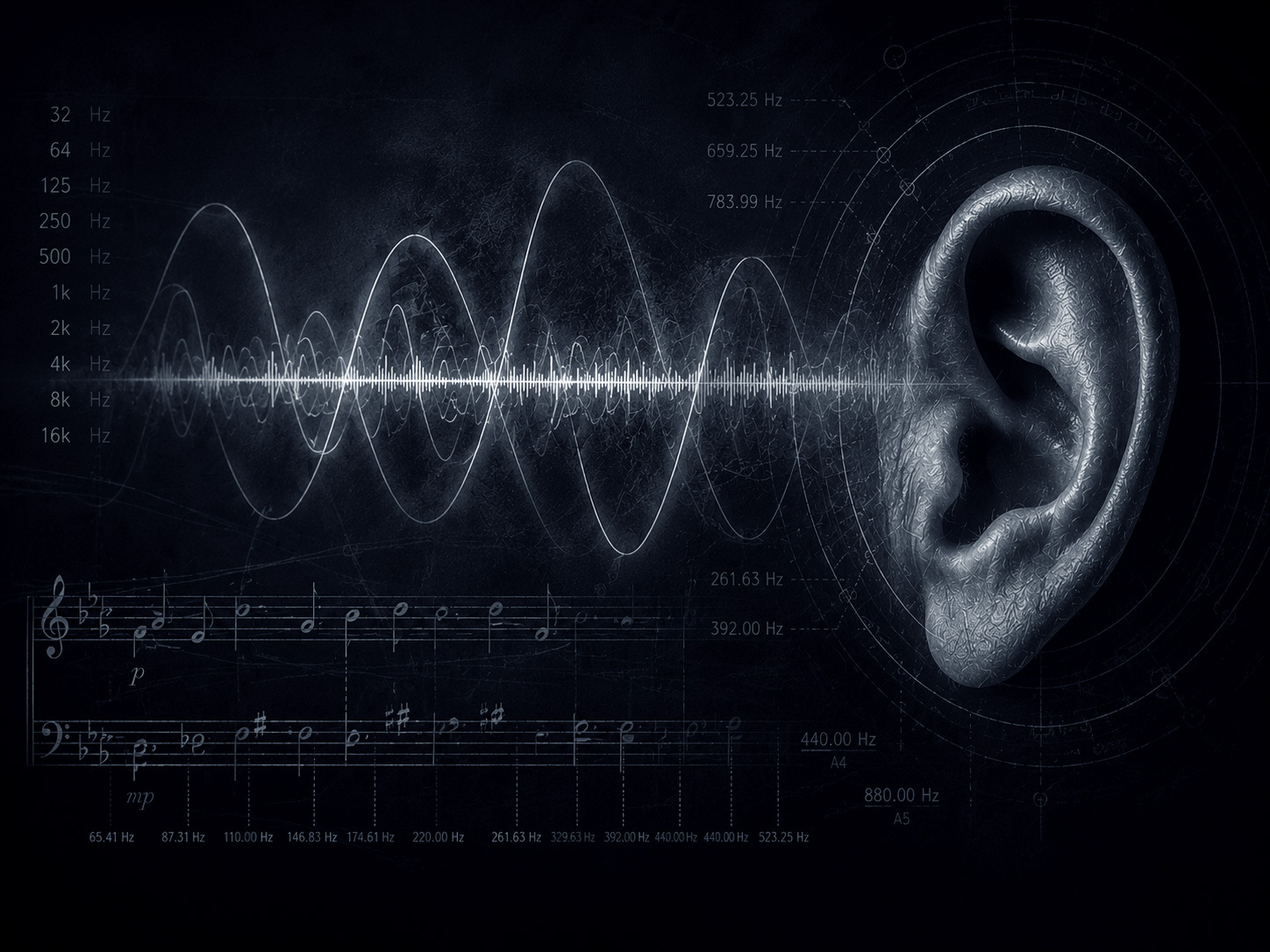
Psychologists have extensively researched a phenomenon which is important for performers to understand. I will refer to this as "pitch perception drift", or "pitch drift" for short. For the purpose of discussion, two definitions are required:
(a) "Frequency" is the absolute phenomenon of measurable wave peaks of energy generated by the instrument. This is measurable by a frequency counter or a strobe.
(b) "Pitch" is the subjective interpretation we give to the perceived frequency.
It has been observed¹ that we perceive a "drop" in pitch corresponding to an increase in volume (amplitude, "loudness") of a tone. The writer's subjective response of an increase from 50 db to 100 db for an A 440 hz is about 2/3 of a semi-tone. (This was done in a controlled environment, the A being a sine-wave sound from a tone generator, with a strobe for a check.)
Brass Bulletin 34, II / 1981 pages 5–12
All content is protected by copyright © Brass Bulletin 1981–2026