Explore institutional access Explore institutional access

12 min. read

Music in an American Frontier Communal Society

Aurora Colony
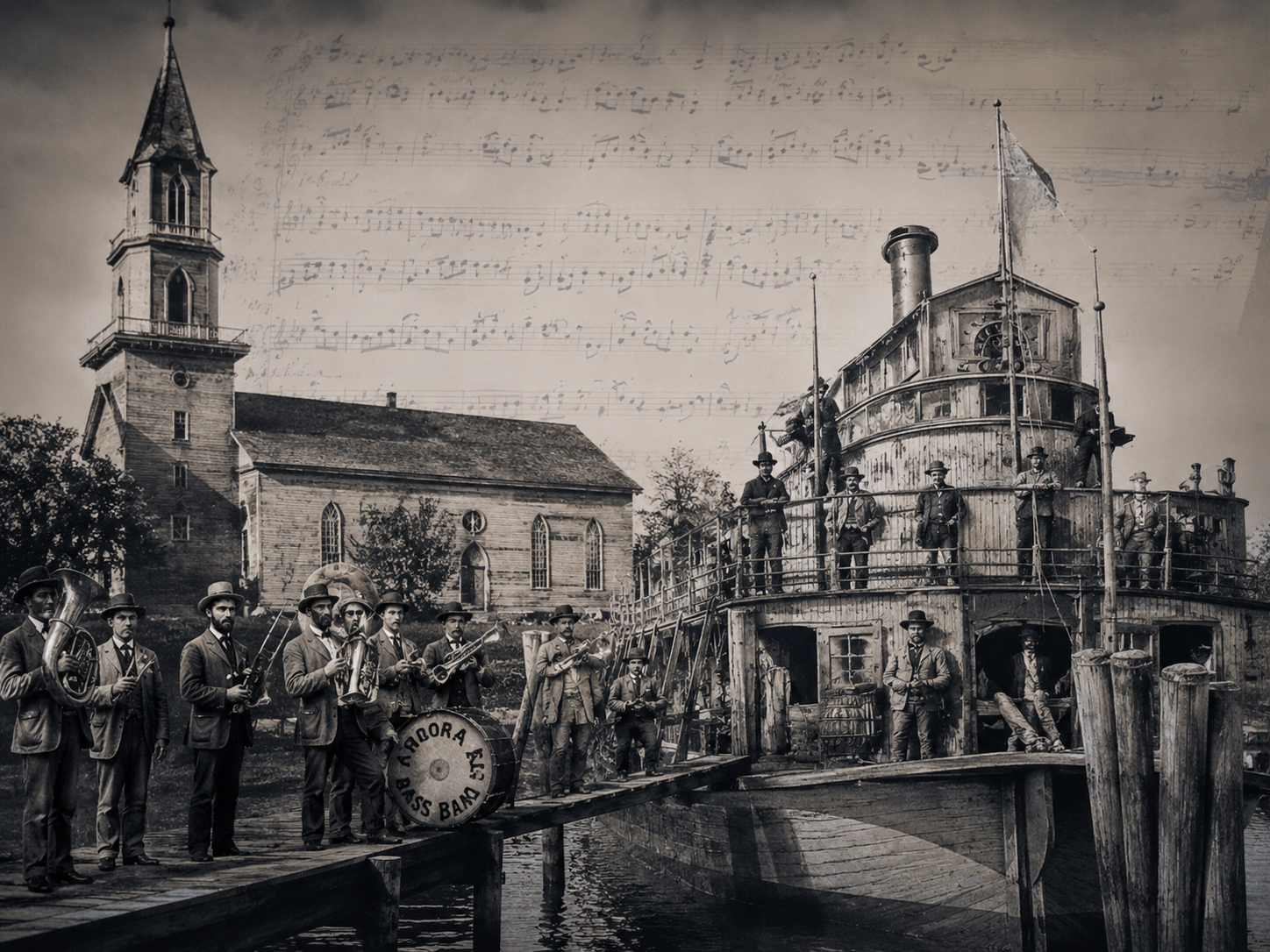
Music shaped daily life in Aurora’s communal colony, from civic ceremonies and political events to touring brass bands that carried its identity across the American West.
Music in an American Frontier Communal Society

Rehearsals of the band were apparently public. According to one contemporary source, the band "would practice on pleasant evenings to the delight of the travellers."¹⁴ Public or not, high quality was insisted upon. Bass player George Wolfer recalled that all solo passages were to be played to the complete satisfaction of all musicians present at rehearsals.

The Pioneer Band was an ever-present feature of colony gatherings, including the spring and summer festivals, Dr. Keil's birthday celebration on March 6, colony funerals, and most religious holidays.¹⁵ Frequently it played in the two large colony halls as a concert band or for colony dances. During the summer the band often performed in the bandstand located in the Aurora Park. The land for this 12-acre park, which had been cleared and maintained by colony labor, was given to the colony by Henry C. Finck expressly for this purpose.

According to Hendricks:

The colony people... improved and beautified the park, built a grand stand, provided seats for large crowds and erected a commodious kitchen and constructed a big bakery for the preparation of meals on public occasions. They hauled dirt and formed a great mound in a place convenient to the grand stand and to the amphitheater for the seats, and the spacious refectory. They covered the mound with a beautiful growth of grass, bordered with flowers... and provided a most unique and ornamental place on the top for the band.¹⁶

Following the suggestion of Henry C. Finck, two balconies were built on the Aurora church tower so that two groups might play antiphonally,¹⁷ and the band often performed from one or both balconies. The rooftop platform of the hotel (constructed between 1864 and 1867) was also used by the band on festive occasions. After the appearance of the railroad the band frequently greeted arriving passengers with short concerts from the hotel platform.¹⁸

Continue reading

Access the full Digital Edition.

Brass Bulletin 35, III / 1981 pages 49–58

All content is protected by copyright © Brass Bulletin 1981–2026

Share this article

Facebook LinkedIn
Loading…

Questions & Answers

How the Digital Edition works

What does the Digital Edition include?

The Digital Edition brings together the articles already digitized as searchable online texts—not simply as scans or PDF files—along with their original illustrations, notes, authorship, issue information, and available translations. Related-article suggestions currently include only this digitized material.

Are the digital articles identical to the originals?

We preserve the original text, language, illustrations, captions, footnotes, and editorial context as faithfully as possible. The presentation is adapted for comfortable online reading, and obvious transcription or scanning errors may be corrected. The substance and character of the published article remain unchanged.

Which languages are available?

Brass Bulletin was published in English, French, and German throughout its history. Italian and Spanish translations were added from issue No. 60 onward.

On the Italian and Spanish sites, articles from issues 1–59 are therefore shown in English by default.

How often are new articles added?

New articles are added almost daily, with approximately one complete issue digitized each week. The pace may vary depending on the preparation, image work, and editorial checking required.

Why aren’t all articles available digitally?

The complete Brass Bulletin collection contains 1,246 articles published between 1971 and 2003. The full index is already available online, allowing readers to discover every article in the collection, including those whose complete text has not yet been digitized.

Digitization began in February 2026. Each article is carefully prepared for online reading, checked, and connected to its issue, authors, subjects, and illustrations. At the current pace of digitization, the complete collection is expected to be available online by February 2028.

Why do some references mention articles that are not available yet?

References in the original articles are preserved even when the material they point to has not yet been digitized. This keeps the historical and editorial record intact. As more issues are added to the Digital Edition, an increasing number of these references will lead to articles that can be read online.

Can I suggest an article or report a transcription error?

Yes. If there is an article you would particularly like to see digitized, or if you notice a possible transcription error or missing detail, please contact us. Reader feedback helps us improve the Digital Edition and prioritize useful connections within the archive.

How can I support Brass Bulletin?

Your support helps fund the preparation, verification, and online publication of the complete collection.

Subscribe to the Digital Edition

Prefer to support us without subscribing?

Make a donation

How is the digitization progressing?

We’re gradually making the Brass Bulletin available online, article by article. You can read newly digitized articles as soon as they’re ready, even before an entire issue is complete.

Visit our Digitization Roadmap to browse recent additions and see estimated availability for upcoming issues. These estimates follow our recent pace and may change.

Search Brass Bulletin.