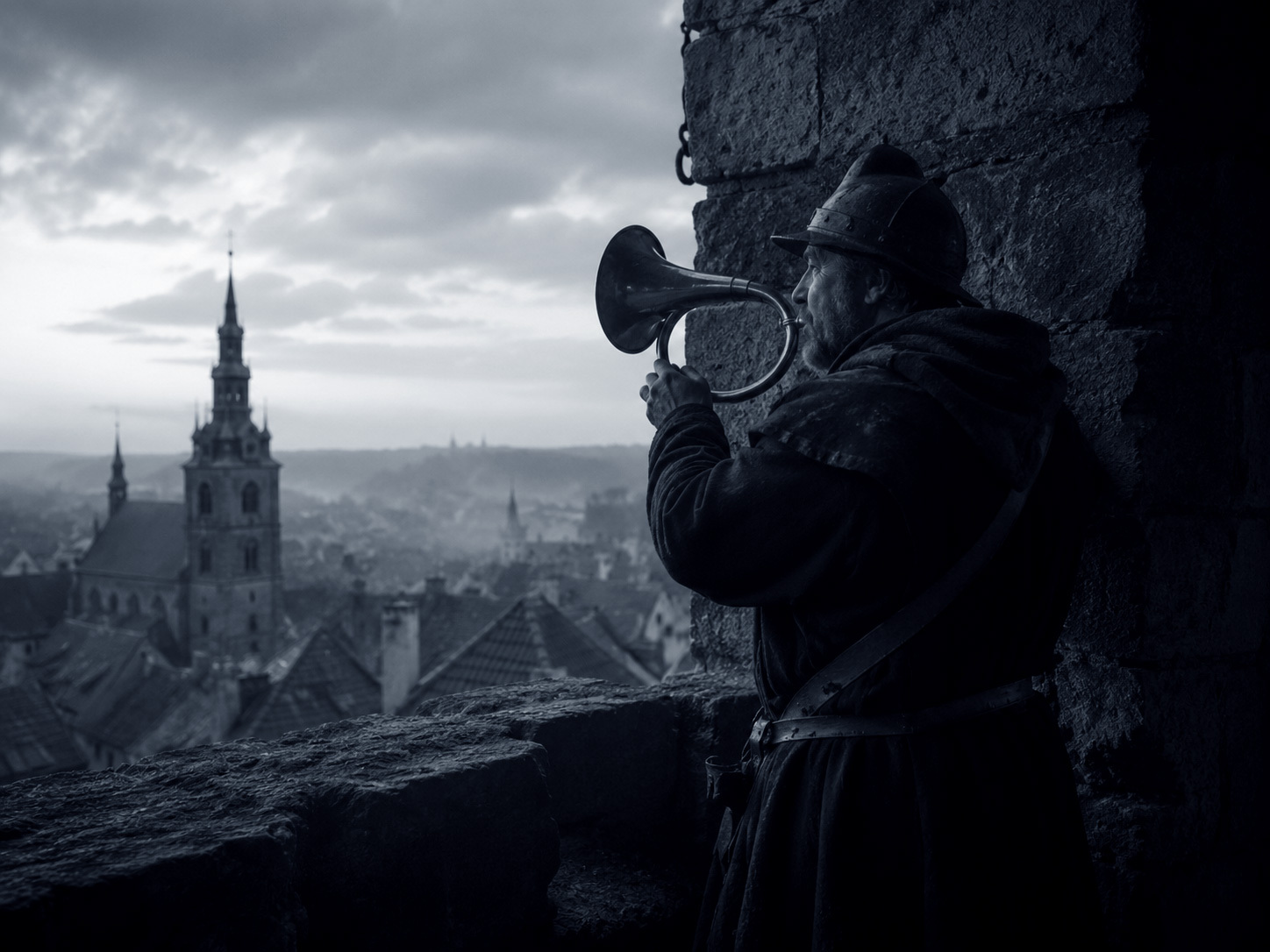

Not all the musicians were satisfied with being devoted to the nobility like the trumpeter Mikuláš. They therefore chose a free life, roamed from town to town, performed their music in the open air in the squares of towns and villages, or played for dancing in taverns.
The dissolute way of living of roving musicians met with no approval from the pious Hussites, who considered the musicians' profession the kind trade which cannot be carried on without sin. Fifers, fiddlers, drummers and trumpeters at that time earned their living by playing for dancing (i. e. by sin) and belonged, therefore, to the obvious sinners, who had to be punished. An old manuscript enumerates the obvious sinners in the following sequence: hangman, swindler, gambler, fifer, cither-player, drummer, trumpeter (playing for dancing), thief, robber, magician, forger of money, metals and weighing machines.
The Hussites liked singing and composed art songs in very great numbers, but their resistance to instrumental music was so intense that all their opponents used it as something to taunt them with and a means of insulting them. If Catholic soldiers captured a member of the Hussites' troops, they often burnt him to the sound of trumpets which — as they believed — would increase his suffering.
One of the most typical figures of the Czech lands was from time out of mind the night-watchman. It used to be a communal manservant or a poor tradesman. For a small fee, he walked through the village at night and by sounding his horn announced the hours.
The characteristic outfit of a night-watchman included a heavy coat of sheepskin and a bull-horn. In the royal fortified towns, it was a tower-watchman, that is some kind of professional night-watchman, who performed his duties on a tower, where — as a rule — he also lived. The tower-watchman drew a whole-year salary according to the contract agreed. Usually, the roving trumpeters applied very often for this kind of service, because in this position they were not held in such great contempt. In this way in Bohemia there originated a peculiar group of musicians who greatly exceeded the qualifications demanded for this service. It was due to them that the art of the Czech trumpeters successfully survived the troubled period of the Hussite revolution.
The duties of tower-watchmen were established by regulations. Besides announcing the time at night, as already mentioned (to which a motto of a religious character was often added), they had to warn of fire, storm, unusual phenomena in the sky or an approaching enemy.
The tower-watchman at Písek had one more pleasant duty: every morning on 1st May he welcomed the coming spring by sound of his horn:

At Tábor, the melody had an almost military character:

In the town Klatovy which is situated close to Šumava mountains, the following melody sounded from the horn of the tower-watchman, who kept watch on the Black Tower:

The ancient origin of the watchman duty in Slavonic countries is proved by the song "Bogorodica Ljubica" which sounds up to this date from the tower in Polish Krakow, in our century, however, played just on a modern valve-trumpet. This song is said to be composed by St. Vojtěch (Ethelbert).
The records about the activity of tower-watchmen which we find in old annals often recall our "black chronicle". Until the beginning of the 20th century in Stanislavov there was a melody played, in its middle suddenly interrupted by a wrong tone. This recalls the raid of Tatars in 1241: on that occasion the tower-watchman blew the alarm but did not finish the signal because he was killed by the dagger of an enemy soldier.
The top of the tower of the church in Velvary was set on fire by lightning which simultaneously stunned the trumpeter who, consequently, could not blow alarm. On 13th May 1753 between 8 and 9 o'clock p. m. as a result of only a very slight wind, the 60 ell high stone tower in the town Jaroměř collapsed. The wife and daughter of the tower-watchman were killed in this disaster and found early in the morning in the ruins.
In 1594 an old tower-watchman in Rakovník became a victim of human greediness: a young candidate applying for this position together with the wife of the existing watchman killed the old man and at night they both threw his body down from the High Gate.
No wonder that the watchmen tried to improve their hard life by various means. Some of them enjoyed a good drink, which was brought up to the tower in different ways. The tower-watchman Lukes, when tortured in the jail of the town Kutná Hora in 1556, admitted that he had had an agreement with the landlady Fantová: whenever he threw a small stone on the roof of the inn, she prepared a jug of beer which was then lifted on a rope to the top of the tower. One day, Lukes twice in vain threw a stone on to the inn roof, the third stone split a slate on the roof and one piece of it fell down right in among the sexton’s family who were coming back from a country-wake.
If some watchman intended to get married, however, he tried to improve his wedding day by sending a petition to the municipal government of Kutná Hora in order to obtain some more beer free of charge.
When tower-watchmen neglected their duties — for example, were late in warning of a fire, they were put in jail and their salary stopped; in some cases, especially when they slept through a fire, they were discharged. It is said that the town Jindřichův Hradec twice burnt down by carelessness of tower-watchmen.
The ancient citadels and castles used to have a whole squad of tower-watchmen. In Karlštejn, for example, the watch was kept at six stations: four watchmen around the main tower, one in front of the palace, one at the well. Their warning signal is one of the most popular ones:

Translation of the words:
"Keep away from the castle, lest you meet with a sudden disaster.”
During the plague-epidemic there was no trumpet sound from the towers. When the emperor Rudolf II ruled in Bohemia, instrumental music began to develop intensively. From the towers the art music of trombone-ensembles sounded more and more, whereas the skill of playing animal horns fell slowly into oblivion. A pity. When constructing new tube-instruments, manufacturers still in the 19th century drew inspiration from old animal horns.