In particular Augustus the Strong (1694-1733 Elector of Saxony) in neighbouring Dresden tried to equal Count Sporck, and even to outdo him. To do so he needed horn players and the best he could get came from the "Bohemian School". Now the Kapellmeister of the Dresden court, for their own part, were very keen on an artistic improvement in hunt music and sought, as the competent authorities, to bring about some refinement in the normally rough and ready hunt playing for composition purposes. Hunt fanfares of a musically ever more demanding nature were written into the virtuoso horn parts to be found in the most important movements of lengthy "hunt cantatas" and specifically expressive playing was required from the "new" horns on occasions. This was the best way for the hunting horn to develop into a fully fledged musical instrument. The players, who knew how to rattle out such marvellous brilliant fanfares, were now increasingly concerned to play their horns in a musical, "singing" style.
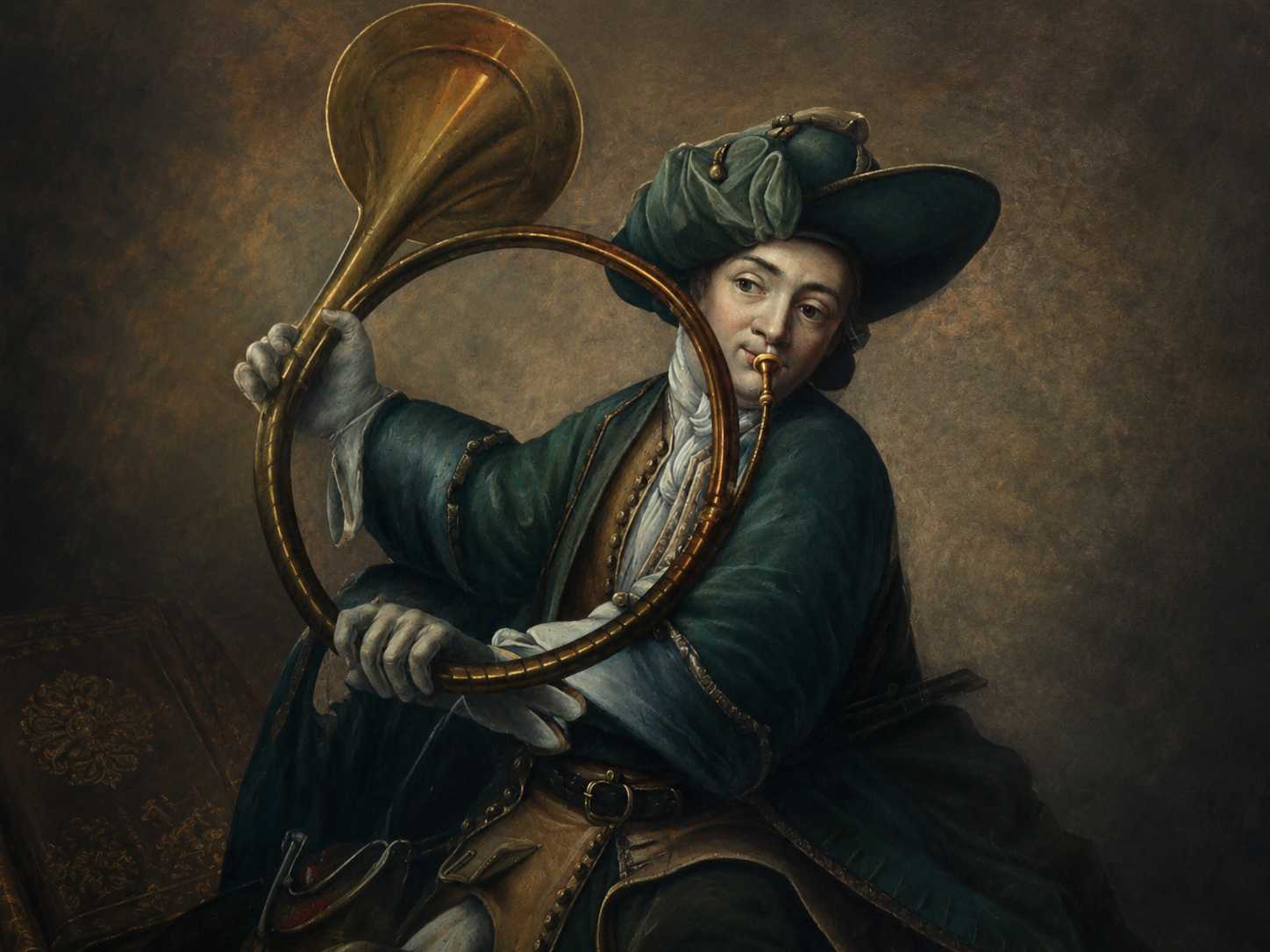
Augustus may well have realised that this progress meant a significant new direction, if not exactly a new beginning. Like a true Baroque prince, relating all contemporary events to himself, he had a splendid portrait painted of one of these new horn players. This picture was to have been only one from a large collection, painted by the foremost artists, combining representations of many kinds of masks, costumes and uniforms. We can be certain it was painted purely in order to demonstrate for posterity all those people who rushed to the great court festivals, hunts, pageants and masques for no other reason than to do homage to the Elector as sovereign.
We do not know what may have made Augustus the Strong choose this picture of our horn player, painted on a gold background, to adorn so beautifully the heavy leather binding which contains the whole collection. It is not even certain which master painted the unsigned picture, although it could have been Johann Elias Ridinger (1698-1769), famous for his paintings, drawings and engravings of hunting scenes. He certainly knew it, for he made an engraving based on this showpiece, differing from it only in detail. He gave it the explanatory title "Hearing”.
Now, three centuries later, when even the most illustrious members of the Order of St. Hubertus are no more than historical figures, our cover picture can still be a symbol of one of the first people from the self-perpetuating fraternity of horn players who really knew how to bestow the attributes of hearing and appreciation throughout the world. It must henceforth be our clear duty constantly and carefully to nurture and develop their art which came to us from Bohemia; but it will be to our credit if we perfect — with some thought for the past but also a desire to renew it — their long-lost art of clarino playing.