13 min. read
Part 2 – End
Articulation or bowing on the trumpet
Thus articulation is not just the beginning of the note but also a specific way of holding it, stopping it and in some cases joining it to other notes⁷. Each type of articulation has three sections — the beginning, the stationary part and the end. In a group of slurred articulations the ending of the note is replaced by the technique of joining notes. The quality of these techniques bears a direct relation to the player's schooling and culture.
In the course of describing types of articulation we shall also mention several of their constituent elements in order to see the distinguishing features of each more clearly.
The nomenclature of many types of articulation has been borrowed from string players and this terminology has become generally accepted. Of course the notational signs for articulation must also become generally accepted and we will have more to say about that. We shall consider types of articulation in two groups: with the tongue and without.
Articulation with the Tongue
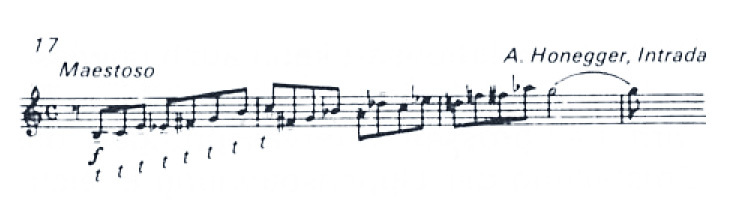
Détaché: In French the word détaché means "detached, separated". Détaché involves playing notes on the same dynamic level detached from one another by an attack; the sonority of the note is held level throughout and the ending is soft and rounded, without the tongue.
Détaché is indicated in notation by a line above or below the note but often there is no indication.
The word "separated" is not a totally accurate indication of how détaché sounds for this refers rather to the way it is played on string instruments, where each note is played with a separate movement of the bow upwards or downwards. The moment at which the bow direction is changed also determines the extent to which the notes are separated. For wind players the way the note is articulated with the normal attack predetermines the division of the overall sound, as does the change in bow direction for string players.
In détaché playing it is possible to reduce to a minimum the pauses separating one note from another and to achieve, when required, a cantabile, almost legato sound.
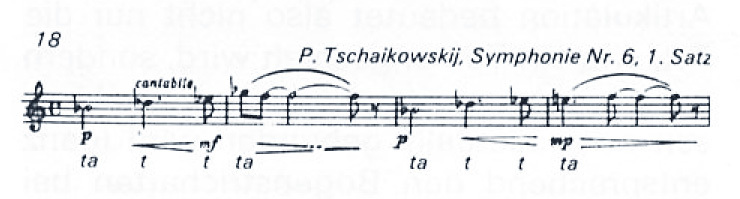
In trying to achieve a smoother sound, however, one must not change from the normal to the soft attack since the use of the soft attack is characteristic of a different articulation.
Détaché is not an accented articulation but its attack must be vigorous and definite — sooner accented than cautious and flabby.
Détaché is the most frequent type of articulation, it sounds well at any dynamic level and is suitable for use in all registers.
Marcato: The Italian word marcato means "emphasised, picked out, marked". The musical sense of this word is connected with dynamics and relates to the nature of the beginning of the note. Marcato involves an emphatic articulation of the note and so has entered common usage as a term for a type of articulation.
Marcato means playing accented notes separated from one another by an attack. An energetic accented beginning to the note, with subsequent weakening, is characteristic of this type of articulation. The weakening can be gradual, as in diminuendo, or quick, as in subito piano or sforzando. The ending of the note must be soft, rounded, even "spun out", without the tongue.
The marcato articulation uses the normal attack and is indicated in notation by a little "hairpin" like a diminuendo sign:
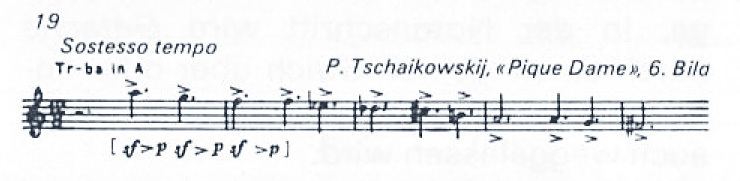
Shortening the note in marcato playing helps to overcome some technical difficulties more successfully. Thus when playing wide leaps the tension of the lip muscles can be altered more conveniently:
Brass Bulletin 31, III / 1980 pages 35–54
All content is protected by copyright © Brass Bulletin 1980–2026