Explore institutional access Explore institutional access
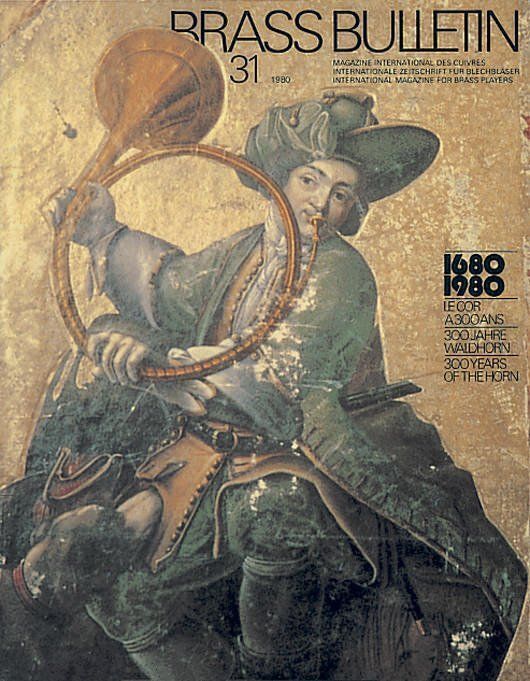
Brass Bulletin 31 - 3 / 1980
Issue
Brass Bulletin No. 31
Date
III / 1980
Pages
100
Contents
10 articles

Out of print

All issues

Brass Bulletin No. 31

III / 1980

Contents

10 articles

300 Years of the Horn in Bohemia

Kurt Janetzky

pp. 3–4 Horn History Society

An unsigned portrait from the Dresden court links the rise of Bohemian horn playing to the ceremonial world of Baroque hunting culture.

300 Years of the Horn

Part 1

1680-1980, an attempted survey

Peter Damm

pp. 19–33 Horn History Equipment

From Versailles to Bohemia, hunting horns enter orchestral life through makers, players, early works and the Austro-Bohemian tradition.

Articulation or bowing on the trumpet

Part 2 – End

Timofey Dokschidser

pp. 35–54 Trumpet Technique Teaching

Trumpet articulation becomes a full performing language, from détaché and staccato to legato, glissando, dynamics and score interpretation.

Transcription fundamentals

Ralf Sauer

pp. 55–56 Repertoire

Between Bach fugues and Mozart concertos, Ralph Sauer questions where brass transcription renews a work — and where it merely imitates.

A Trombone Martyr

Auguste Léonard de la Tuilerie

Benny Sluchin

pp. 57–66 Trombone History Society

A Paris apothecary turned trombone evangelist challenges 19th-century musical habits, imagining the slide trombone as the future voice of harmony.

Cleveland Orchestra Audition in 1966

Ronald T. Bishop

pp. 67–70 Tuba Encounters Professional life

George Szell’s demanding 1966 audition process unfolds through orchestral excerpts, dynamic extremes and the search for absolute ensemble precision.

The contrabass sackbut

a modern copy

Richard Lister

pp. 71–76 Trombone Equipment Instrument Makers

A reconstructed 17th-century contrabass sackbut revives forgotten low brass practice, from Venetian polychoral music to modern performance challenges.

Practical Hints

Part 2

James Stamp

pp. 77 Technique Teaching

A simplified preparation method adapted from Herbert L. Clarke links transposition, tempo variation and repetition to technical fluency and mental anticipation.

Women and brass: 3 Portraits

Barbara Stone, Betty Anderson, Kate Kaminga

Markus S. Bach

pp. 97–98 Society Professional life

Three British and Dutch conductors moved from brass band performance to leadership roles, confronting a scene still largely shaped by male traditions.

Miroslav Kejmar

Portrait in brief

Jean-Pierre Mathez

pp. 99 Trumpet Encounters Professional life

From Bach’s Brandenburg Concerto to Czech contemporary music, the Prague trumpeter combined Baroque precision with orchestral versatility across Europe.

Loading…

Questions & Answers

How the Digital Edition works

What does the Digital Edition include?

The Digital Edition brings together the articles already digitized as searchable online texts—not simply as scans or PDF files—along with their original illustrations, notes, authorship, issue information, and available translations. Related-article suggestions currently include only this digitized material.

Are the digital articles identical to the originals?

We preserve the original text, language, illustrations, captions, footnotes, and editorial context as faithfully as possible. The presentation is adapted for comfortable online reading, and obvious transcription or scanning errors may be corrected. The substance and character of the published article remain unchanged.

Which languages are available?

Brass Bulletin was published in English, French, and German throughout its history. Italian and Spanish translations were added from issue No. 60 onward.

On the Italian and Spanish sites, articles from issues 1–59 are therefore shown in English by default.

How often are new articles added?

New articles are added almost daily, with approximately one complete issue digitized each week. The pace may vary depending on the preparation, image work, and editorial checking required.

Why aren’t all articles available digitally?

The complete Brass Bulletin collection contains 1,246 articles published between 1971 and 2003. The full index is already available online, allowing readers to discover every article in the collection, including those whose complete text has not yet been digitized.

Digitization began in February 2026. Each article is carefully prepared for online reading, checked, and connected to its issue, authors, subjects, and illustrations. At the current pace of digitization, the complete collection is expected to be available online by February 2028.

Why do some references mention articles that are not available yet?

References in the original articles are preserved even when the material they point to has not yet been digitized. This keeps the historical and editorial record intact. As more issues are added to the Digital Edition, an increasing number of these references will lead to articles that can be read online.

Can I suggest an article or report a transcription error?

Yes. If there is an article you would particularly like to see digitized, or if you notice a possible transcription error or missing detail, please contact us. Reader feedback helps us improve the Digital Edition and prioritize useful connections within the archive.

How can I support Brass Bulletin?

Your support helps fund the preparation, verification, and online publication of the complete collection.

Subscribe to the Digital Edition

Prefer to support us without subscribing?

Make a donation

Search Brass Bulletin.