7 min. read
The attack
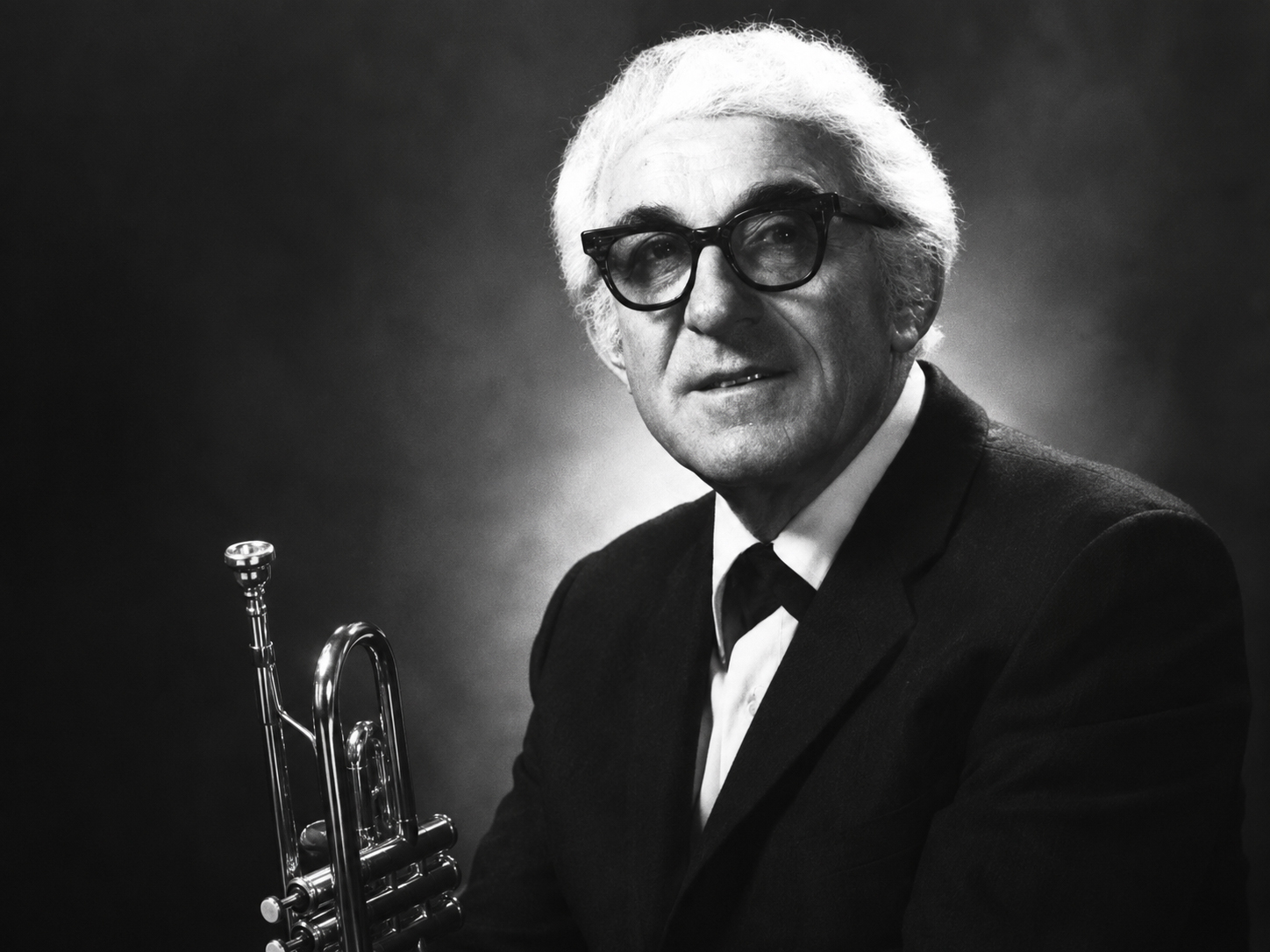
Louis Davidson
Since all aspects of playing the trumpet are inextricably bound to the attack, it is logical that this be the first subject dealt with.
The importance of a good attack cannot be emphasized enough. Whether it be slurring, tonguing, high notes, low notes, a fortissimo, a pianissimo, each of these starts with that first note — the attack. It is the one technique above all others that must be as natural, as uncomplicated, and as much a reflex action to the player as breathing or walking. This can be most readily achieved by keeping in mind that the less fuss and preparation there is before attacking a note, high or low, loud or soft, the more natural and secure that attack will be. Before inhaling, preparatory to attacking a note, the lips should assume, for one moment, the posture of complete repose in order to counter any tendency, conscious or otherwise, to pre-set the tension of the lips for the particular note to be attacked.
A good attack by definition is one in which the note starts freely, without hesitation, without force, with purity of sound, with immediacy and presence, with no hint of a "hiss", and obviously, of course, with no trace of a split tone. To achieve this requires the coordination and synchronization of the three basic elements of the attack — the lips, the breath, and the tongue. Should the timing of any one of them be remiss, the result will be a bad attack.
Though the point of contact of the tongue may vary slightly with each player, the general area will be somewhat at the juncture of the upper teeth and gum line. The tongue should never be held in a fixed position at this point of contact before releasing for the attack but should, rather, be used much in the manner of a tympanist striking his drum-head softly with the mallet — a short downward and upward motion of the mallet corresponding to the short forward and retracting movement of the tongue. It is not this forward movement which starts the note, but rather the retraction of the tongue which releases the air and activates the vibration of the lips.
While there are some excellent players who attack and tongue between the teeth, they are the exception rather than the rule. The position of the tongue upon retraction will be different with each of the three syllables — "taa," "too," "tee," (for low, medium, and high registers). With the "taa" the tongue will arch in the lower part of the mouth, like a bowl held upright; with the "too" the tongue will flatten in the center of the mouth; with the "tee" the tongue will arch in the upper part of the mouth, somewhat in the manner of an inverted bowl. This is merely mentioned in passing as some players may be unsure as to whether they are proceeding correctly on finding the tongue in different positions upon retraction. The most important thing is that the point of contact of the tongue must always be the same regardless of range (high or low), volume (loud or soft), or degree of the articulation (hard or soft).
The correct sensation of timing in the attack can be ascertained, at first, by going through the motions of making attacks without the mouthpiece or trumpet and by simply practicing the coordination of the three basic elements of the attack — the breath, the tongue and the lips. When a feeling of naturalness in making attacks has been arrived at in this manner, one should begin to practice attacks with the mouthpiece alone. Again calling attention to the importance of the timing factor in the attack the following steps must be strictly observed:
Brass Bulletin 41, I / 1983 pages 16–19
All content is protected by copyright © Brass Bulletin 1983–2026