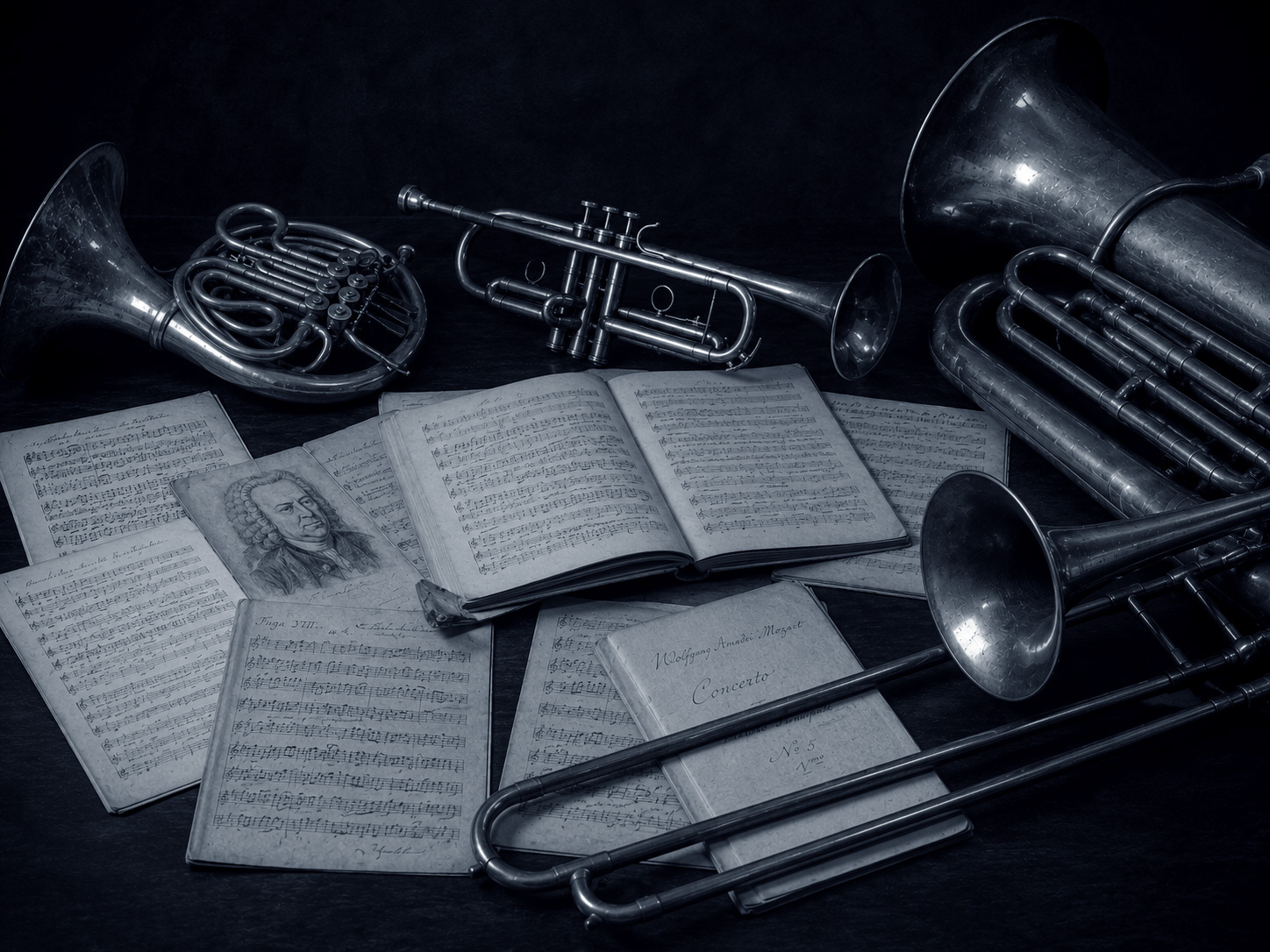
The questionable group includes all pieces which are used for purely technical purposes as teaching and learning devices. Bordogni vocalises, for example, can play a major role in the development of a brass player; however, it is doubtful that this type of transcription would be successful in public performance.
The best transcriptions give the music new life, reveal subtleties which were not apparent before, and allow the listener to hear the work from a fresh point of view. Giving the music new life might involve the resurrection of a forgotten masterpiece, perhaps allowing the public to hear a piece for strings which is seldom performed due to the vastness of the string literature. For example, in recent years, the trio sonatas of Corelli have probably been performed more often by trombones than by the original instruments.
New subtleties are sometimes revealed by the orchestration of the instruments. Some of Bach's keyboard music, especially the organ fugues, can be scored for brass very effectively. Brass instruments have most of the sonority and power of the organ and at the same time delineate the counterpoint in a manner which few organs are able to duplicate.
A transcription which allows the listener to hear a work from a fresh point of view might involve a different and intriguing interpretation of a well known piece. However, this depends a great deal upon the musical abilities and ideas of the individual player. There is little justification for a trombonist to play, for example, a Mozart violin concerto, unless the player has discovered new musical insights which have been overlooked by generations of violinists. Since this is unlikely, a performance would probably only be of interest to other trombonists.
In reality, these three elements are often interrelated to such a degree that it is almost impossible to consider each separately. When a fine piece of sculpture is viewed from various angles, a new facet of the work is revealed with each position and our experience broadened.
Not all music responds favorably to this kind of examination; and in most cases, transcriptions are not justified. A transcription should definitely not reveal negative aspects of the original work.
The task is to find pieces which allow these concepts to be applied without destroying the greatness of the original music, which is strengthened and not weakened by our efforts. It is my belief that the closer a transcription comes to satisfying most or all of these requirements, the greater the likelihood of finding an extraordinary musical vehicle.
--
Ralph Sauer is the co-principal trombonist with the Los Angeles Philharmonic Orchestra. His teachers were Robert Harper of the Philadelphia Orchestra and Emory Remington at the Eastman School of Music.
Prior to Los Angeles, he was principal of the Toronto Symphony Orchestra. In addition to orchestral playing, Ralph Sauer is active as a soloist, recording artist, and teacher.