A musician's own particular timbre is characterised by the presence of a "formant", that is to say the emergence of a preferred group of harmonics.
It is therefore probable that the instrument "breaks", becomes more flexible, in a manner determined by the formant frequencies.
The importance of this particular flexibility of the instrument becomes obvious when another musician plays it and imposes his own playing on it, at least for some time.
I remember that, when I was working as a horn player, I had a horror of lending my instrument to anyone else, even for a few minutes, feeling that I could not get my sound or my security of attack back.
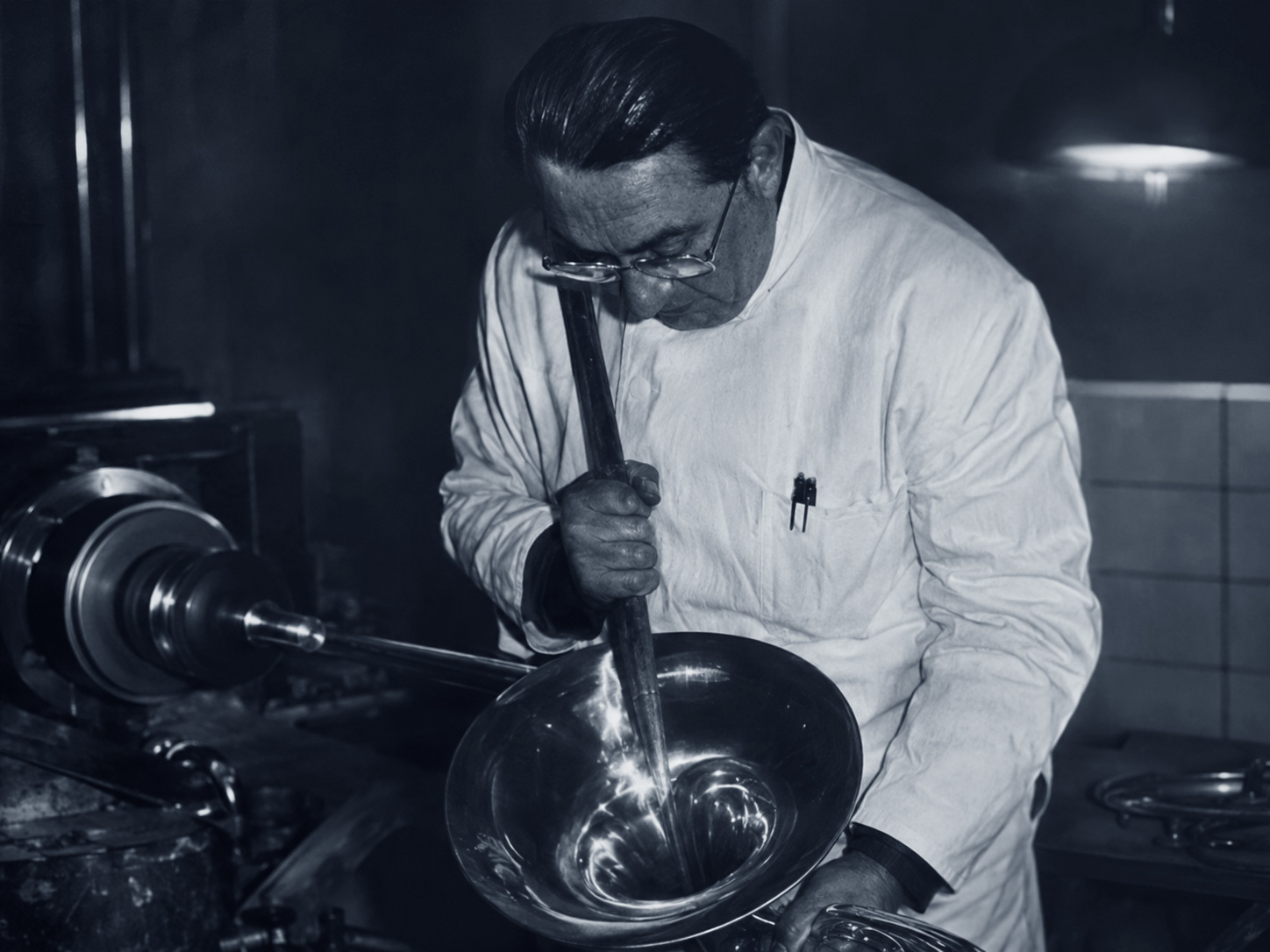
When he speaks of the hunting horn, M. Jacques Poncet is right: cold-hammering improves the timbre and annealing makes it worse; but it is the presence of a reinforcement which is crimped and not soldered that prevents the horn bell from vibrating at its proper frequency.
The job of the hunting horn is to communicate the circumstances of the hunt to its widely scattered participants.
In view of the very great acoustic deadening due to the trees in the forest, it is sounded with a "saturated" timbre which has great intensity of sound.
The dynamic fff is obtained by adding upper harmonics and the dynamic pp by subtracting these same harmonics, the intensity of the weak harmonics remaining roughly the same in both cases; this is why, on all instruments, the timbre is not the same in pp, mf and ff.
To raise a different matter entirely, I must say that I found Thomas Stevens' article "The Trumpet in the U.S.A.", which dealt with the modifications that American artists have had made to their trumpets, extremely interesting.
This is probably the Cartesian mind of a Frenchman at work, but I think that adapting an instrument has to be done in a logical way; if not, anything can happen.
For example, you can try new mouthpipes as long as you like without producing the desired result if the fault lies in the cylindrical tubing, in a brace or in a valve airway or if a pressure antinode is situated right on a valve diameter.
Let me say in passing that, when one talks about "vibration nodes and antinodes", one should always specify "speed nodes and antinodes" or "pressure nodes and antinodes".
In the matter of tuning, the corrections made on a speed antinode are quite different from those made on a pressure antinode for the same result.
The positions of these nodes and antinodes of speed and pressure in the body of the instrument are determined by calculation and verified experimentally.
Many corrections have to be made to the basic formula: the impedance of the mouthpiece, the bore diameter, the radii of the curved tubing and the bows (a curved tube does not have the same impedance as a straight tube of the same diameter), temperature distribution etc.
Since the mouthpipe is always warmer than the rest of the instrument, the sound wave obviously moves through it faster.
Temperature problems are often overlooked, and yet between 10°C and 40°C (50°F and 104°F) there is a difference of a semitone!
The viscosity of the air is not the same at all temperatures and sound travels faster through warm air.
This speed of propagation also varies with humidity and with the CO2 content.
Stroboscope adjustment therefore has to be done at a constant temperature, otherwise one is wasting one's time.
There is much to be said on the subject of instrument making and instrumental acoustics and, to judge from the questions they ask me every day, young musicians seem ready to hear about these matters and I am able, through lectures, to share with them my passion for my work.