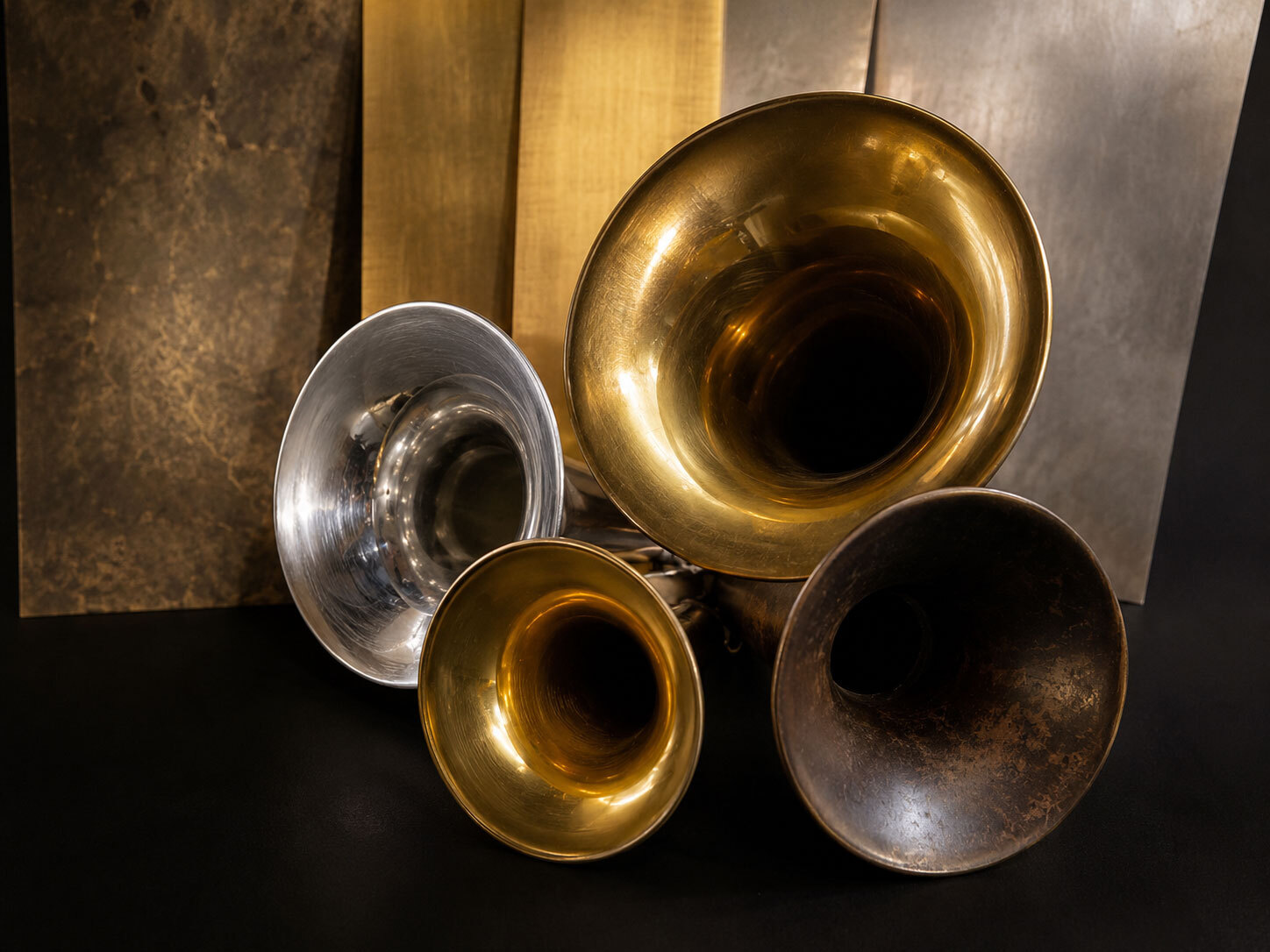
Many manufacturers quote material (usually bell material) in their sales specifications. Martin specify "natural yellow brass", Holton "regular (yellow) brass", Yamaha talk generally about their "special Yamaha alloys" and then specify bell alloy for trumpets, cornets, flugelhorns and trombones, yet not for horns, euphoniums, or basses?
On the subject of the French horn, Reynolds tell you "use of brass rather than nickel silver gives the instrument a somewhat brighter, freer tone", and Conn agree by saying that "use of a brass bell rather than nickel silver gives this instrument a slightly brighter tone". This is explained when Reynolds reveal that "solid nickel silver construction produces a dark resonant sound", but Paxman cast doubt by claiming that "a considerably 'darkened' tone quality was attributed to the alloy (wrongly we think) rather than to a radically different bell profile... nickel silver brightens and... condenses the tone into a crisp clarity".
A Reynolds trombone is "nickel plated for contemporary appearance and sound", or for the tuba player Conn say that "hard nickel plate on the bell flare gives better resonance". Schilke, on the other hand, claims that "...plating does not affect the playing qualities of brass instruments", though this does not deter Olds from praising their Superstar range of which "the bright silver finish projects a quality of sound that stands out and takes the lead". King produce a cornet with a "solid sterling silver bell... projects tone farther with less effort".
Though yellow brass tends to be the standard material, many top range models include gold (or red) brass sections as standard or as an alternative. Between Conn, Bach, Olds, Paxman, and Miraphone, this material destines the sound to be dark, veiled, mellow, sonorous, resilient, compact, round, full bodied, delicious, and rich, and gives the sound greater carrying power. These claims are reasonably consistent compared to those about instruments made from other materials and processes, though they still have dubious substantiation. Holton, Yamaha, Getzen, and Reynolds all specify gold (or red) brass for some of their instruments though they say little or nothing about it.
Other miscellaneous materials are used: Conn produce "Coprion" bells electroformed from copper which on a trumpet gives a "darker richer tone". Conn also produce an "Electro-D" bell which is electroformed from a non-specified alloy, but it is specified that the "Electro-D" bell adds "stability and precision of response". Reynolds produce a trombone on which the "Bronze-O-Lite flare centers and delivers the tone", and another on which the "bronze alloy bell gives... a richer, darker sound and excellent projection".
Schilke found that by "...tapping the steel bell, it would emit a very ringing sound. However, when we played this instrument, the quality of sound was extremely dead... the lead bell... if rapped... emitted an extremely dead sound like rapping a piece of wood. However, the sound that emanated when it was blown was extremely brilliant". His findings led him to use his "beryllium bronze" of which he says "this particular material has a wonderful acoustical effect in that it has remarkable carrying power. Its projection of sound is quite phenomenal".
Miraphone use a "secret formula brass. As resonant as it is flawless, this secret formula brass produces the symphony sound which distinguishes Miraphone from all other brass instruments".
In many cases it is not just the alloy which is allocated specific properties but also its thickness and mechanical state. We have already met pounded bells and annealed bells, but Conn maintain that "electroforming offers control over the shape, grain structure, and metal thickness... bells produced by this method have outstanding tonal qualities over a wide dynamic range". Alternatively, in the Yamaha factory "the bell is pounded, greatly enhancing the instrument's good response and unique tonal beauty".
Olds explain the principle of their "ultrasonic bells", which are seamless because seams "really show up in the sound. The acoustically dead solder seams break up the horn's natural vibrations, or sound waves... just as a breakwater prevents the natural flow of sea waves".
The seamless theme is also hailed by King whose "seamless bell tail is wave-free and uniform in grain structure and metal thickness", and Yamaha whose "bell, seamless welded, non engraved, formed with varied wall thickness, provides superb tonal quality, precise intonation, and even response in all registers".
Despite the Olds "ultrasonic bell", the Olds trombone with "the remarkable 'tone band', positioned on the bell flare, provides the timbre required in contemporary music", and Yamaha mention that "a special leaded bell rim enhances the instrument's good response and well-centred tonality".
Some people rate instruments by tapping the bell: Martin's "Urbie Green" trombone goes "ding instead of clunk. This instrument vibrates when you play... you can actually feel the note... it's alive". Reynolds produce a trumpet with a "...live bell...", and Getzen's Eterna trumpet has a "bell with special acoustic properties and resonance that you can feel as well as hear".
On the other hand, Schilke says that "as far as the overall instrument is concerned, the more inert it is to vibration, the better it is. However the thickness of the metal and the temper of metal in the mouthpipe, tuning slide, and bell greatly affect the quality of sound produced by the instrument", also that "metal with excess temper gives too many vibrations of its own".
Wall thickness is an oft mentioned property. Bach say that "for maximum resonance, one piece bells are graduated in thickness according to a secret formula", and produces an instrument "with a thin gauge bell for brilliance and minimum resistance". Yamaha "bells are precision formed with automatically controlled thickness... micrometer tested for unfailing strength and tonal response", but they seem unsure as to what thickness should be: they make instruments with a "bell that has been formed and worked to uniform thickness for producing superior tonal quality", and instruments where "there is a subtle variance in bell wall thickness which critically affects the instrument's tonality".
Schilke talks about "the thickness of an ordinary brass bell, I like the vulnerable areas to be... between 12 and 14 thou... with beryllium bronze, I am able to make bells with vulnerable areas to 6 and 7 thou", which contradicts what he said about instruments having to be as inert to vibration as possible.
It is quite widely accepted that lacquer used on violins can critically affect acoustic properties of the instrument. To some, the same is felt about brass instruments. Conn use a finish called "Lustre-Conn" of which "only a very thin coating is needed, preserving the natural beauty of tone of the instrument". Yamaha claim that "...our advances in chemistry have created finishes that result in the highest sound clarity, detail and realism", but Schilke says that his "lacquered instrument... had a very much impaired tonal quality and the overall pitch was changed", which, he says, is due to the fact that lacquer is about 7 thou thick whereas a finish like silver is only about 1/4 thou thick (which he claims does not affect the instrument).
Most of the above material is exclusively directed at the bell of the instrument, though we have already had Schilke on the wall thickness of the mouthpipe and tuning slide. Additional to the solid sterling silver bell on King cornets is a "solid sterling silver mouthpipe..." which "...utilizes the unique properties of sterling silver to provide a dark, but extremely resonant sound", and Yamaha make a trombone on which "the integral-drawn, yellow brass one-piece outer slide... contributes to this instrument's good resonance".
As can be seen, there is much written about the mechanical and physical properties of materials and finishes used on brass instruments. Manufacturers seem to be in little doubt that materials play a vital role in the quality of acoustics of an instrument yet they contradict each other when it comes to identifying this role. Schilke is the only one who offers any evidence to back up claims, but his experiments are far from rigorous and his explanations far from scientific.
So who is right and who is wrong? I hope that the apparent flippancy of this article does not cover the underlying need for conclusive and rational scientific experimentation to resolve the differences of opinion highlighted above.
Part of the problem is that there are too many variables, not the least of which are production tolerances; which manufacturers can boast that all the instruments off a production line play identically? These random differences may be larger than the subtleties bestowed upon the material of construction.
Too many people have tried to solve all the problems in one go and have produced results which, to this day, do not seem to have conclusively identified any significant mechanisms to relate material of construction with playing quality. I hope that this will not be the position for too much longer!