Brass Bulletin is now also available in Italian and Spanish.

1 min. read

Benny Sluchin

Portrait in brief

Benny Sluchin

Benny Sluchin

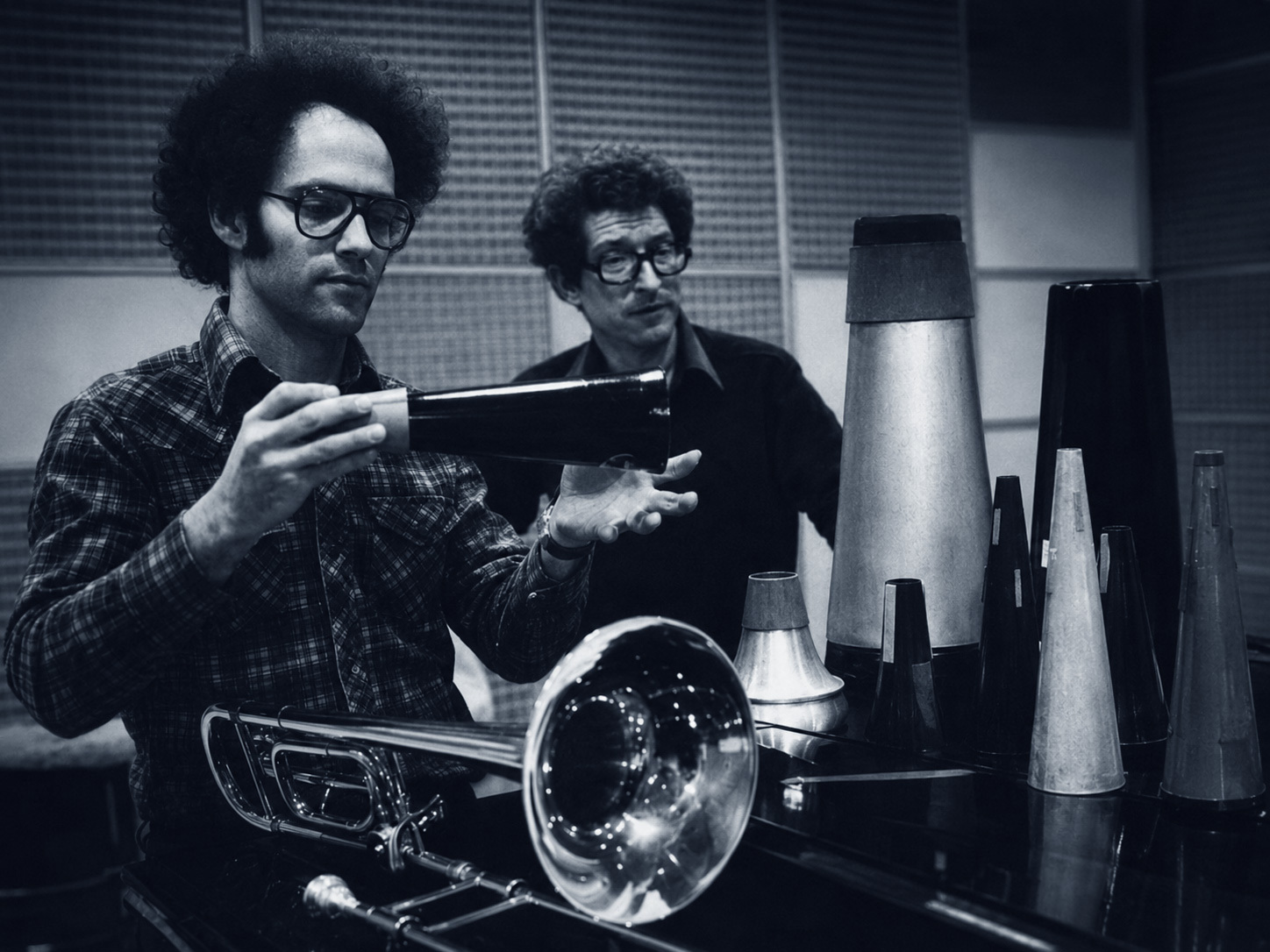
Brass Bulletin presents its new trombone and bass trombone editor: Benny Sluchin

In spite of his many professional activities Jean Douay, solo trombone at the Orchestre National de France, has helped and supported us in this field for many years and we would like to express here our deepest gratitude to him.

In order to ensure continued interest in this side of the brass family, as well as giving it a fresh impulse, we have called on Benny Sluchin (see the brief biographical note below) and invite our readers to an appreciation of our new colleague's ideas when we publish in our next edition a "historico-anecdotal" article on the transcription problem.

Benny Sluchin was born in Tel Aviv in Israel in 1948. He studied music at the Rubin Academy of Music, and trombone with Messrs. Grabler and Ostrowsky. He followed mathematics and philosophy courses at Tel Aviv University at the same time and graduated "Master of Science" with distinction.

His professional career began in the Israel Philharmonic Orchestra where he stayed for two years before going as co-soloist for four years to the Jerusalem Symphony Orchestra (Radio Orchestra). A German government grant took him to Cologne where he studied trombone with V. Globokar and obtained his artist's diploma with distinction.

Since 1977 he has lived in Paris where he is a member of the Ensemble Intercontemporain, a group of soloists created by Pierre Boulez with the intention of playing the music of our century. He also has various activities as a soloist.

Apart from that he is leading a research project in brass acoustics at IRCAM (Institute for Research and Coordination in Acoustics and Music) and working on a doctoral thesis in mathematics at the Sorbonne.

Brass Bulletin 30, II / 1980 pages 5–6

All content is protected by copyright © Brass Bulletin 1980–2026

Share this article

Facebook LinkedIn
Loading…

Questions & Answers

How the Digital Edition works

What does the Digital Edition include?

The Digital Edition brings together the articles already digitized as searchable online texts—not simply as scans or PDF files—along with their original illustrations, notes, authorship, issue information, and available translations. Related-article suggestions currently include only this digitized material.

Are the digital articles identical to the originals?

We preserve the original text, language, illustrations, captions, footnotes, and editorial context as faithfully as possible. The presentation is adapted for comfortable online reading, and obvious transcription or scanning errors may be corrected. The substance and character of the published article remain unchanged.

Which languages are available?

Brass Bulletin was published in English, French, and German throughout its history. Italian and Spanish translations were added from issue No. 60 onward.

On the Italian and Spanish sites, articles from issues 1–59 are therefore shown in English by default.

How often are new articles added?

New articles are added almost daily, with approximately one complete issue digitized each week. The pace may vary depending on the preparation, image work, and editorial checking required.

Why aren’t all articles available digitally?

The complete Brass Bulletin collection contains 1,246 articles published between 1971 and 2003. The full index is already available online, allowing readers to discover every article in the collection, including those whose complete text has not yet been digitized.

Digitization began in February 2026. Each article is carefully prepared for online reading, checked, and connected to its issue, authors, subjects, and illustrations. At the current pace of digitization, the complete collection is expected to be available online by February 2028.

Why do some references mention articles that are not available yet?

References in the original articles are preserved even when the material they point to has not yet been digitized. This keeps the historical and editorial record intact. As more issues are added to the Digital Edition, an increasing number of these references will lead to articles that can be read online.

Can I suggest an article or report a transcription error?

Yes. If there is an article you would particularly like to see digitized, or if you notice a possible transcription error or missing detail, please contact us. Reader feedback helps us improve the Digital Edition and prioritize useful connections within the archive.

How can I support Brass Bulletin?

Your support helps fund the preparation, verification, and online publication of the complete collection.

Subscribe to the Digital Edition

Prefer to support us without subscribing?

Make a donation

Search Brass Bulletin.