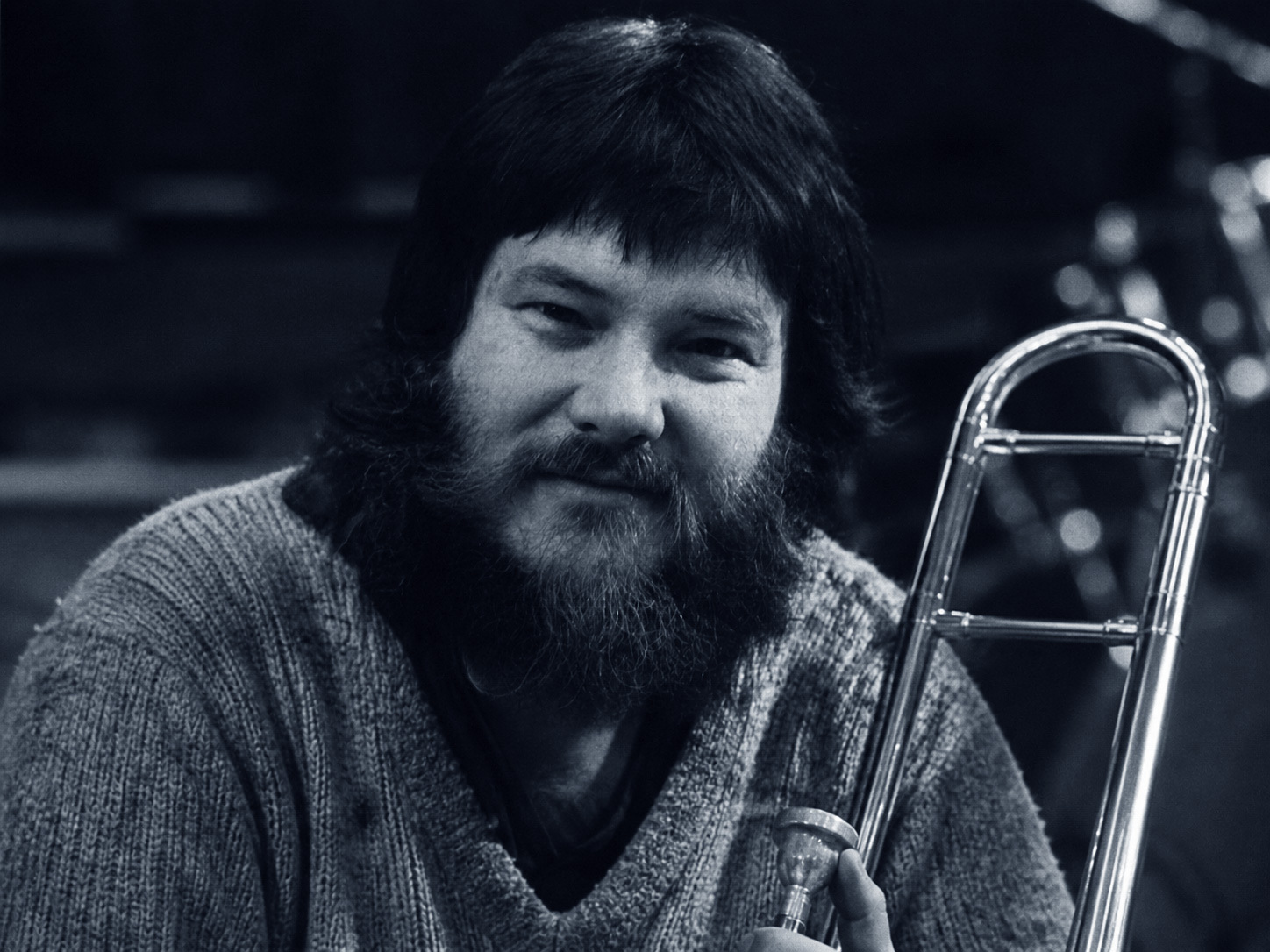
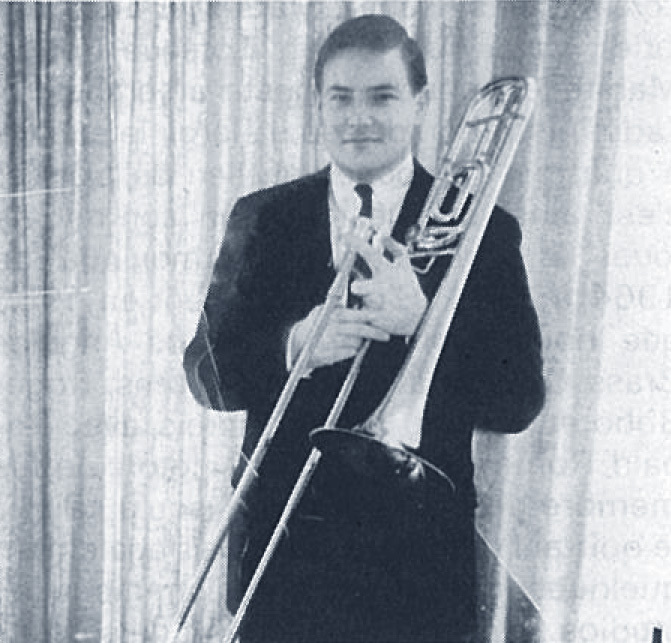
I studied with Robert Marsteller and I got what they call a Masters Degree and then I went on the road and played with the Les Brown Orchestra which was a well known big band in America. I did that for about a year and a half to two years, then I decided to freelance in Los Angeles, mostly concert kind of music. At that time I had the opportunity to do some substitute work with the Los Angeles Philharmonic because Robert Marsteller was ill. I did that for one year and then they decided that when he came back they would have four trombones and so I was given a contract and I played in the Los Angeles Philharmonic from 1964 to 1971. Also, around 1965, I, along with Tom Stevens, Roger Bobo and, I think, at the very beginning Ronald Romm and Wayne Barrington, we formed the Los Angeles Brass Quintet and I was a member of that ensemble until I left the Orchestra. Also I did some studio work — not too much solo performances at that time —. 1971 then took the job as principal trombone in the San Francisco Symphony. I was there till 1974. I came back to Los Angeles and freelanced and did much more solo playing since that time around Los Angeles, partly in the United States. That's my history basically.
J.-P. M.: How do you balance the professional work of freelance playing and your own interest in new music which is actually only a marginal tendency ?
M. A.: What do you mean ?
J.-P. M.: Freelance and studios playing is in fact your income occupation. How do you explain your interest in new music which is evidently not the way to make money.
M. A.: As a freelance player, my interest is divided between making money and making music. So I've learnt that in the money-making music, that I don't necessarily expect pleasure in playing and an opportunity to, you know, play good music, so since I have that desire I do that sort of thing — playing good music. But I find this whole thing a big problem. One gets in the way of the other. It's difficult to pursue the professional playing, the freelance playing when the other part of your head wants to do some solo playing, and play music for its own sake, and when a lot of your time is taken pursuing freelance work — because when you freelance you have to go after the work, it does not necessarily always come to you, you know. That gets in the way of preparing yourself for playing music for its own sake. So I find this is still a conflict and have not been able to resolve this problem to my own satisfaction. I am on a vacation now and am trying to come up with some better ideas. But ideally for me it would not be to play music just for the profession, just to make money. But I have to see whether I can do that. That's very nice.
J.-P. M.: In one year working in Los Angeles, can you say how much of the time you are able to express yourself as a musician ?
M. A.: I can't express it in actual numbers and say what percentage of my life it is, it's true, because let's say I go on a job that for its own musical sake isn't good, so I can choose to be very unhappy about that and be miserable. But usually, at least in Los Angeles, you can always find something to enjoy. Say the actual music that I am playing is bad music but I may be with some very fine musicians, so somehow we work together and make it sound good and so I focus my attention on this. Otherwise it's ridiculous, there's no point in even being on this job at all. So, but, if you want to say how much time I spend in playing concerts that I like or solos that I like, in time I would say — maybe 25 %. More than most people are able to do. But then I don't make a lot of money playing because I give more attention to this other — you know — «music-music» you might say. If I want to make more money I have to let that go and concentrate only on making money.
J.-P. M.: You are now at an age where a musician gets his complete faculties of skill, and intellectually you understand many things and so, how do you face the future ?
M. A.: Well, for myself right at this moment it's a little hard to say. I can tell you what I am doing right now. I'm just on this vacation so I'm trying to face exactly and make a decision exactly how to proceed with my life in music — you know — and I think that maybe I will take a chance and do less working and concentrate on just doing music for myself and do concerts and live off that. I used to think it was not possible to do that but maybe it is, and also go for smaller concerts and also, I guess you would say, more neighbourhood kind of music. Smaller communities. And hopefully I'll use my imagination and create new places to play music. As for music in general, I am not much of a prophet and I can’t see exactly where the whole thing will go, but it seems to me, at least in the United States, that there has been very much centralization of musical activities into just a few large cities and hopefully that tendency will change and go in another direction so that it spreads out and we have music in more places. We have a lot of musicians in the United States and they can contribute more if they aren’t all in Los Angeles and New York City — you know — and when more people can get out of their houses and away from their television sets and go to concerts and plays and other activities like that... But I don't know when that will happen. It may be that everything will be mechanical and they will all be in their homes watching everything on video tape for all I know. That's what is starting to happen in many ways... Time will tell...