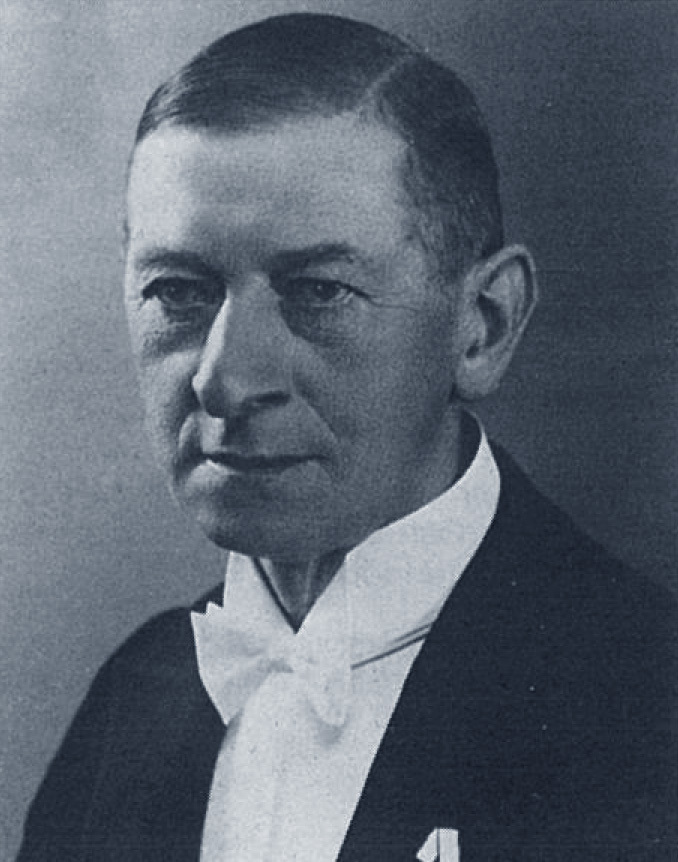
Anton Hansen
He also wrote a Method for Trombone which was published in 1941. In many ways Hansen was a pioneer in his time. He reintroduced slide trombones into Danish symphony orchestras where mainly valve trombones had been used before. Besides slide and valve trombone Hansen also played violin and piano, on occasion even in public.
Gifted as Hansen was, he was drawn into many differing activities. Many composers composed specially for him. He always accompanied his students’ solos himself on the piano. In addition to his orchestral work he often appeared as a soloist, giving more than 150 solo concerts during his life.
He was also an active trade unionist and was one of those who prepared the way for better pay and working conditions for musicians in Denmark. Together with his first teacher, the former solo trombone at the Royal Theatre, August Petersen, he made many appearances with the historical old Norse lurs². They also made the first record of lurs (“The Lurs”, 1925).
Hansen lived all his life in the working-class district on Nørrebro where he was born. He never forgot his origins, even when, as a celebrated soloist and as an orchestral musician at the Royal Theatre, he daily frequented people from a higher level of society.
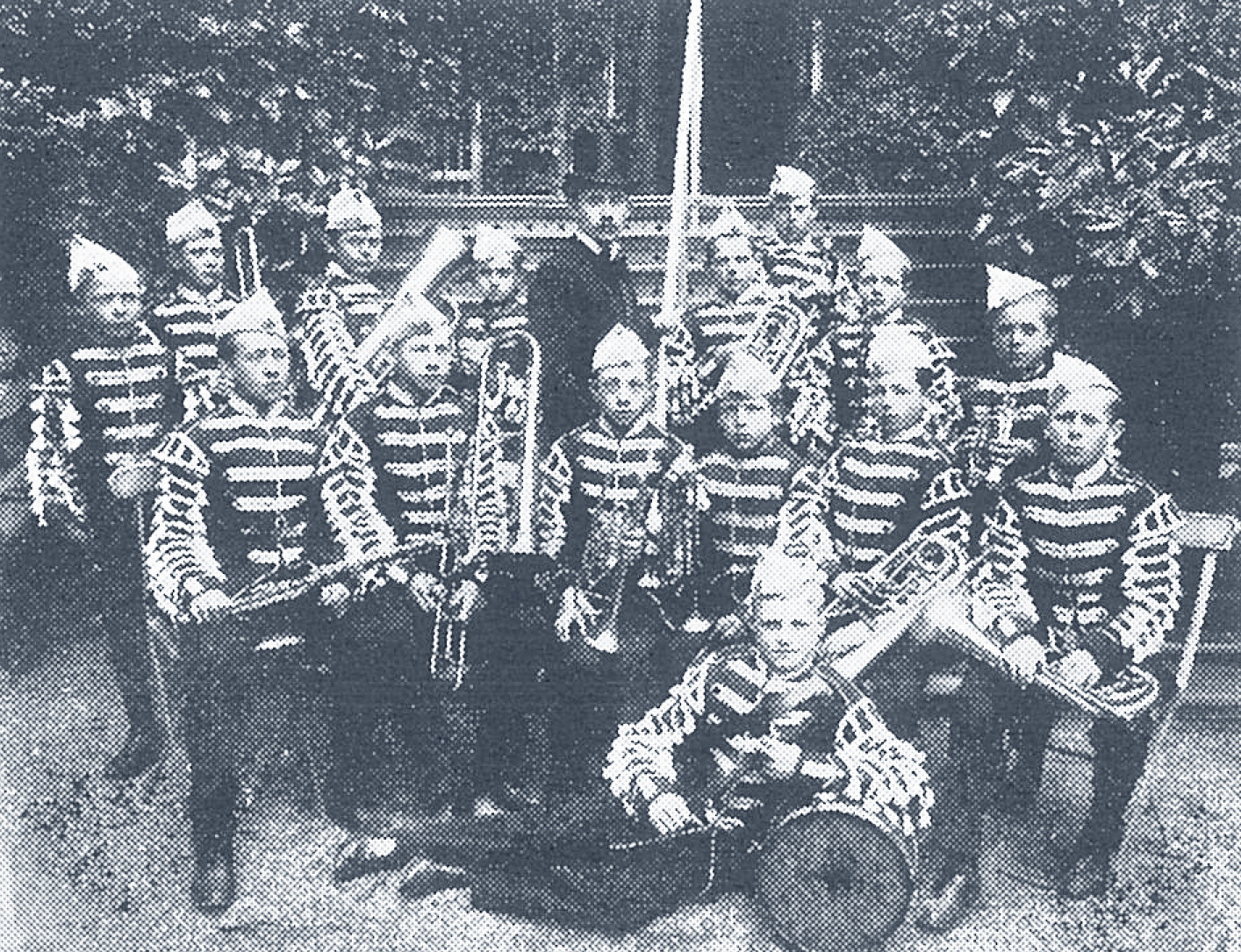
1 — Anton Hansen: valve trombone. The Boy Orchestra, Sweden, 1893.
Childhood and youth
Copenhagen around 1884
Anton Hansen’s father was a member of an amateur vocal quartet which often rehearsed in his house. These musical influences, his vivid experience of barrel-organs in the streets, and the military band, all this soon awakened his interest in music. When the military fell in for exercises, it was always with a band at the head of each regiment and Hansen was one of the excited boys who followed them.
He was especially impressed by the Royal Life Guards band, to the point that he forgot all time and place, and even forgot the thrashing he would get when he came home late. The first musical instruments that he played as a boy were the ocarina, the mouth-organ, the drum and the accordion; later his father gave him a bugle on which he practised hard.
A teacher by the name of Fritz Nehm discovered Hansen’s musicality and offered him free lessons if he could acquire a violin. Hansen himself writes about this in his reminiscences:
One day when I had been sent to the baker to buy bread, the baker himself was in the shop and I asked him anxiously whether his son still played the violin. “No, the lazy brat never touches it; it’s just lying about getting broken,” was his answer. When I told him about the teacher’s offer, he took the violin, which was a three-quarter size, out of a cupboard and said I could borrow it. I was over the moon.
When he was 10, Hansen also began to play the piano. For several months he was taught by a cousin. Since the Hansens themselves had no piano, young Anton had to make the long journey to the cousin’s house every day to practise.
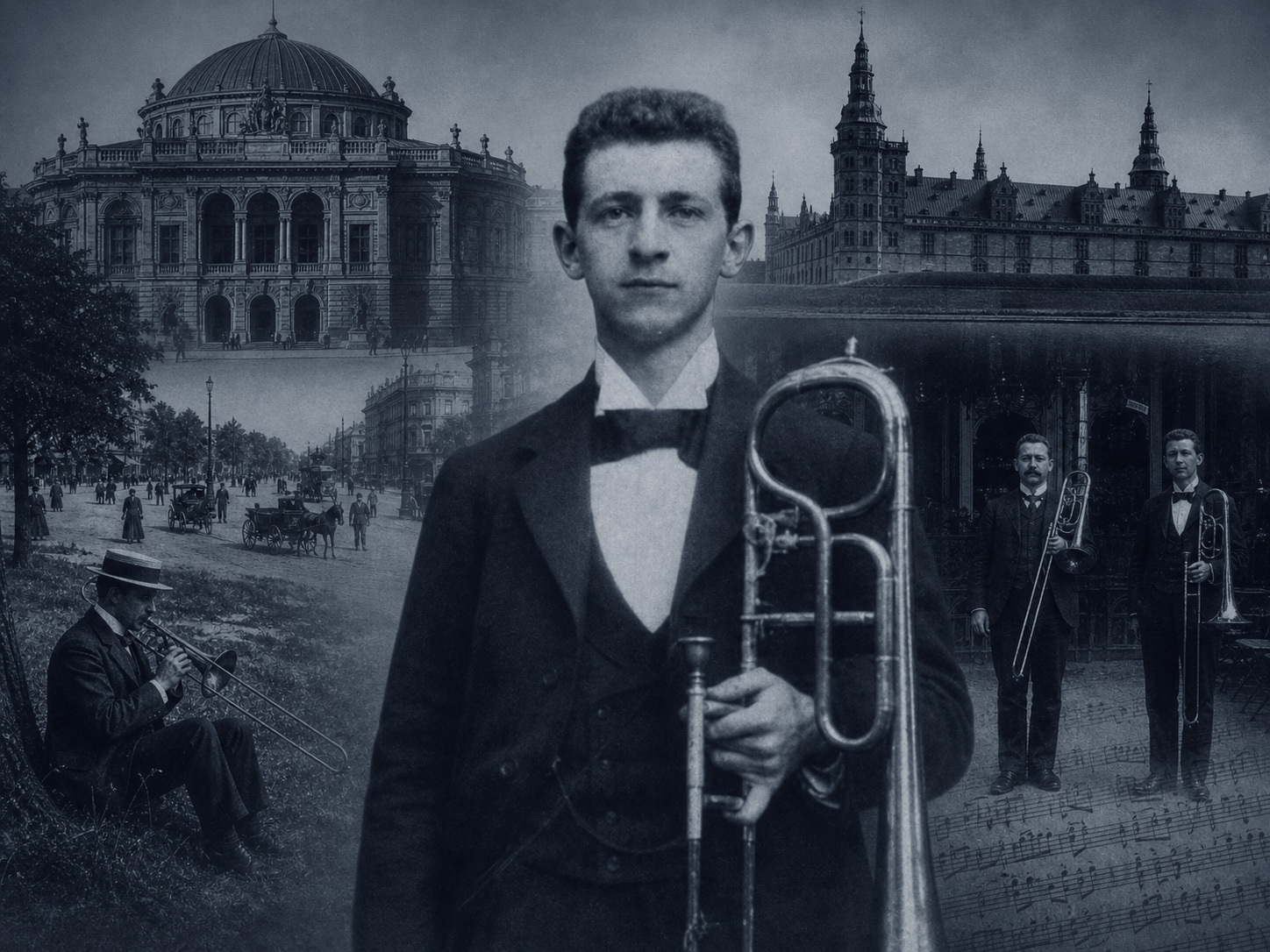
2 — Anton Hansen at Kronborg Castle.
When he was 14, his father read an advertisement in a newspaper looking for boys for an orchestra. Hansen was accepted and it was decided that he should play trombone. So a valve trombone and a tutor were bought and he started to practise on his new instrument. After six months the boys’ orchestra was playing so well that the conductor felt bold enough to take on an engagement in the Tivoli where the orchestra was to march before the Tivoli Guard.
Hansen also went abroad for the first time with this orchestra, because of engagements in Sweden among other things. Eventually he became too old for the boys’ orchestra. He himself writes:
I was confirmed, and a decision had to be taken about my future. My father was not at all in favour of my becoming a musician and I can clearly remember him saying, “The lad isn’t to be one of these drunken musicians.” Since I was already earning some money then, partly from dance-music and as an accompanist at dancing lessons and partly from teaching, no decisive step was made towards taking care of my future.
My burning desire was to go to the Hegner College of Music³, but money was tight. The pretentious idea of trying for a free place at the Danish (later Royal Danish) College of Music never entered my head. I had no great opinion of my own ability and I never dreamed that 24 years later I would become a teacher in that distinguished institution. I really only had one wish — to be able to keep myself.
In the summer of 1894, Hansen obtained his first engagement as a pianist in the “Wienerhallen” restaurant in a street called “Vimmelskaftet”. He was supposed to stand in for a friend for a few evenings but the result was that the proprietor wanted to take him on in his friend’s place.
After a lot of toing and froing — because my parents were not pleased at my playing in a restaurant — I finally got my way and took the job. The pay was 3 Kroner an evening including a cooked evening meal — a good fee, when one considers that at that time a manual worker was earning 12 to 18 Kroner a week for a strenuous 12-hour day.
It was boring, especially on Sundays, when during the good summer weather there were hardly any customers; but I had to play from 8 o’clock till 12 even when it was empty. I used to play the easier Chopin waltzes and some Kuhlau or Mozart sonatas for my own pleasure to pass the time.
The waiters couldn’t care what I played but, if the proprietor should appear unexpectedly from his den at the back of the restaurant, I had to change over smartly to a hit; the classics were not the thing to attract customers.
But I stuck it out because now I could realise my long cherished desire to get into the Hegner College of Music.
Ludvig Hegner became Hansen’s piano teacher and he received violin tuition from Anton Block, later a royal court musician.
Until now I had never had any trombone tuition although I practised the instrument constantly. Then something happened which was to be of decisive importance for my future. In the Euphrosyne Music Society⁴ where I played I met a wholesale dealer called Lohrer who played the trombone for pleasure and took lessons from the then solo trombone at the Royal Orchestra, August Petersen.
Lohrer advised me to contact him, and I did so. To my delight it turned out that August Petersen was a cheerful man who immediately took an interest in me.
After a few months he declared he could not teach me any more and would on no account take a fee.
I heard through an older colleague that there was a trombonist’s job vacant in the First Regimental Band. He said, “Apply for the audition; the bandmaster would like to have you in his band”. I discovered later that the Director of Music had previously heard me at the Private Music Society⁵.
I passed the audition and was taken on. Full of delight I told August Petersen about my good luck but to my great disappointment he said, “That is not for you. You must cancel it. You have a different and a much greater future”.
I could not understand him, for my greatest wish had been fulfilled — a permanent position. It was with the greatest misgivings that I gave the bandmaster some pretext for not being able to accept the position.
So Hansen played on in the “Wienerhallen”. A little later, however, he got a job as a trombonist in the “Lorensberg” in Gothenburg in Sweden. The orchestra consisted of Austrians, Dutchmen and Germans.
Among the members of the orchestra was a middle-aged German clarinettist. He advised me to get a slide trombone. “With your talent,” he said, “you have a great future on that instrument.” He also told me how much more beautiful and lively a sound one could get on a slide trombone than on the valve instrument.
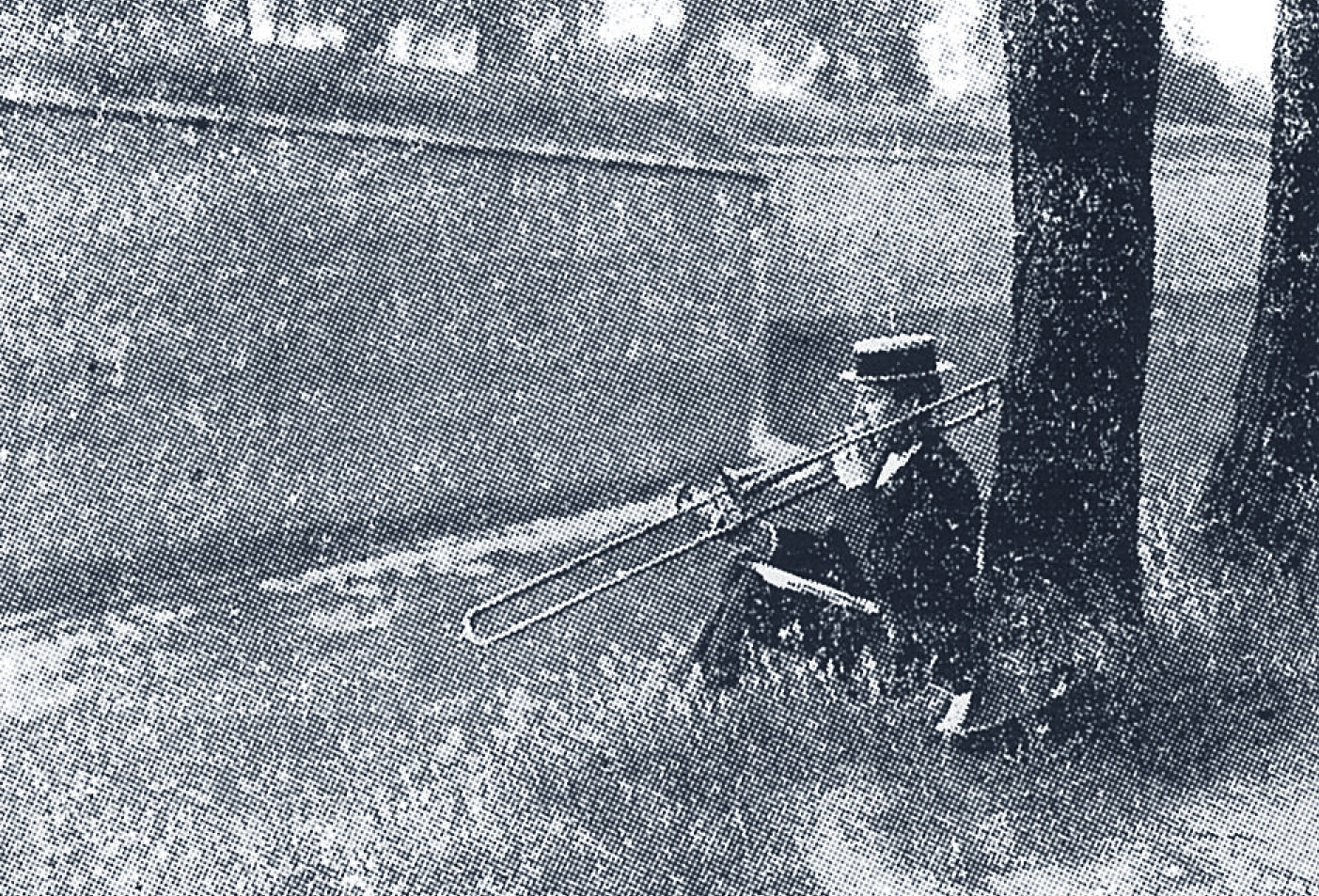
One day, while taking a walk in a part of the town I did not know, I saw a slide trombone in a second-hand shop; I bought it at once and started to practise. Although I had no tutor, before too long I acquired a fairly good knowledge of the peculiarities of the instrument, and soon I got as far as playing fairly connected melodies.
My job had now come to an end and Serpek, the conductor, tried to persuade me to stay with him for the winter. I did not give in, but went back home.
My first visit was to August Petersen. I took the slide trombone with me and, when I played him a few melodies, he exclaimed, “Good Heavens! Who taught you that?” I explained what had happened and he was visibly impressed.
He also played the slide trombone himself but he was by no means a virtuoso. (In the Royal Orchestra he played valve trombone.)
I carried on with my piano and violin lessons, and played slide and valve trombone, and practised from morning till night.
Engagements in various symphony orchestras
After some casual engagements as violinist, pianist and trombonist the 18-year-old Hansen got engagements in Sweden and Finland with the Danish composer and conductor of the time, Christopher Jensen. When he returned to Copenhagen some time later, he had lost his previous contacts there and he had to live off his earnings in Finland.
But with the selection of Joakim Andersen⁶ as conductor of the Tivoli Concert Hall Orchestra Hansen had an opportunity which was to be of decisive importance for his future as a trombonist.
Joakim Andersen was appointed flautist in the Royal Orchestra at the age of 22 but left nine years later and went abroad, wanting to widen his horizons. Many people said he had left Copenhagen because he had debts, but that may be untrue, like many things one hears.
For a while he worked at the St. Petersburg opera in Russia, then he went to Berlin and was taken on by the Imperial Court Orchestra, until he became solo flute at the philharmonic concerts in Berlin, where he often conducted. Joakim Andersen became world-famous as a flautist.
Unfortunately paralysis of the tongue forced him to give up his brilliant career and it was as a conductor that he then won his great reputation here in Copenhagen.
At that time only slide trombones were used in symphony and opera orchestras abroad. Here in Denmark everyone played valve trombones. Joakim Andersen found this too parochial. And rightly so.
Only two of the three trombonists who had played under the previous conductor, Georg Lumbye, could play the slide trombone, and so the third place had to be filled. On the recommendation of August Petersen Anton Hansen was selected.
I had to start my job as trombonist at the Concert Hall and I felt rather nervous on my way to the first rehearsal. It went much better than I had expected, however, and I was soon at ease in my new surroundings.
My teacher August Petersen had arranged to meet me on the opening day in Tivoli. Since he thought I would need a stimulant, to calm my nerves as he thought, he suggested we share a half bottle of port. We did share it, but in such a way that I drank only one small glass and left the rest to him as he had earned it well.
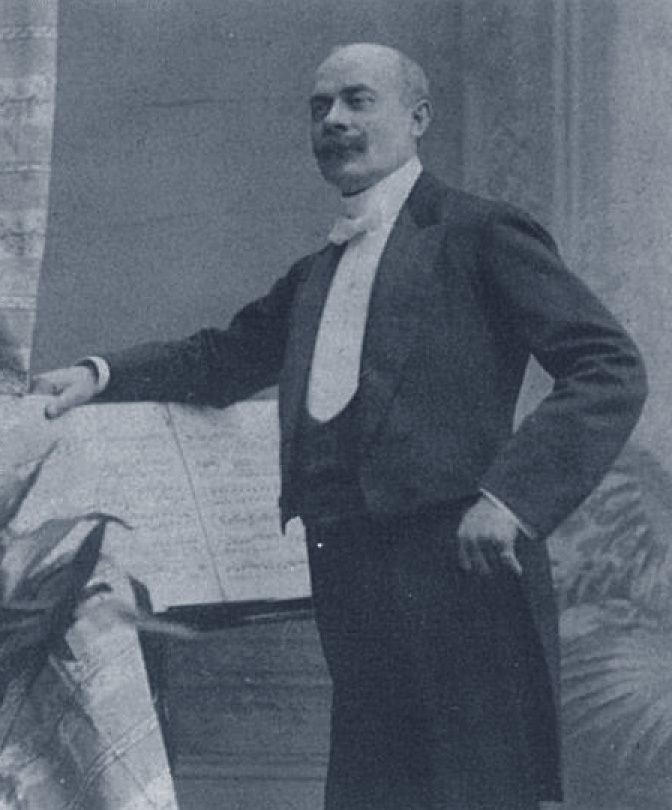
3 — Flautist and conductor Joakim Andersen (1847–1909). Photo from 4 May 1909.
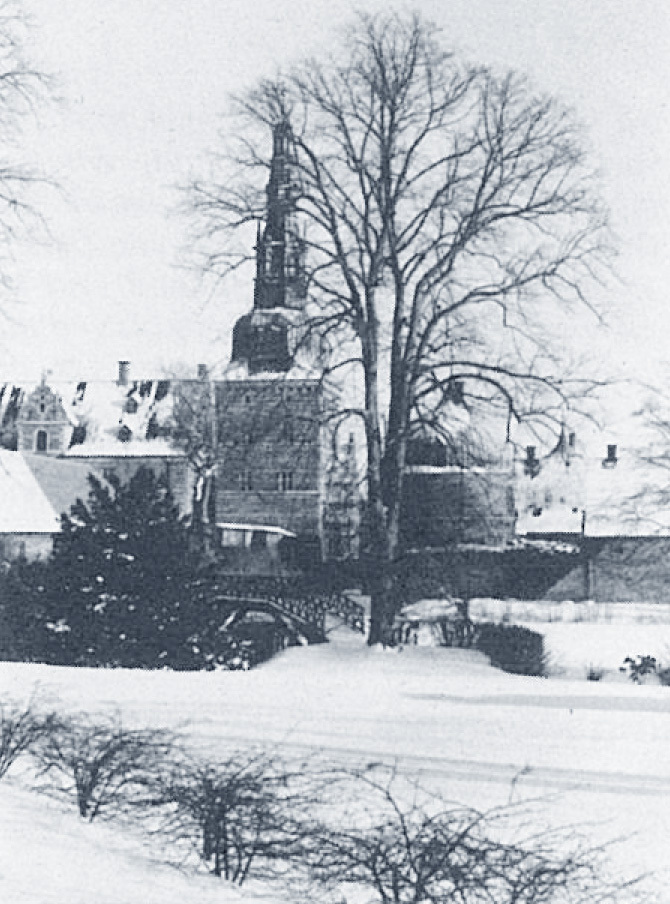
5 — The Royal Garden “Rosenborg Have”. Photo: Per Gade.
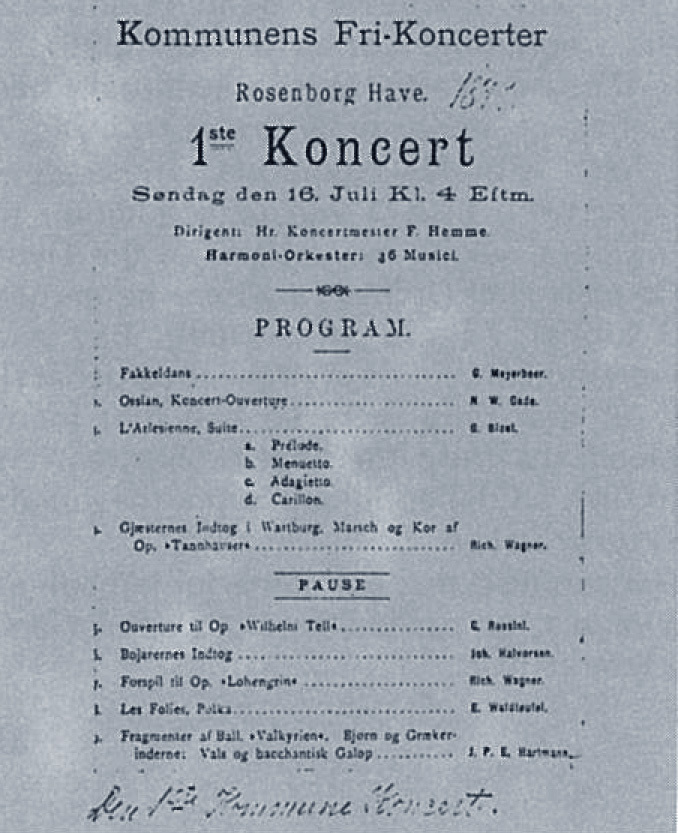
6 — Wind band concert programme in the “Rosenborg Garden” (The Royal Garden), Copenhagen, 16 July 1899. Hansen played the baritone (euphonium) in a 36-member ensemble.
Trombone audition at the Royal Orchestra
In January 1898 there was a trombone vacancy at the Royal Orchestra. My old teacher, August Petersen, said there was no question but that I should take part in the competition and maintained with conviction that I would get the job.
On the day of the contest he came to my house in the morning and had me play the two pieces he had chosen for me, the David and Sachse concertos. When I had finished, he said, “If you play as well as that in the competition, the job will be yours.”
When I had gone, my teacher said to my mother, “You can phone the ‘Grand Café’ right away and order lunch because there is no doubt that your son will get the job.”
My mother waited for the result before doing anything, however, and it was just as well, for I did not win.
The solo trombone at the Tivoli Concert Hall, Carl Christensen, won the competition and shortly afterwards Hansen took his place as solo trombone at the Tivoli. The conductor, Joakim Andersen, often included Hansen’s name on the programme as soloist.
Life went on for Hansen. In 1899 the city of Copenhagen decided to have 10 wind band concerts each summer in the “Rosenborg Garden” (The Royal Garden). Hansen was given the baritone (euphonium) part. The first concert was on Sunday 16th July 1899 at 4.00 p.m. The band numbered 36 musicians and the programme was as follows (Illustration 6).
In these concerts Hansen eventually had plenty of opportunity to appear as a soloist with his trombone. These concerts were also a welcome addition to the poor wages he received at the Tivoli Concert Hall Orchestra where he earned 3 kroner 75 øre an evening.
Pay and working conditions in orchestras generally at that time were so bad that many musicians from the best orchestras had to take all the additional work they could in order to live.
Hansen also made a name for himself as a pianist at parties, as both soloist and accompanist.
At times my piano playing brought me the biggest fees I have received as a musician. I was much in demand as an accompanist at private concerts and evening functions and I had gradually built up a considerable amount of business as a pianist at parties, playing for the nobility and the bourgeoisie.
I asked a high fee for those days and could often earn in a single evening half of what a young orchestral musician earned in a month. Sometimes the work made great demands on me, for example as an accompanist, when one of the guests wanted to entertain the others with some songs.
Often, when I arrived at Count Raben-Levetzau’s, for example, I would be given a lot of new pieces, usually English, which I then had to play at sight.
I had many amusing experiences at these parties and, although I would be delighted to recount more, I will content myself with just one. I once played at a masked ball given by Count Reedtz-Thott where the then Crown Prince Christian⁷ was present, dressed as the composer Offenbach.
During a break His Royal Highness asked me if we could play the then popular Emperor Waltz — we had five musicians — and whether he could conduct us. The Crown Prince beat time. Those present listened attentively and, when the piece was over, the applause was thunderous.
His Royal Highness signed to me to get up and took me by the hand, and we went out into the middle of the room together to receive the applause.
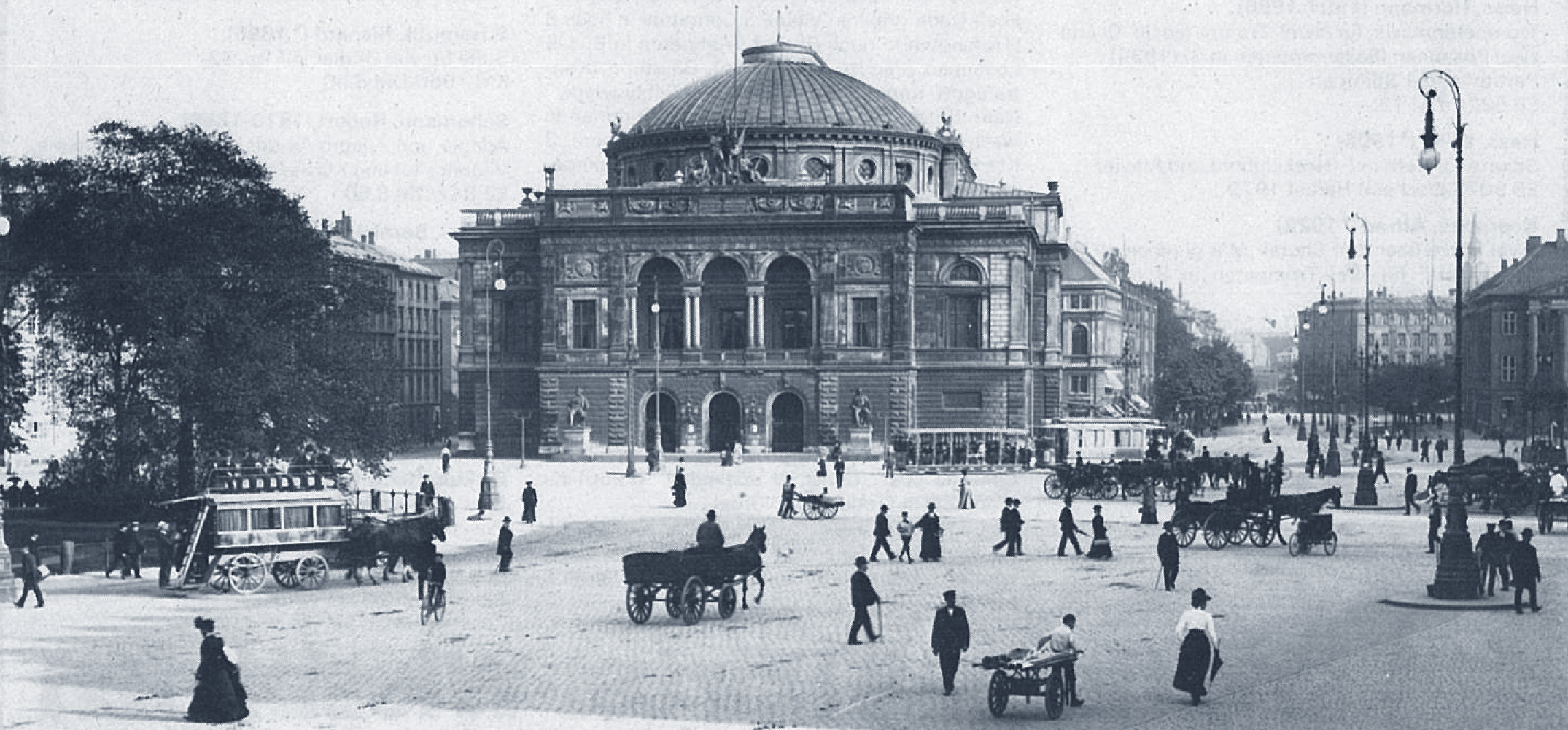
4 — Photo: Royal Library Collection. The Royal Ballet & Opera House, Copenhagen, 1889.
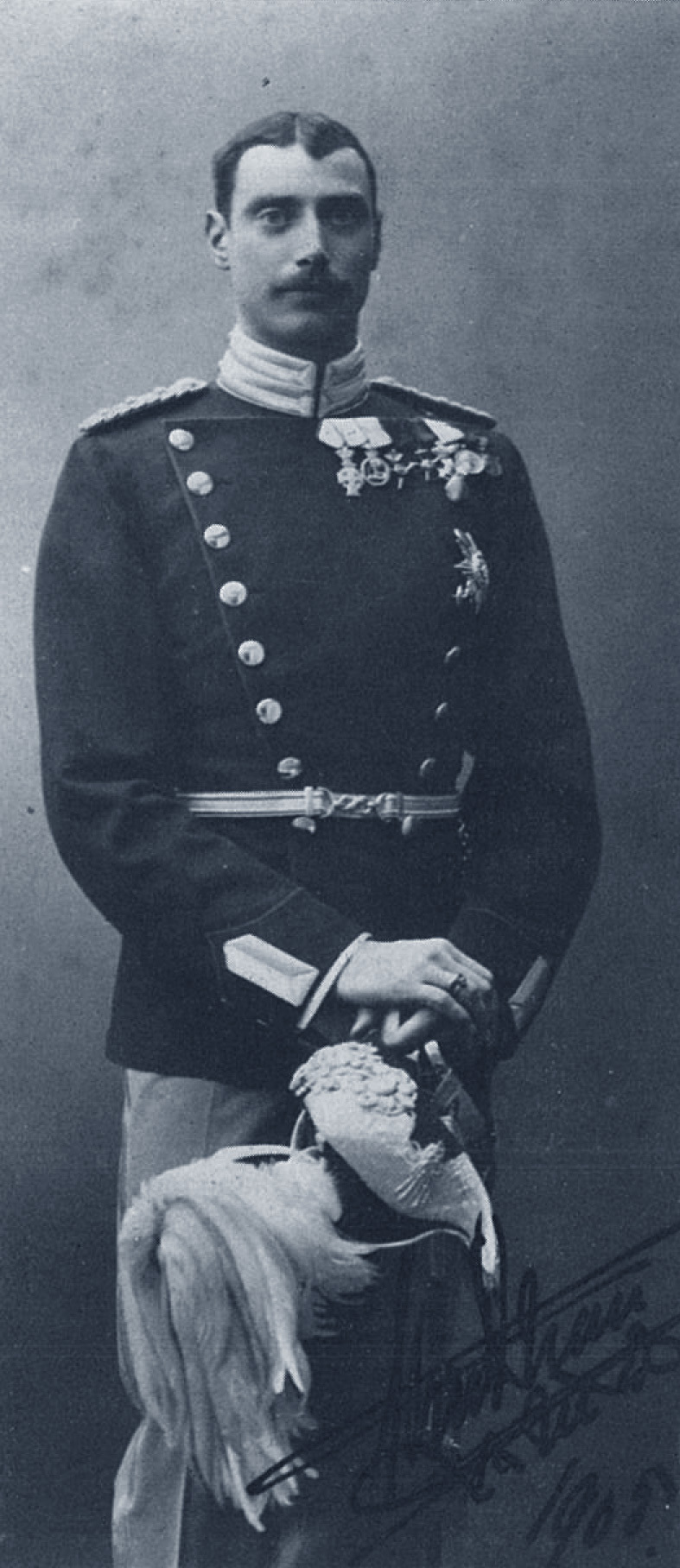
7 — Crown Prince Christian, 1905 (later King Christian X of Denmark)⁷.
Appointment to the Royal Orchestra
Another trombone vacancy occurred in the Royal Orchestra in 1905 and the auditions took place in August.
I had played in the orchestra as a deputy during the two preceding seasons. I hoped that my knowledge of the repertoire, thus gained, would give me a better chance of getting the job.
I tried to play as many solos as possible the preceding summer, both in the concert hall and in the city concerts in the Royal Garden. In both places I saw among the audience one or other of the trombonists I would have to contend with. But I worked so hard that I did not go into the forest once all that summer.
I chose the same two concertos I had played at the 1898 audition. When at last the day came for the audition, I appeared in the theatre rehearsal room where the adjudicators were the theatre director, Count Danneskiold-Samsøe, the conductors Johan Svendsen and Rung, the concertmasters Anton Svendsen and Holm, and the Musician of the Royal Chapel, Axel Gade.
I arrived along with my accompanist, Holger Dahl, with both my instruments, my slide trombone and my valve trombone. That morning I read this note in a newspaper: “The auditions for the orchestra take place today. Eleven people have applied for the viola position while only one has applied for the trombone position but we hope he will play like an angel.”
I still firmly believed that I would have to do an audition. But, as I waited for a signal to begin, Johan Svendsen got up, turned to the director and said, “I do not know whether Your Excellency wishes to hear the young man play. There is no need, as we already know him well.”
The director expressed no wish and Johan Svendsen then said to me, “Then we can only congratulate you.”
I left the hall and the many members of the orchestra outside received me with handshakes and congratulations.
The next day the same paper said: “Only one candidate had applied for the trombone position, Mr. Anton Hansen. The reason for this is said to be that all Mr. Hansen’s colleagues gave up when they heard of his candidacy because they know how good he is. Mr. Anton Hansen obtained the post.”
I learned at the same time that the orchestra had once before had a case similar to mine. That was 20 years earlier, when the trumpeter Thorvald Hansen got his job in the orchestra in the same way.
In 1910 Hansen made a request to the Royal Theatre to be considered for the award of the “Kirstein Bequest”. This bequest was made each year in two parts, as it is now, to Royal Opera House musicians who wished to study their instruments further.
Each bequest amounted to 900 Danish Kroner, which was not a small sum for those days! To an orchestral musician on the most junior pay scale it was equivalent to nine months’ pay.
The bequest was awarded to Hansen as the best brass player in the orchestra and he made his preparations to go and study with Paul Weschke, the great trombone virtuoso at the Berlin Opera.
For various reasons I was not able to start the journey stipulated by the bequest before the end of the coming Tivoli season. Meanwhile I got in touch with the Musician of the Royal Chamber, later Professor, Paul Weschke in Berlin, who was the solo trombone at the Berlin Opera. He was regarded as the best trombone player in Germany.
In my first letters I asked him to let me know which studies he used in his lessons and what solo pieces there were for the instrument. I got hold of those I did not know and practised them enthusiastically.
I brushed up my school German, and wrote essays and took German lessons in order to get as much as possible out of my study trip.
Paul Weschke
In 1911 Hansen was granted two months’ leave from the Royal Opera House so that he could make the planned journey to Berlin. He left from Copenhagen Central Station on 18th September.
A few days earlier I had sent details of my arrival time to Paul Weschke, who was not only first trombone at the opera, but also a teacher at the Royal College of Music.
When the train arrived in Berlin and I was about to get out, I was very surprised when a complete stranger introduced himself to me with a smile as Paul Weschke. I had never sent him a photograph of myself and so I asked him how in all the world he had known who I was.
“Well,” he answered, “you were the only passenger with a trombone under his arm.”
I had forgotten all about that.
(To follow)
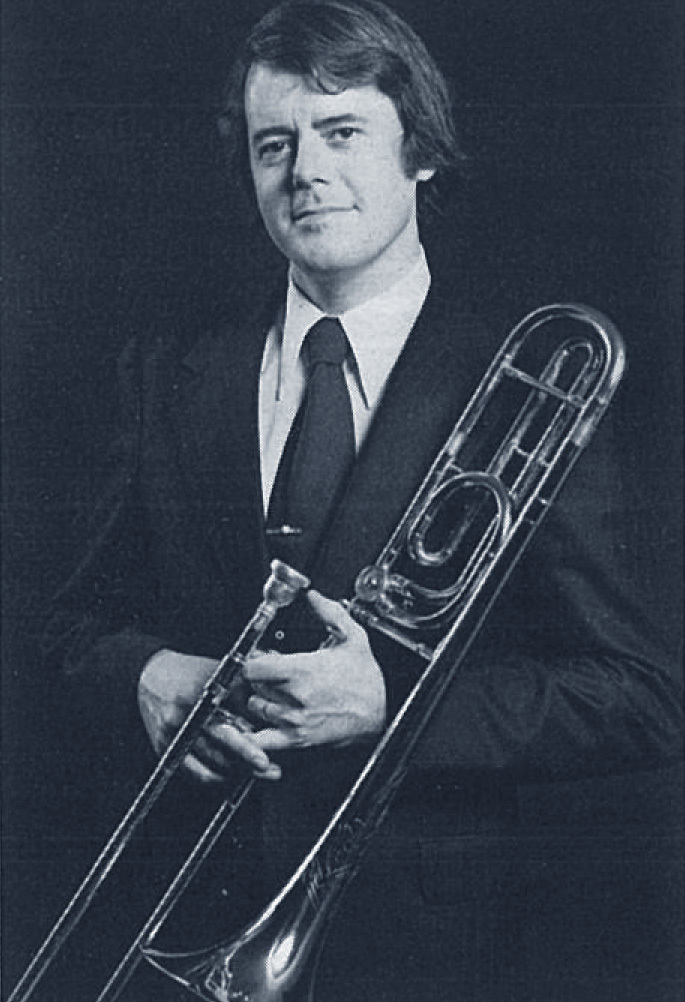
Per Gade
The Author
Per Gade was born in Aalborg in Denmark on 26th May 1944. He started as a jazz trombonist and then studied the instrument at the Royal Academy of Music in Copenhagen where he obtained a first prize. He also studied psychology, conducting, composition and orchestration.
He then continued his studies, working with Denis Wick in London and Jay Friedman in Chicago.
He gave first performances of many trombone works by Scandinavian composers (he plays alto and soprano trombones, bass trumpet, valve trombone, baritone, euphonium and bass trombone).
He began teaching as an assistant of Professor Palmer Traulsen at the Royal Academy of Music in Copenhagen. He is now professor of trombone, baritone and brass ensemble at the College as well as at the Academy of Music in Sakuyo in Japan.