Explore institutional access Explore institutional access

3 min. read

Viktor Venglowski

Musician and Teacher

Viktor Venglowski

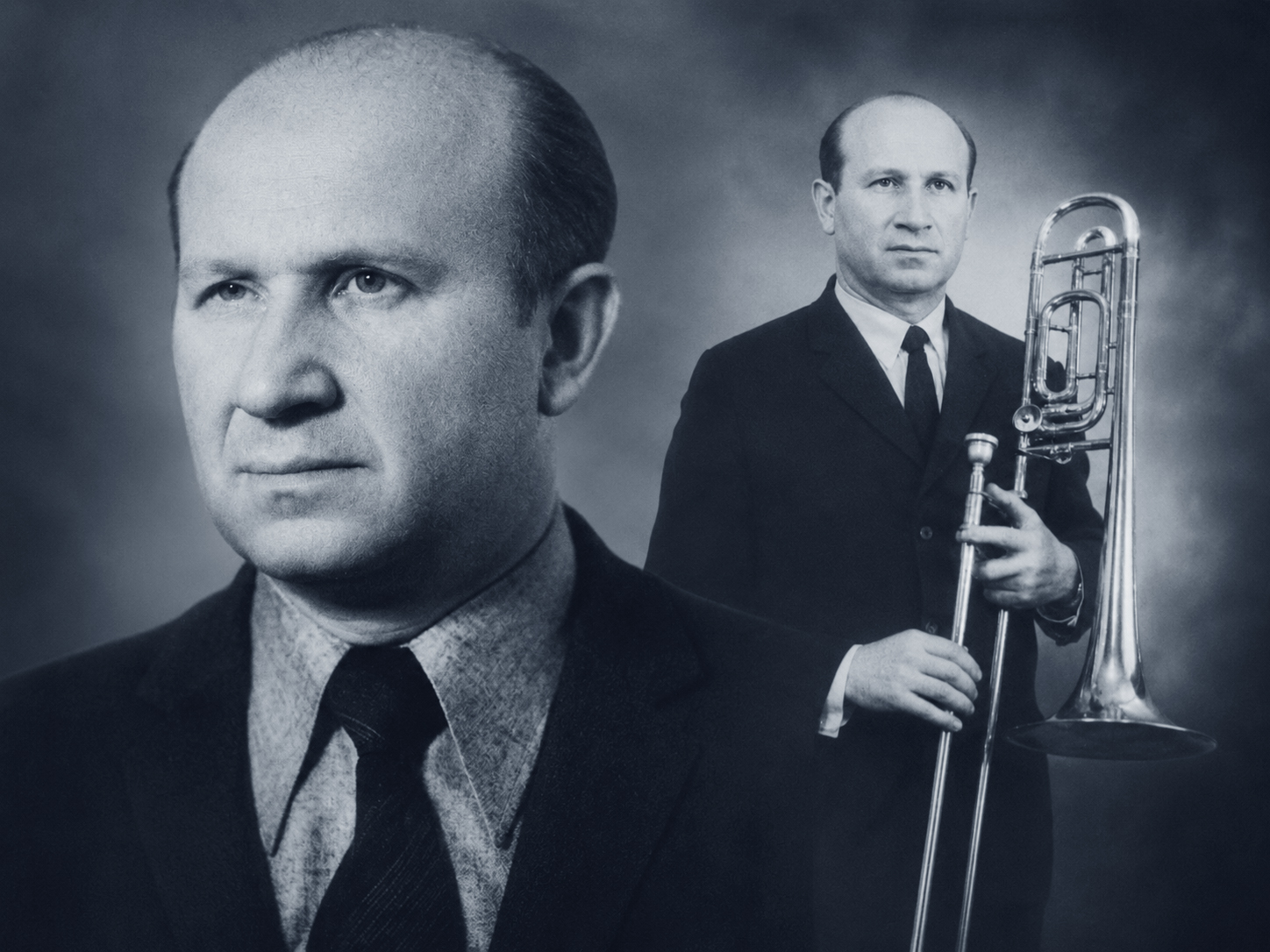
The most important name in trombone circles in the Soviet Union at present is that of the Leningrad trombonist Viktor Fyodorovich Venglovskiy.

As a highly gifted musician and a tireless worker he is making a great contribution to popularising and perfecting trombone playing.

I was fortunate enough to study with Viktor Fyodorovich and teach under him for two years at the Leningrad Conservatoire where he has taught since 1963 and where I saw for myself what a busy musical life he leads and how much effort he devotes to his beloved art.

Although a soloist in one of the world's finest orchestras — the Leningrad Philharmonic Symphony Orchestra, holder of an RSFSR award — since 1950, he does not confine his playing to this. Every year he gives several solo concerts at which he always plays new works, some receiving their first performance in this country. He has provided the initiative for many new works for trombone which have an established place in the Soviet musicians' repertoire.

Seeing great importance in widening the trombone repertoire and keeping it up to date, he not only uses the best foreign pieces but also maintains a tireless search for new material, from classical foreign, Russian and Soviet sources, suitable for arrangement.

He has made the following arrangements for trombone and piano: Grieg, Elegy; Rachmaninov, Elegy; J.S. Bach, Siciliana; Handel, Gigue; Vivaldi, Concerto for 2 Violins and Orchestra, first movement; Shostakovich, Three Preludes and the Romance from the film The Gadfly.

Also, for brass quintet: Tchaikovsky, Elegy; Shostakovich, Prelude and Fugue and Prelude. It is no coincidence that Venglovskiy should write brass quintet arrangements, as he has for several years been a permanent member of a splendid quintet (with V. Malkov, Y. Bol'shiyanov, V. Buyanovskiy and V. Galuzin) which has given interesting concerts in various Leningrad halls.

As well as playing in the quintet, Venglovskiy is also the leader of an excellent and busy trombone quartet, playing works by Beethoven, Bozza, Dondeyne, Serocki, Tomasi, Falla, Kladnitskiy, Boyarskiy and Okunev. The last three of these composers wrote their pieces specially for this quartet, whose skill can be heard to advantage on two recent recordings.

This account of Venglovskiy’s musical activities is all the more impressive if one adds radio and television recordings as well as discs, of which he has now made eight. It would be impossible to list all the composers whose works Venglovskiy has played, they are so numerous.

Some works have been specially written for this outstanding musician, and dedicated to him: the Concertino by Uspenskiy, the Scherzo and Adagio by Okunev, and pieces by Buyanovskiy, Angelov, Yel'cheva, etc.

In addition to his heavy commitments as a performer Venglovskiy is also involved, as a professor at the Leningrad Conservatoire, in passing on his wealth of experience to young people. His achievements in teaching are just as great as in playing.

This is confirmed by the success enjoyed by his students, of whom there have been many over a quarter of a century. Four of his former students work at the Bolshoi Theatre in Moscow: A. Skobelev, who was also the winner of the Geneva international competition in 1973; A. Morozov, V. Golikov and V. Pachkayev.

At the Kirov Opera and Ballet Theatre in Leningrad: N. Novikov, V. Maslov, A. Shutov and N. Timofeyev; R. Krasner at the Malyy Opera and Ballet Theatre in Leningrad; Y. Bryndin at the Kiev Opera and Ballet Theatre; S. Ivanov at the Minsk Bolshoi Opera and Ballet Theatre, etc.

Many of Venglovskiy’s former students also now teach, passing on their teacher's wealth of experience. Amongst these are A. Skobelev at the Moscow Conservatoire, T. Adamavichus at the Lithuanian State Conservatoire, the present author at the Odessa State Conservatoire, etc.

Venglovskiy's success as a performer and teacher is due to his selfless and enthusiastic devotion to his instrument, which he communicates to his students, and the object of his efforts is thus bound to prosper and develop.

A modest and responsive person, he is always ready, despite his heavy workload, to answer any question and help anyone he can. This can be seen from the many contacts he has at home and abroad and from the high esteem in which he is held by the people with whom he maintains these contacts.

This, then, is a brief and incomplete portrait of a great musician and teacher, the international competition prizewinner, Professor Viktor Venglovskiy, a model of selfless devotion to art.

Brass Bulletin 34, II / 1981 pages 23–26

All content is protected by copyright © Brass Bulletin 1981–2026

Share this article

Facebook LinkedIn
Loading…

Questions & Answers

How the Digital Edition works

What does the Digital Edition include?

The Digital Edition brings together the articles already digitized as searchable online texts—not simply as scans or PDF files—along with their original illustrations, notes, authorship, issue information, and available translations. Related-article suggestions currently include only this digitized material.

Are the digital articles identical to the originals?

We preserve the original text, language, illustrations, captions, footnotes, and editorial context as faithfully as possible. The presentation is adapted for comfortable online reading, and obvious transcription or scanning errors may be corrected. The substance and character of the published article remain unchanged.

Which languages are available?

Brass Bulletin was published in English, French, and German throughout its history. Italian and Spanish translations were added from issue No. 60 onward.

On the Italian and Spanish sites, articles from issues 1–59 are therefore shown in English by default.

How often are new articles added?

New articles are added almost daily, with approximately one complete issue digitized each week. The pace may vary depending on the preparation, image work, and editorial checking required.

Why aren’t all articles available digitally?

The complete Brass Bulletin collection contains 1,246 articles published between 1971 and 2003. The full index is already available online, allowing readers to discover every article in the collection, including those whose complete text has not yet been digitized.

Digitization began in February 2026. Each article is carefully prepared for online reading, checked, and connected to its issue, authors, subjects, and illustrations. At the current pace of digitization, the complete collection is expected to be available online by February 2028.

Why do some references mention articles that are not available yet?

References in the original articles are preserved even when the material they point to has not yet been digitized. This keeps the historical and editorial record intact. As more issues are added to the Digital Edition, an increasing number of these references will lead to articles that can be read online.

Can I suggest an article or report a transcription error?

Yes. If there is an article you would particularly like to see digitized, or if you notice a possible transcription error or missing detail, please contact us. Reader feedback helps us improve the Digital Edition and prioritize useful connections within the archive.

How can I support Brass Bulletin?

Your support helps fund the preparation, verification, and online publication of the complete collection.

Subscribe to the Digital Edition

Prefer to support us without subscribing?

Make a donation

Search Brass Bulletin.