Discoveries for brass players, once a month. Join our free newsletter →

4 min. read

This article is free.

Gregory Cass

Horn and soul

Gregory Cass

Gregory Cass

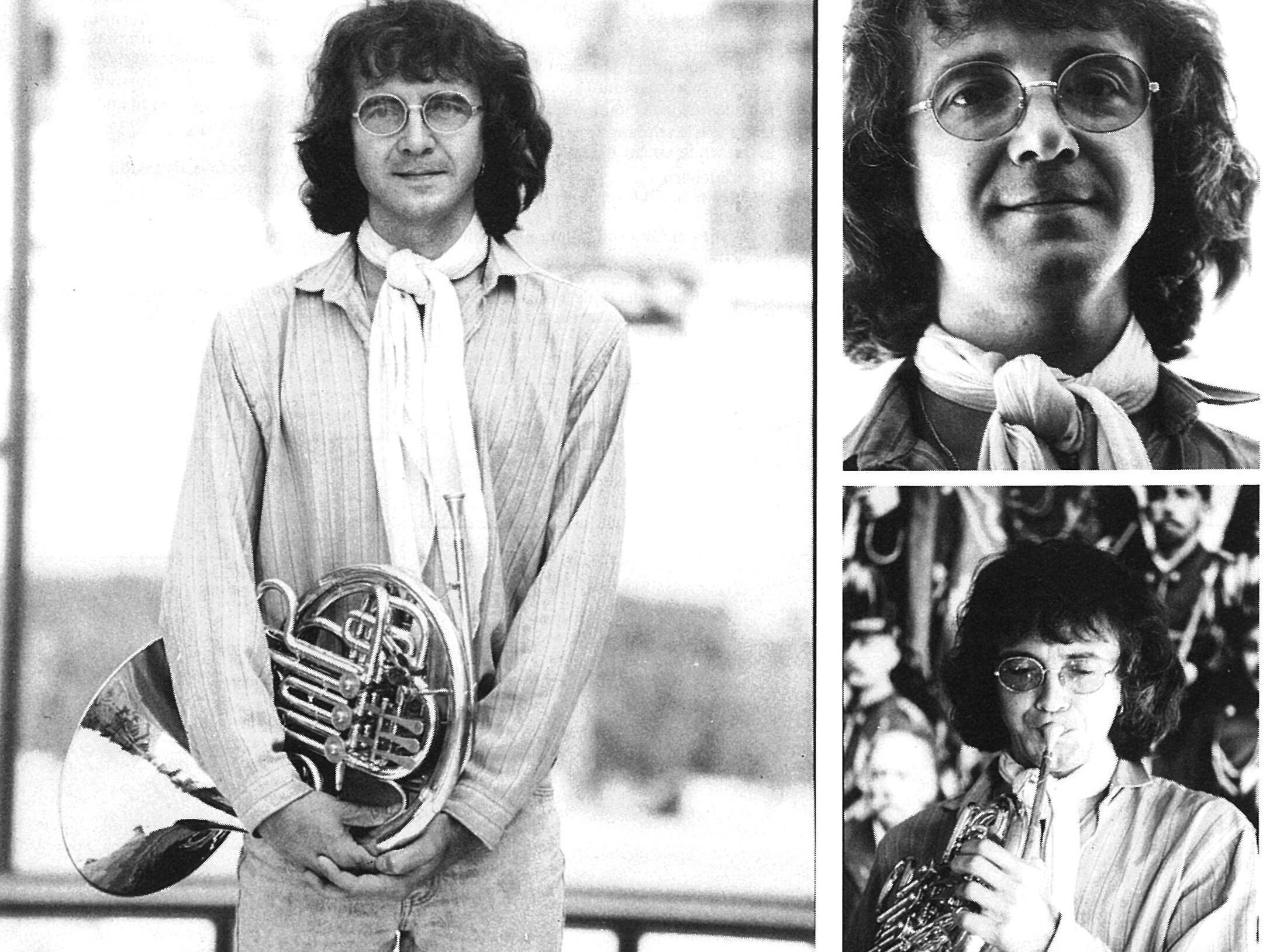
Gregory Cass’s career is an example of the fact that talent in its raw state is not enough to make a long career and that thought and study are the indispensable ways to establish and maintain a musician’s mental and physical balance

The beginnings

Greg was born on 13th August 1952 in Bury St. Edmunds, in Suffolk in south-east England, into a family of amateur musicians. He entered the world of music at the age of 8 with a cornet, then tried all the instruments imaginable without finding one that suited him. He stopped all musical activities when he was twelve. But fate was to reclaim him... When he was 15 he was asked to play a missing instrument in his school orchestra — the horn! Three months later, and for two years, he was to play with the Suffolk Youth Orchestra. The atmosphere of these sessions gave him a glimpse of what a musician’s life can be and he developed a taste for playing. Then came his decisive meeting with Ifor James, the great British virtuoso, who by a happy coincidence was teaching in Colchester, close to where Greg lived, which spared him the necessity of going to London, which is expensive and distracting.

Meteoric rise

Greg started to study with Ifor James in September 1970. A year later he had already obtained a certificate. In 1973 he was appointed 1st solo horn at the Suisse Romande Orchestra in Geneva, a post he still holds. This renowned orchestra had a very open policy which involved taking the risk of appointing very young virtuosos with little professional experience. Greg was 21; Michel Becquet, his opposite number on trombone, had just turned 18. Greg was on the crest of a wave. Talent, youth and success made him an object of admiration. He bought a house over the border in France and worked hard on it with the aim of finding and maintaining the internal balance so necessary for holding the exposed position of a soloist.

Pause for reflection

In 1976 he met Bruno Schneider¹, then studying in Dortmund (FRG) with Michael Höltzel, one of the great German masters of horn teaching. Greg realised that his natural talent had made him treat a certain number of important steps superficially. Further meetings and discussions triggered a fresh awareness. The life of an orchestral soloist is not as simple as all that. With age tensions appeared and nerves increased. Something had to be done!

When I started, everything was too easy. I finally realised I had to organise my practice and learn to practise intelligently. I was fed up being a slave to my instrument and I was determined to do anything that would enable me to play my instrument for as long as possible. So I started by taking stock and letting the questions surface. What is it that’s really difficult? Not necessarily a passage with lots of notes but, for example, playing well something easy. That’s already a whole programme, a whole philosophy. I eventually started a serious detailed study of the etudes of Kopprasch and other masters who have bequeathed to us the keys of mastery. Nothing too difficult (generally speaking, in the music world, people practise things that are too difficult) I established a warm-up system and developed my own artistic conception of sound and style.

In 1978 Gregory Cass was appointed to the Geneva Conservatoire populaire de Musique, an institution which is particularly dynamic and open to many sources of thought which make it possible to provide subtly varied, sensitive and sensible teaching. It was there that he discovered the Alexander technique which helped him enormously.

A musician is often his own enemy! Why is there such a drop in standards among musicians who played very well at 20? An instrumentalist’s characteristics change constantly, seldom for the better, especially if he doesn’t take care. A talented brass player can make a spectacular breakthrough in a few years whereas string players, for example, have to spend many years acquiring the necessary skill.

This kind of thinking gradually revealed to him the serious deficiencies in brass teaching. His personal research and the problems inherent in every pupil combined to produce a fruitful educational experience (Gregory Cass has guided many pupils to success).

Deficiencies in teaching

There’s something wrong in brass teaching. Why do people want at all costs to start by producing a sound? That’s the start of the trouble. There’s bound to be too much air, and the seeds of the faults are sown. This excess air will fatigue all the muscles pointlessly. Why not start by clearing the way, by analysing the mechanisms? Why not start by teaching patience? You have to change the state of mind which gives priority to the goal and the result instead of to working on oneself. It is more fruitful to bring a philosophy to bear, to stimulate thought and analysis, than to obey mechanical routines and silly intensive training.

Some advice from Gregory Cass

Warm-up (approx. 15 minutes)

— I use James Stamp’s Warm-ups (especially with the mouthpiece alone), without too much air!
— I start every session exclusively legato
— Then I play slowly, slurred and detached, in a single breath:

A) Major scales
 1) over one octave, descending gradually by semitones;
 2) over two octaves, ascending progressively higher and higher.
B) Minor scales over two octaves in a cycle of fifths or a low octave scale alternating with a high octave scale, detached.
C) Slurs on harmonics, slow, each twice ff and twice pp.

Then I take a break before going on to the studies (Kopprasch, Clarke, Arban (Method), Maxime-Alphonse 1-4 etc.) or my solo repertoire, or else orchestral excerpts.

Gregory Cass’s equipment

Instruments

— Alexander F/B♭ horn (1960) (That’s what I’ve found best!)
— Lawson interchangeable mouthpipes.
— Alexander little high F horn.
— Alexander F/B♭ horn, 3rd valve ascending (An extraordinary instrument, for the B minor Mass by Bach, for example).
— Engelbert Schmidt triple horn.
— Alexander natural horn.

(I sometimes play other horns but that’s rather rare. It’s a pity that people are obsessed nowadays by big bells and large bores. People who care about sound can’t play large bores. Moreover I find it lamentable that people try to play everything on one and the same instrument, especially a high F! That pitch can be useful at times but it should only be used as a last resort.)

Mouthpiece

— Bach no. 11

(But that’s not very important. The essential thing is to find a balance: rim not too wide, cup not too deep.)

Notes

¹ Bruno Schneider is currently solo horn in the same orchestra as Gregory Cass (OSR). He is another example of exceptional young talent. Very soon we will have an opportunity to introduce him in these columns.

Brass Bulletin 61, I / 1988 pages 44–47

All content is protected by copyright © Brass Bulletin 1988–2026

Share this article

Facebook LinkedIn
Loading…

Questions & Answers

How the Digital Edition works

What does the Digital Edition include?

The Digital Edition brings together the articles already digitized as searchable online texts—not simply as scans or PDF files—along with their original illustrations, notes, authorship, issue information, and available translations. Related-article suggestions currently include only this digitized material.

Are the digital articles identical to the originals?

We preserve the original text, language, illustrations, captions, footnotes, and editorial context as faithfully as possible. The presentation is adapted for comfortable online reading, and obvious transcription or scanning errors may be corrected. The substance and character of the published article remain unchanged.

Which languages are available?

Brass Bulletin was published in English, French, and German throughout its history. Italian and Spanish translations were added from issue No. 60 onward.

On the Italian and Spanish sites, articles from issues 1–59 are therefore shown in English by default.

How often are new articles added?

New articles are added almost daily, with approximately one complete issue digitized each week. The pace may vary depending on the preparation, image work, and editorial checking required.

Why aren’t all articles available digitally?

The complete Brass Bulletin collection contains 1,246 articles published between 1971 and 2003. The full index is already available online, allowing readers to discover every article in the collection, including those whose complete text has not yet been digitized.

Digitization began in February 2026. Each article is carefully prepared for online reading, checked, and connected to its issue, authors, subjects, and illustrations. At the current pace of digitization, the complete collection is expected to be available online by February 2028.

Why do some references mention articles that are not available yet?

References in the original articles are preserved even when the material they point to has not yet been digitized. This keeps the historical and editorial record intact. As more issues are added to the Digital Edition, an increasing number of these references will lead to articles that can be read online.

Can I suggest an article or report a transcription error?

Yes. If there is an article you would particularly like to see digitized, or if you notice a possible transcription error or missing detail, please contact us. Reader feedback helps us improve the Digital Edition and prioritize useful connections within the archive.

How can I support Brass Bulletin?

Your support helps fund the preparation, verification, and online publication of the complete collection.

Subscribe to the Digital Edition

Prefer to support us without subscribing?

Make a donation

How is the digitization progressing?

We’re gradually making the Brass Bulletin available online, article by article. You can read newly digitized articles as soon as they’re ready, even before an entire issue is complete.

Visit our Digitization Roadmap to browse recent additions and see estimated availability for upcoming issues. These estimates follow our recent pace and may change.

Search Brass Bulletin.