Discoveries for brass players, once a month. Join our free newsletter →
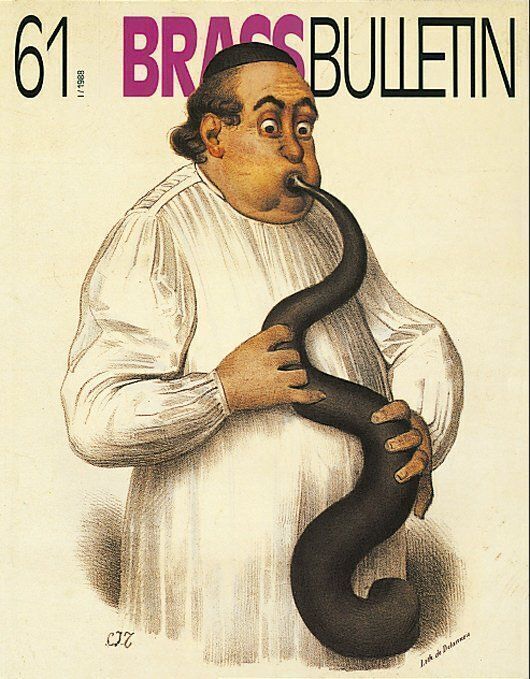
Brass Bulletin 61 - 1 / 1988
Issue
Brass Bulletin No. 61
Date
I / 1988
Pages
128
Contents
14 articles

This issue is still available in print.

CHF 15.00
All issues

Brass Bulletin No. 61

I / 1988

Contents

14 articles
Free

Editorial

Jean-Pierre Mathez

pp. 23–27

In 1987–1988, Brass Bulletin links its growth to five languages with the support of advertisers and subscribers within the international brass community.

Empire Brass Quintet

The road to success

Jean-Pierre Mathez

pp. 30–36 Report

In 1987, the Empire Brass Quintet combines soloistic playing, a wide-ranging repertoire and polished stagecraft as its concert career gains international recognition.

Free

Trumpets of the future

Ole Edvard Antonsen and Gérard Métrailler

Jean-Pierre Mathez

pp. 38–43 Trumpet Competition

Ole Edvard Antonsen and Gérard Métrailler discuss their preparation, performances and results as trumpet prizewinners at the 1987 Geneva competition.

Free

Gregory Cass

Horn and soul

Jean-Pierre Mathez

pp. 44–47 Horn Encounters Teaching

Appointed principal horn in Geneva at 21, Gregory Cass went on to rethink how he practised and brought what he learned into his teaching of brass players.

19th Century Brass Instruments at the Shrine to Music Museum

Margaret Downie Banks

pp. 50–59 History

The Shrine to Music Museum’s collection of more than 1,500 nineteenth-century brass instruments includes European and American examples, from serpents to echo cornets.

Free

Kurt Laberer, instrument maker in Munich

Jean-Pierre Mathez

pp. 60–61 Trumpet Instrument Makers

In 1985, Kurt Laberer took over a Munich instrument repair shop, where he and Werner Pietralla developed a new range of traditional German trumpets.

Part 1

The Alto Trombone

Benny Sluchin

pp. 70–75 Trombone History Equipment

Once a fixture of the orchestral trombone section, the alto fell out of use before returning to the orchestra, with the E-flat instrument the most widely used of several types.

Hakan Hardenberger

The conquest of the future

Jean-Pierre Mathez

pp. 76–79 Trumpet Encounters

Hakan Hardenberger recalls how Paul Sacher’s commission became Endless Parade and how he prepared for the 1987 premiere of Birtwistle’s work for trumpet, strings and vibraphone.

The Millière Trio

Brass players, a family story

Jean-Pierre Mathez

pp. 82–85 Encounters

The Millière brothers took up trumpet, trombone and horn under their father’s guidance, trained in Troyes and Paris, and formed a brass trio in 1977.

Periodontal disease in brass players

Robert Coutet

pp. 88–90 Health

After treatment for periodontal disease allowed tubist Robert Coutet to play again, he drew on his experience to make the case for dental care among brass players.

Doctor Mouthpiece Series • Part 4

Flesh meets metal 3

The rim bite

John Stork, Phyllis Stork

pp. 91–92 Equipment

The inner edge and outer contour of a brass mouthpiece rim affect how it plays and feels, making the player’s lip shape a practical guide to choosing a rim.

Brass Techniques Series • Part 8 – End

Arms, Hands, Fingers

Jean-Pierre Mathez

pp. 94–96 Technique

A relaxed hold and precise valve or slide action help brass players articulate cleanly, while practising the movements slowly without playing can improve control.

Part 4 – End

Jazz Improvisation

The melodic minor scale 2

Charlie Shoemake

pp. 98–101 Repertoire Teaching

The fourth instalment of Charlie Shoemake’s jazz method uses recorded solos and an exercise in all keys to show how melodic minor works over dominant seventh chords.

Bob Malone

U.S.A. Profile

Thomas Stevens

pp. 103 Instrument Makers

In Los Angeles, Bob Malone made his name modifying trumpets and designing custom leadpipes, and one of his C trumpet conversions appears on Hakan Hardenberger’s debut album cover.

Loading…

Questions & Answers

How the Digital Edition works

What does the Digital Edition include?

The Digital Edition brings together the articles already digitized as searchable online texts—not simply as scans or PDF files—along with their original illustrations, notes, authorship, issue information, and available translations. Related-article suggestions currently include only this digitized material.

Are the digital articles identical to the originals?

We preserve the original text, language, illustrations, captions, footnotes, and editorial context as faithfully as possible. The presentation is adapted for comfortable online reading, and obvious transcription or scanning errors may be corrected. The substance and character of the published article remain unchanged.

Which languages are available?

Brass Bulletin was published in English, French, and German throughout its history. Italian and Spanish translations were added from issue No. 60 onward.

On the Italian and Spanish sites, articles from issues 1–59 are therefore shown in English by default.

How often are new articles added?

New articles are added almost daily, with approximately one complete issue digitized each week. The pace may vary depending on the preparation, image work, and editorial checking required.

Why aren’t all articles available digitally?

The complete Brass Bulletin collection contains 1,246 articles published between 1971 and 2003. The full index is already available online, allowing readers to discover every article in the collection, including those whose complete text has not yet been digitized.

Digitization began in February 2026. Each article is carefully prepared for online reading, checked, and connected to its issue, authors, subjects, and illustrations. At the current pace of digitization, the complete collection is expected to be available online by February 2028.

Why do some references mention articles that are not available yet?

References in the original articles are preserved even when the material they point to has not yet been digitized. This keeps the historical and editorial record intact. As more issues are added to the Digital Edition, an increasing number of these references will lead to articles that can be read online.

Can I suggest an article or report a transcription error?

Yes. If there is an article you would particularly like to see digitized, or if you notice a possible transcription error or missing detail, please contact us. Reader feedback helps us improve the Digital Edition and prioritize useful connections within the archive.

How can I support Brass Bulletin?

Your support helps fund the preparation, verification, and online publication of the complete collection.

Subscribe to the Digital Edition

Prefer to support us without subscribing?

Make a donation

How is the digitization progressing?

We’re gradually making the Brass Bulletin available online, article by article. You can read newly digitized articles as soon as they’re ready, even before an entire issue is complete.

Visit our Digitization Roadmap to browse recent additions and see estimated availability for upcoming issues. These estimates follow our recent pace and may change.

Search Brass Bulletin.