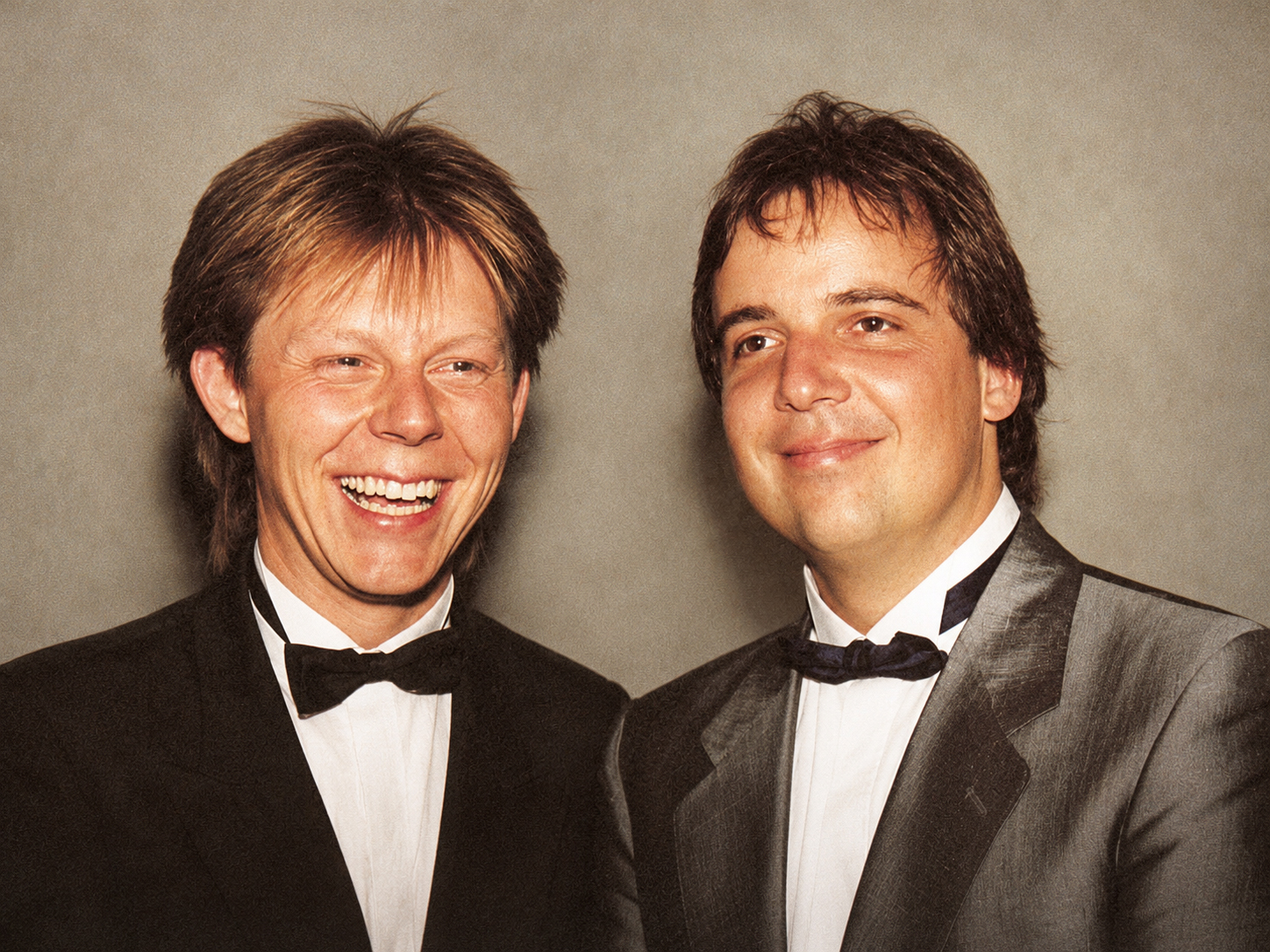
O.A.: I was pleased, but overcome with nerves!
G.M.: That was the moment when I hoped to reach the final. The tension increased but so did the motivation and stimulation.
B.B.: How was your experience of the second round?
O.A.: I was no longer thinking of anything but doing as well as possible. I tried to persuade myself that I was about to play in a concert rather than a competition. The acoustics worried me a little. I wondered whether I had overestimated my strength (the Honegger is a real killer). But once I was on the platform, I felt on form. After I played, I didn’t listen to anyone (apart from my friend Agnas) and I took nothing more to do with the other competitors.
G.M.: For me the tension was less than in the first round and I felt distinctly more comfortable playing Enesco and Henze. But obviously I was overcome by uncertainty again and I waited anxiously for the results. I listened to three other semifinalists, but without worrying too much about them.
B.B.: In your opinion, was the orchestral excepts test with the orchestra wise?
O.A.: [smiles]. I found myself in a familiar situation such as I experience every day in Oslo. I was happy to be in the final.
G.M.: It was a difficult round, a new facet to master.
B.B.: After that first half of the final did you have any inkling of the final placing?
O.A.: I was trying not to think about it. I didn’t want to know.
G.M.: I realised that Ole was very sure and that Forman was a little less so. I felt the same thing during the two days we spent together.
B.B.: And at the final confrontation, with the Arutiunian concerto?
O.A.: I had a problem with my 1st valve and that preoccupied me throughout the second part of the performance. My concentration was shaken. What a relief at the end! That was when I realised what nervous tension I’d been under in the last few days.
G.M.: For me it was a double test since the orchestra accompanying me was the one that had taken me on a year before. It was a very special situation. I was torn between fear and pleasure. To begin with I was a bit surprised by the acoustics but I was able to handle it. Overall I was happy with my interpretation.
B.B.: How do you rate this 1987 competition as regards organisation and atmosphere?
O.A.: Very good, apart from a few details: the rehearsals with the orchestra for the final could have been fixed in advance; that stage was a bit agitated. The time between the rounds was very long... A question of planning.
G.M.: Obviously for me it was perfect — I live in Geneva, I was at home, with the all the advantages that brings.
B.B.: How do you rate the jury?
O.A.: ... [laughs]. Perfect! Yes, perfect! [laughs].
G.M.: I only regret that the competitors didn’t have enough contact with these gentlemen, after the various rounds, for example, and especially after the final, so as to be able to benefit from their personal comments.
Ole Edvard Antonsen
1st prize
was born on 25th April 1962 in Hamar, a small Norwegian town of 17 000 inhabitants 75 miles north of Oslo. His father plays clarinet and saxophone, teaches music and conducts a big band and many wind bands. At the age of 5 Ole came across an old trumpet among his father’s things and started to amuse himself with it. A month later his father gave him a new cornet as a present and gave him lessons on it until he was 10. Then he sent him along with his brother, a year younger and also a trumpeter, to Oslo to great Norwegian trumpeter Harry Kvebaek, who was to follow both their careers (Ole still works with him today). From the age of 10 Ole played in his father’s different groups as well as in the Norwegian Youth Orchestra. He often appeared as a soloist with his brother, who later became more involved with light music and jazz. At the age of 16, still studying with Kvebaek, Ole entered the Oslo Academy of Music, where, three years later, he obtained the highest distinction. He lives in Oslo and works hard in every sector (studios, theatres, big bands etc.). Although often approached about orchestral solo trumpet posts, he prefers his job as 2nd trumpet in the Oslo Philharmonic, which he has held since 1982 and which gives him enough freedom to play wherever he wants and prepare for his solo career.
Gérard Métrailler
2nd prize
was born on 5th october 1961 in Chalais (Switzerland). He took up the cornet at the age of 13 at the village band music school. At the age of 16 he started a precision engineering apprenticeship, while playing with the Brass Band 13 Etoiles. He continued, self-taught, until he was 20 and then enrolled at the Geneva Conservatoire, first with Mario Alberti, who had him change to trumpet, and since 1983 with Michel Cuvit, Paolo Longinotti’s successor as solo trumpet at the Suisse Romande and professor at the Geneva Conservatoire. He obtained his diploma in 1985 and a year later was appointed 1st trumpet doubling solo at the Suisse Romande. Today he is preparing for his virtuoso diploma.