9 min. read
Barry Tuckwell
Interview
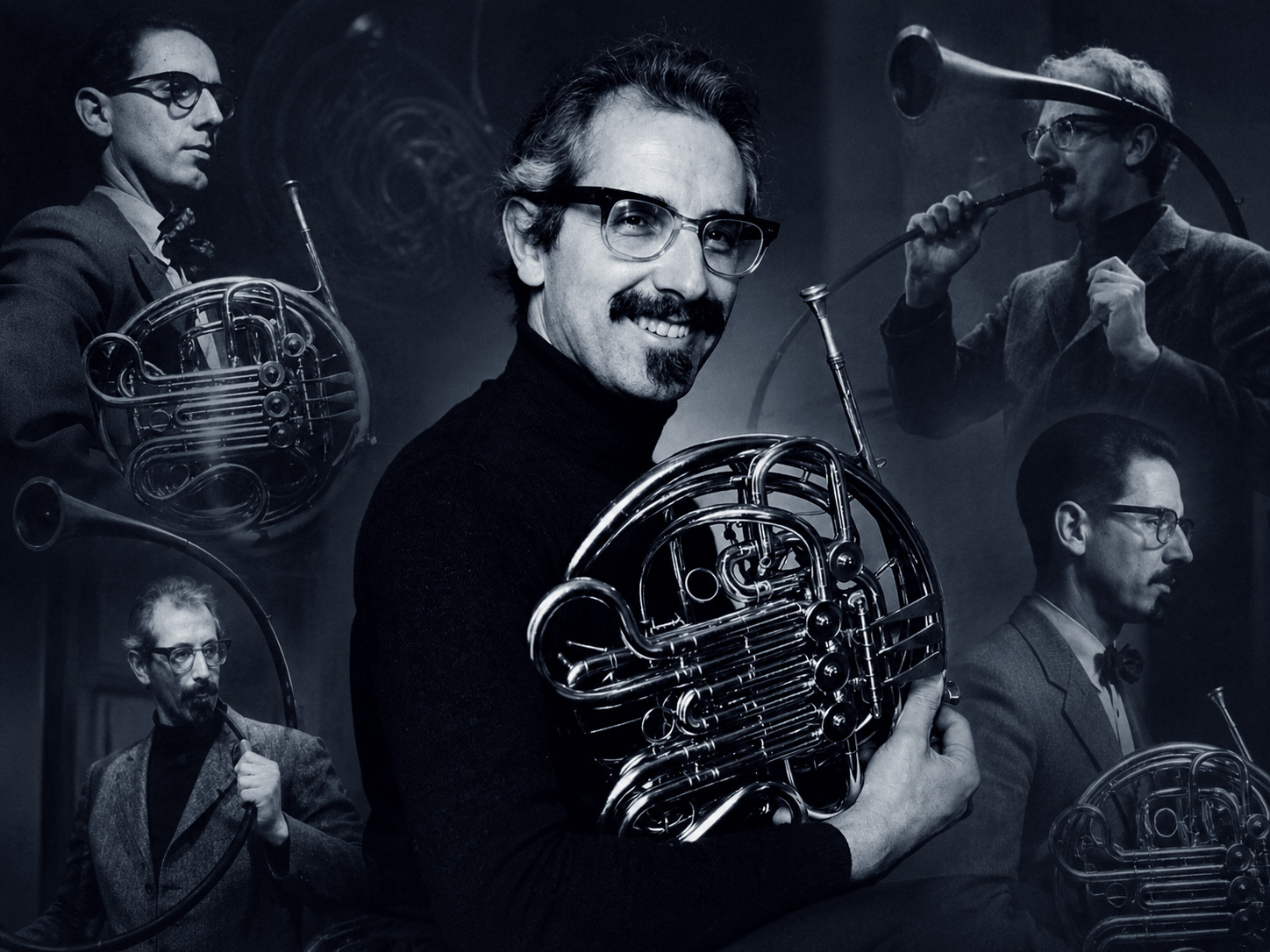
Barry Tuckwell
J.-P. M.: Barry Tuckwell, you're one of the few brass players who is turning all around the world with a brass instrument. How do you explain that this instrument is so seldom in concerts ?
B. T.: Well, all I can say is that I have more concerts offered to me than I can fulfil. So from my point of view it's used a great deal in concerts. But we are very fortunate on the horn, compared to all other wind instruments, in that we have such a rich repertoire of very popular concertos. For instance, we have the four Mozart concertos, we have two Richard Strauss concertos, Weber "Concertino", two Haydn concertos, Telemann and, one can go on of course, but these are the most popular concertos — not counting the contemporary ones which I play a lot. In fact I have just come from this tour in Austria with the Scottish National Orchestra where I played the Thea Musgrave concerto four times: once in Vienna, once in Linz and twice in Graz. This brings up the total number of performances of this concerto to 15 which is very high for a contemporary concerto. And that's only one of the contemporary concertos.
My problem now is to cut down in concerts. I was doing 200 each season. As from the next season I will do much much less and I will only work for nine months of the year and take two big breaks and perhaps one small one here and there...
J.-P. M.: How do you explain that the horn could come so close to the main composers for creating this fantastic repertoire ?
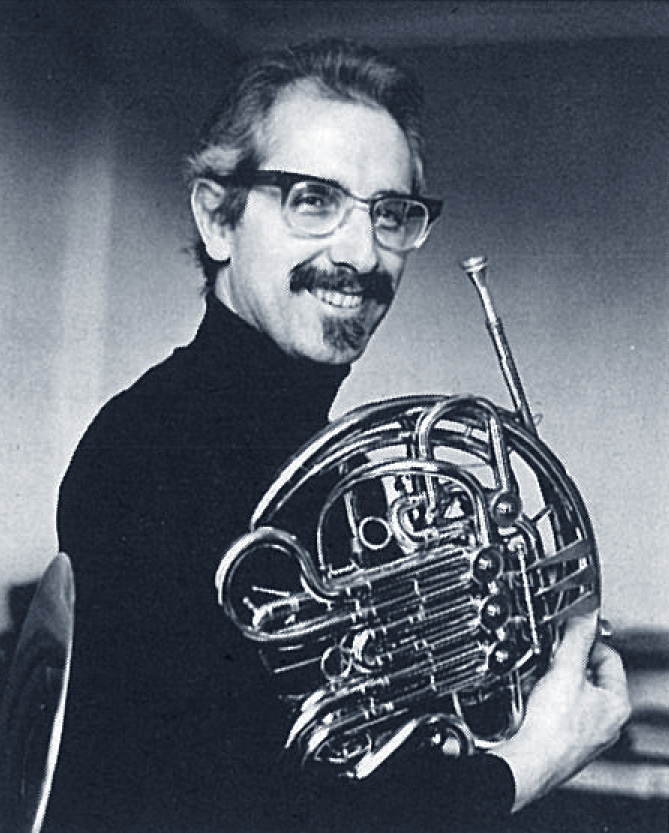
Barry Tuckwell
B. T.: Well there are two reasons. One is that the instrument lent itself to this sort of attention from composers as an instrument. I am thinking now of post-Baroque period because there was not a great deal written for the horn before that. Two or three maybe works of importance but when the hand started to be used it opened up great new avenues. And I think that the sound of the instrument attracted composers, the very lyrical quality, and then the ability to play other than the open notes was very important.
But equally important is the number of players, great virtuoso players that there seemed to be a rash of, particularly in Bohemia. Very few composers will write a work in the abstract, hoping that somebody will play it. Usually they write for particular players. I am thinking now particularly of the orchestra and again in particular of Haydn. Whenever he wrote a particularly difficult horn part in a symphony it was for a particular player, and when one examines him, one finds that he had a separate career from the orchestra as a soloist.
So it is two things, one is the instrument and the other is the outstanding players that there were in this very rich period of the 18th century. Then for some reason, I don't know exactly why, wind instruments went into a decline in popularity, particularly in the latter part of the 19th century. This seemed to be something to do with the development of the orchestra as a richer ensemble, away from the classical period, and in the case of brass instruments, to do with the invention of valves. The composers saw greater possibilities in orchestration. And apart from a few isolated works like the Schumann Adagio and Allegro there was very little written until the 20th century when again it began to emerge as a popular instrument.
J.-P. M.: Maybe you could speak a little about your career.
B. T.: I lived in a musical environment. My father and his two brothers and his sister were all outstanding musicians and all had perfect pitch. And my father and aunt played as a duo, as child prodigies. He played in the Sydney Town Hall at the age of five, playing piano solos so it was that sort of family that I grew up in. And he was a professional pianist and organist and so it was natural that I should develop musically.
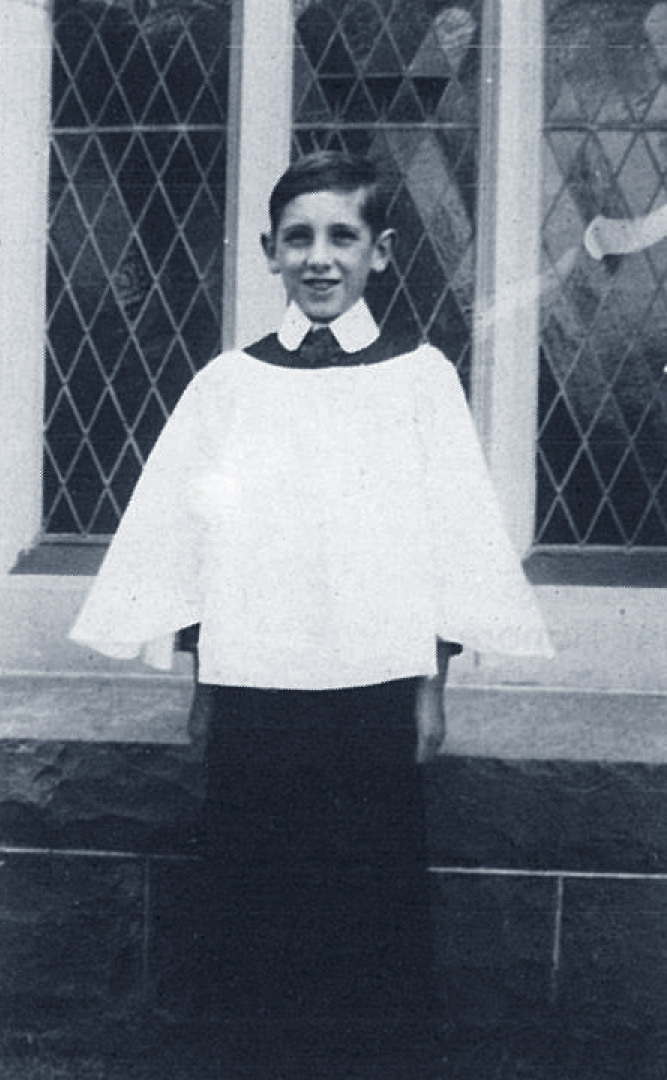
Barry Tuckwell aged 9
St. Andrew’s Cathedral Choir School — Sydney, Australia
J.-P. M.: You were born in Sydney?
B. T.: In Melbourne, Australia in 1931. And I studied the piano, which was logical because there was one in the house. I could read music first, before I could read words, well I was more interested. And I studied violin and the organ, but it wasn't until I started on the horn that I felt there was a potential for me as an instrumentalist. I knew I didn't have sufficient ability on those other instruments to become professional.
The horn was something that I took to and because I could already read music there was no great problem. All I had to do was learn the instrument as such. The musical side was already taken care of. What did concern me was the aspect of transposition because having perfect pitch I was unable, and am still unable, to play on any keyboard instrument that is in the wrong key, say a semi-tone flat. It's all right until I put the first chord down and then it's all the wrong sound and I don’t know what to do and I thought this would be the problem with the horn. But in fact it's easy, because of course, the instrument remains in the same key and transposition, in fact, is I think the easiest part of horn playing.
J.-P. M.: Do you remember how you first chose the horn and do you remember your first contact with the horn ?
B. T.: Well, I didn't choose it. It in fact was chosen for me because... my sister was still a student then, and her fellow students — people like Charlie Mackerras and Richard Merewether, were all good friends and they said, "well look, he's musical, he must be able to play something." And in fact Richard Merewether lent me an instrument and gave me my first lessons. Then I went on from there. It wasn't that I thought that "I must play that instrument, it's the most beautiful sound I have ever heard". I really didn't want to play it, but once I started I found that I had a good ability and so I became enthusiastic and as soon as I left school I took up the position of third horn in the Melbourne Symphony Orchestra.
But before that I had already played, many times, in the Sydney Orchestra and the Melbourne Orchestra too, but I must have been then fifteen. I certainly was playing professionally when I was fourteen, six months after starting to play the instrument. As I say, all I had to think about was the aspect of technique and also, compared to piano music it is much easier because there is only one note at a time and it goes much slower so you have time to think a bit.
I certainly remember the first piece I played. It was the Seraglio Overture of Mozart in a student orchestra of course. And I remember being bewildered by the amount of noise there was sitting within an orchestra. I played in the Melbourne Orchestra, when I was sixteen, and then went to Sydney and played there for three and a half years.
And then my teacher, Alan Mann, and the conductor, Sir Eugene Goossens said that I should get experience abroad. They said I should go and see what was happening elsewhere, so I got on a boat and went to England. I stayed in London a few months, just looking and listening to concerts, and I had a wonderful time. I remember a concert with Furtwängler conducting the Bruckner Seventh Symphony, that was the first half of the concert. The second half Edwin Fischer played the Emperor Concerto. I went to hear Rosenkavalier conducted by Eric Kleiber, so I had a very fruitful time.
And then I got a job in a summer orchestra in Buxton, which is a spa in England. From there I went to the Hallé Orchestra in Manchester, then I came to this orchestra, the Scottish National Orchestra, that was twenty-five years ago. I left the Scottish National Orchestra to go to Bournemouth simply because that was a first horn position, it was my first job as a first horn player.
J.-P. M.: How old were you then?
B. T.: I was 23. A year later the London Symphony Orchestra position became vacant and I went and gave an audition. I remember that very clearly, it was in the Albert Hall and there were no lights. I could have been on the moon, I had no idea where I was, I stayed there for 13 years.
J.-P. M.: And then ?
The conversation continues with Barry Tuckwell’s reflections on orchestral life, solo performance, interpretation, phrasing, audience perception and the physical realities of horn playing.
Brass Bulletin 27, III / 1979 pages 71–79
All content is protected by copyright © Brass Bulletin 1979–2026