Explore institutional access →

3 min. read

Maurice André, better than ever!

Maurice André, better than ever!

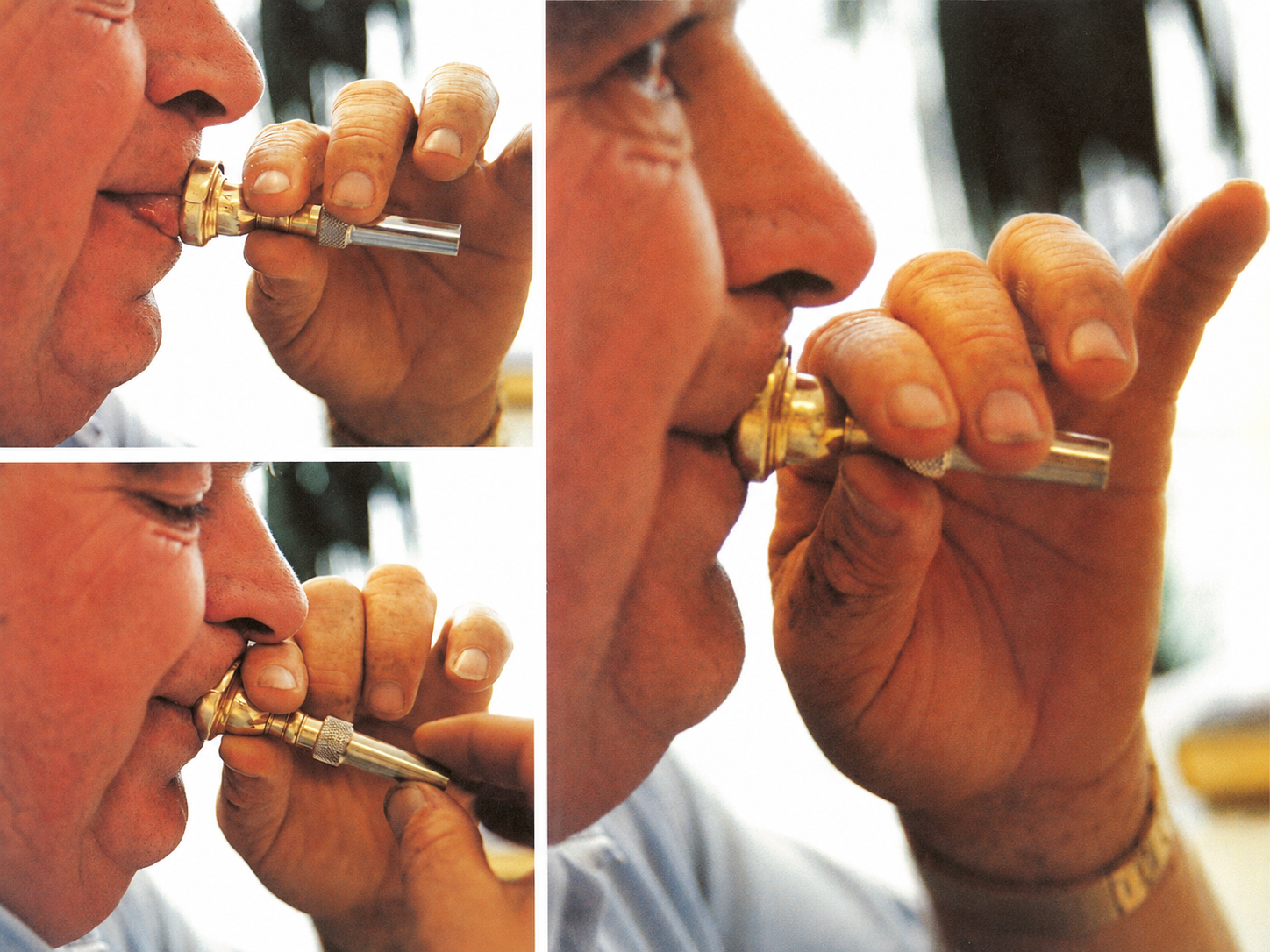
Embouchure and — very characteristic of Maurice André — the tongue test before the mouthpiece is finally positioned

Holding the mouthpiece in the left hand (very supple) and analysing the buzz

All the senses alert (mouth, fingers, eyes) to evaluate the quality of the vibration

Two landmarks in 1987 and 1988 in the continuing story of the great French trumpeter’s career: his appearance on the French television programme Grand Echiquier on 28th October 1987 and the “Maurice André” International Trumpet Competition to be held in September 1988, organised by the city of Paris.

(Article on this subject in preparation).

An encore on the Grand Echiquier

One of the most popular TV programmes in the French-speaking countries (with about 20 million viewers) is Jacques Chancel’s “Grand Echiquier” (roughly translated “The Big Stage”) on the French Channel 2. Chancel invites a well known musician (Maurice André this time) to the programme and has him prepare a whole evening’s entertainment (about three hours on screen!), invite his friends or other musicians whom he admires and likes, the whole thing punctuated by his own performances. Maurice André is one of the very few to be asked to appear for a second time within a few years. BRASS BULLETIN asked him a few questions.

BRASS BULLETIN: Two big programmes in the space of a few years! What have you done to make this one different from the first?

Maurice André: In the first Grand Echiquier I gave my condensed musical life story and I had the pleasure of introducing the people who had been important in it (friends from the early days and musician friends). This second programme will be more “artistic”; I’ll be presenting all the masterpieces in the repertoire.

B. B.: How do you prepare for such a long and difficult programme?

M. A.: Basically I’m trying to make the evening into a real music festival. I’ve made up a programme containing all sorts of music and I’m inviting artists who I admire and who are among the most representative of their kind. I aim to find the combination that will give the audience the best possible entertainment. I’m also working on my own musical pieces. I try them out, change them and vary the sound colours before giving my final choice to the producer. I introduce all the trumpets and all the mouthpieces and test my endurance at the same time. I take a break every twenty minutes or so and talk about mutes, for example, or tell a few stories or introduce the great artists I have invited to the programme.

This second Grand Echiquier is going to be a real kick in the teeth (finale from the Telemann sonata; a solo with the Claude Bolling Big Band; a waltz (virtuoso village music); the great Bach works for trumpet, 2nd Brandenburg, extracts from the B minor Mass and the Magnificat; Bellini, Tartini, Haydn, Hummel and Biscogli concertos; some jazz sets with J. M. Defaye; Hora Staccato by Dinicu-Heifetz etc.).

B. B.: Your mastery of the trumpet is virtually complete. Can you pass on a few secrets to our readers, many of whom are also working towards this same coveted perfection?

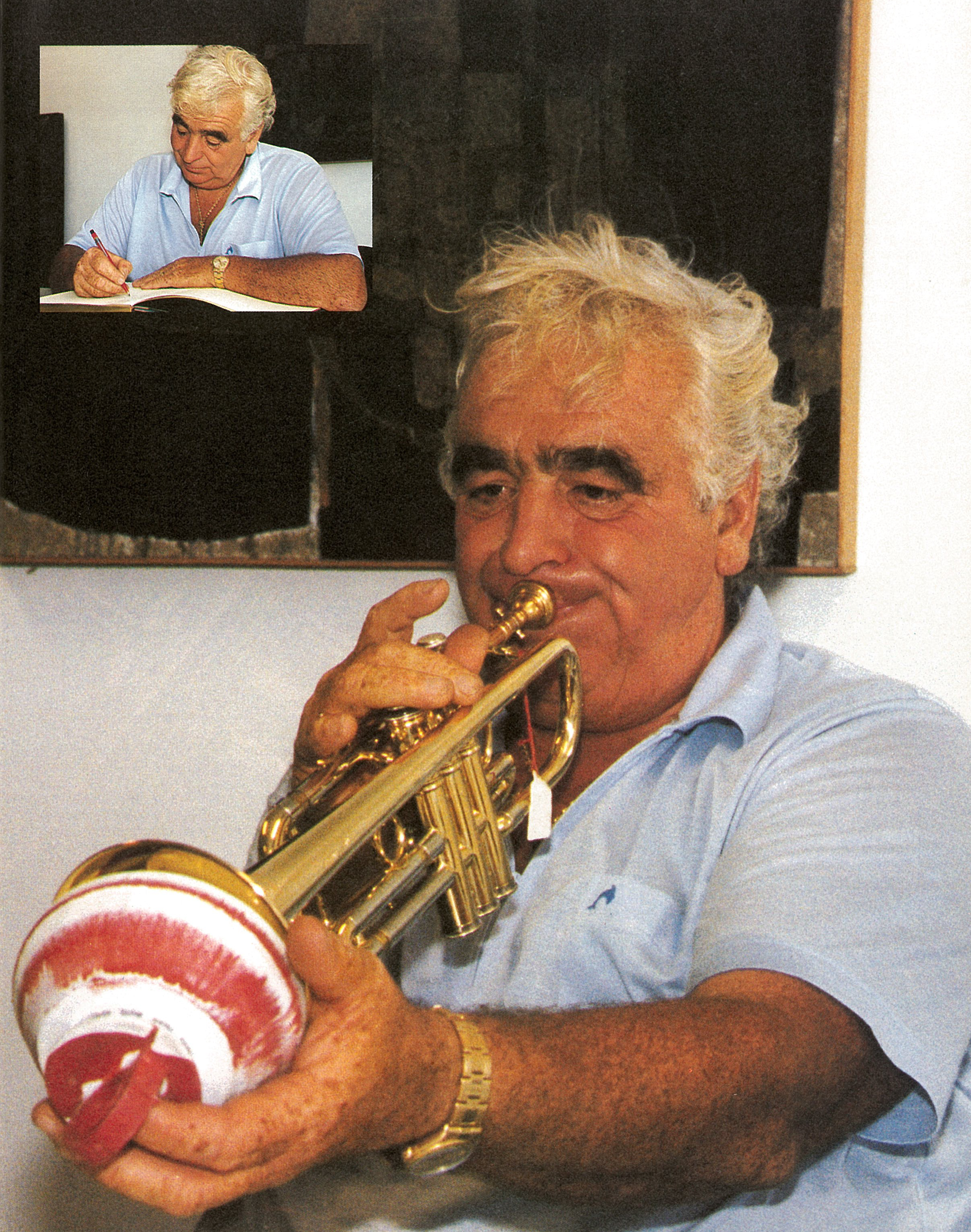
Maurice André

Maurice André

M. A.: In this business, which is physically and psychologically so difficult to master, you have to stay healthy, sleep well and avoid too much alcohol, etc. Personally I have two important places of refuge which help me to stay on an even keel: my family and my manual work (wood-carving¹ and DIY). This enables me to get down to my instrumental work with all the seriousness and concentration necessary.

I easily practise up to five hours a day, especially coming up to a programme like the Grand Echiquier. I reckon I ought to be able to play my whole programme three or four times a day to be absolutely sure of it in performance. Sometimes, knowing how hot it can be on the concert platform or in the studio, I practise in my sauna with the temperature at 35°C [Ed: 95°F!].

Maurice André’s daily warm-up

Morning (approx. 1 hr.)
(The older you get, the longer it takes)

  1. I waken up the muscles and the lips with buzzing exercises and with the mouthpiece alone, taking care to use no pressure on the lips (I don’t worry about the sound at all!).
  2. I move on to the instrument with scale and arpeggio exercises, still very lightly, without pressing and still without worrying about the sound.
  3. I start chord arpeggios over again, but this time looking for good sound. I insist on flexibility, working as slowly as possible. Next I go on to wider and wider intervals (fourths, fifths, single, double and triple octaves), still very slow and pressing as little as possible.
  4. I do no. 3) again staccato.

When that’s done, I can go on (for however long it takes) to my concert programme. I also practise changing instruments and mouthpieces.

Every night, before going to bed, I conscientiously massage my lip muscles with butter, which is rich in vitamin E.

For me the main things in trumpet playing are looking for the right sound and a precise attack.
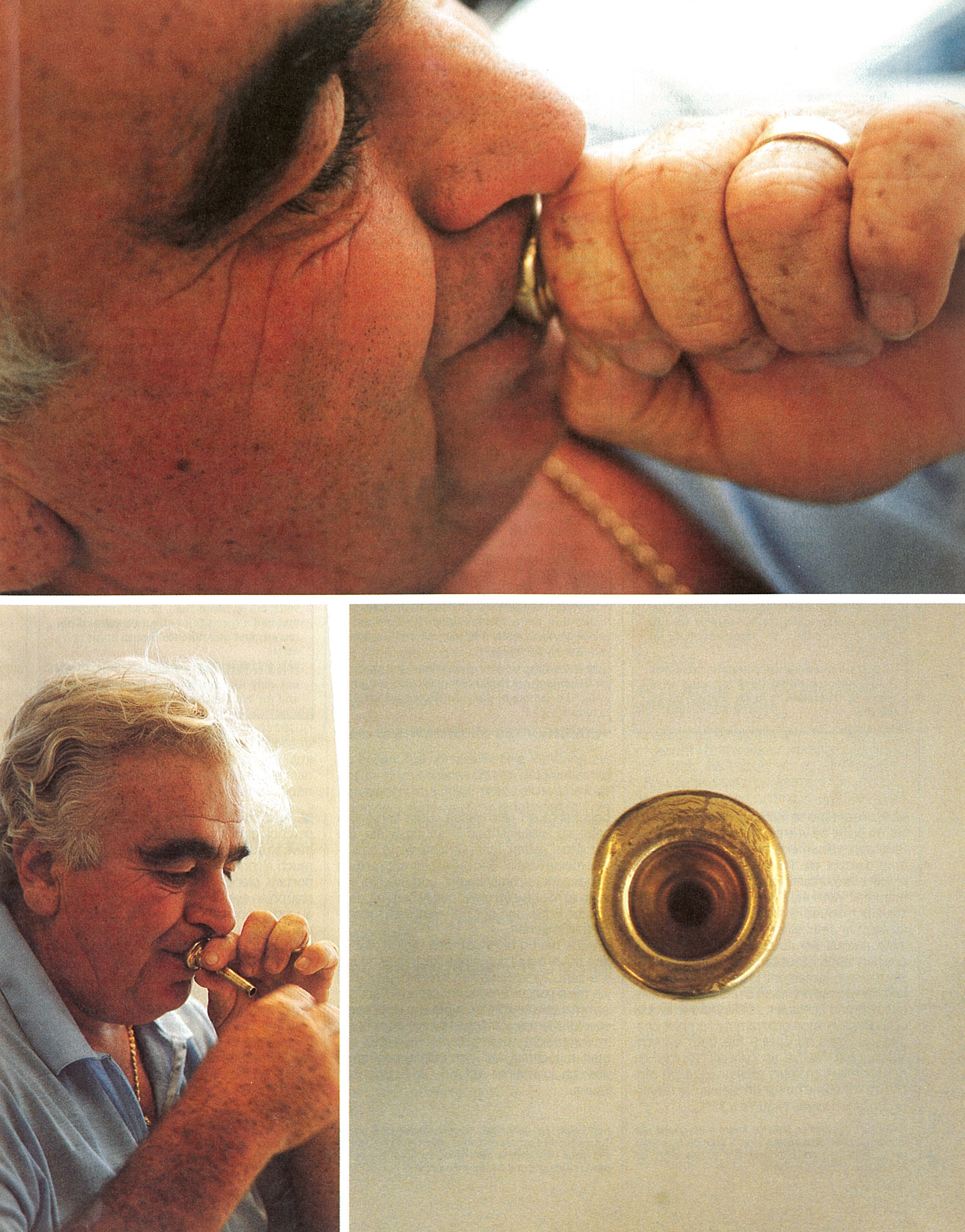
Maurice André’s mouthpiece has been modified (2 mm wider where it rests on the upper lip)

Maurice André’s mouthpiece has been modified (2 mm wider where it rests on the upper lip)

Special changes

In the course of his career Maurice André has changed two basic things about his embouchure:

1) The mouthpiece

As most of the pressure is on his upper lip, he has widened the upper part of his mouthpiece rim by 2 mm.

2) Progressive splaying of the incisors

As the years have passed, the splaying of the central incisors has increased to the point where it has caused problems. He therefore approached a dentist (a highly qualified one, no doubt) to have him plug completely, from in front and behind, the spaces between the two middle upper incisors and their neighbour to the left, with a special ceramic compound. “It’s not beautiful, but it works like magic. My sound production has considerably improved since”, he says with a mischievous smile.

How many people hear Maurice André in a year?

Maurice André gives about a hundred concerts a year to audiences averaging 2,000 people — about 200,000 people a year.

The first Grand Echiquier programme was watched by more than 15 million viewers and had a spectacular effect on sales of his records and on audience figures at his concerts.

It is a remarkable indication of the esteem not only for him but also for the trumpet and for brass instruments in general.

Notes

¹ Over the years Maurice André has developed great skill in this field. He makes many little masterpieces, mostly low reliefs, which give him and his friends great pleasure.

Brass Bulletin 60, IV / 1987 pages 66–72

All content is protected by copyright © Brass Bulletin 1987–2026

Share this article

Facebook LinkedIn
Loading…

Questions & Answers

How the Digital Edition works

What does the Digital Edition include?

The Digital Edition brings together the articles already digitized as searchable online texts—not simply as scans or PDF files—along with their original illustrations, notes, authorship, issue information, and available translations. Related-article suggestions currently include only this digitized material.

Are the digital articles identical to the originals?

We preserve the original text, language, illustrations, captions, footnotes, and editorial context as faithfully as possible. The presentation is adapted for comfortable online reading, and obvious transcription or scanning errors may be corrected. The substance and character of the published article remain unchanged.

Which languages are available?

Brass Bulletin was published in English, French, and German throughout its history. Italian and Spanish translations were added from issue No. 60 onward.

On the Italian and Spanish sites, articles from issues 1–59 are therefore shown in English by default.

How often are new articles added?

New articles are added almost daily, with approximately one complete issue digitized each week. The pace may vary depending on the preparation, image work, and editorial checking required.

Why aren’t all articles available digitally?

The complete Brass Bulletin collection contains 1,246 articles published between 1971 and 2003. The full index is already available online, allowing readers to discover every article in the collection, including those whose complete text has not yet been digitized.

Digitization began in February 2026. Each article is carefully prepared for online reading, checked, and connected to its issue, authors, subjects, and illustrations. At the current pace of digitization, the complete collection is expected to be available online by February 2028.

Why do some references mention articles that are not available yet?

References in the original articles are preserved even when the material they point to has not yet been digitized. This keeps the historical and editorial record intact. As more issues are added to the Digital Edition, an increasing number of these references will lead to articles that can be read online.

Can I suggest an article or report a transcription error?

Yes. If there is an article you would particularly like to see digitized, or if you notice a possible transcription error or missing detail, please contact us. Reader feedback helps us improve the Digital Edition and prioritize useful connections within the archive.

How can I support Brass Bulletin?

Your support helps fund the preparation, verification, and online publication of the complete collection.

Subscribe to the Digital Edition

Prefer to support us without subscribing?

Make a donation

How is the digitization progressing?

We’re gradually making the Brass Bulletin available online, article by article. You can read newly digitized articles as soon as they’re ready, even before an entire issue is complete.

Visit our Digitization Roadmap to browse recent additions and see estimated availability for upcoming issues. These estimates follow our recent pace and may change.

Search Brass Bulletin.