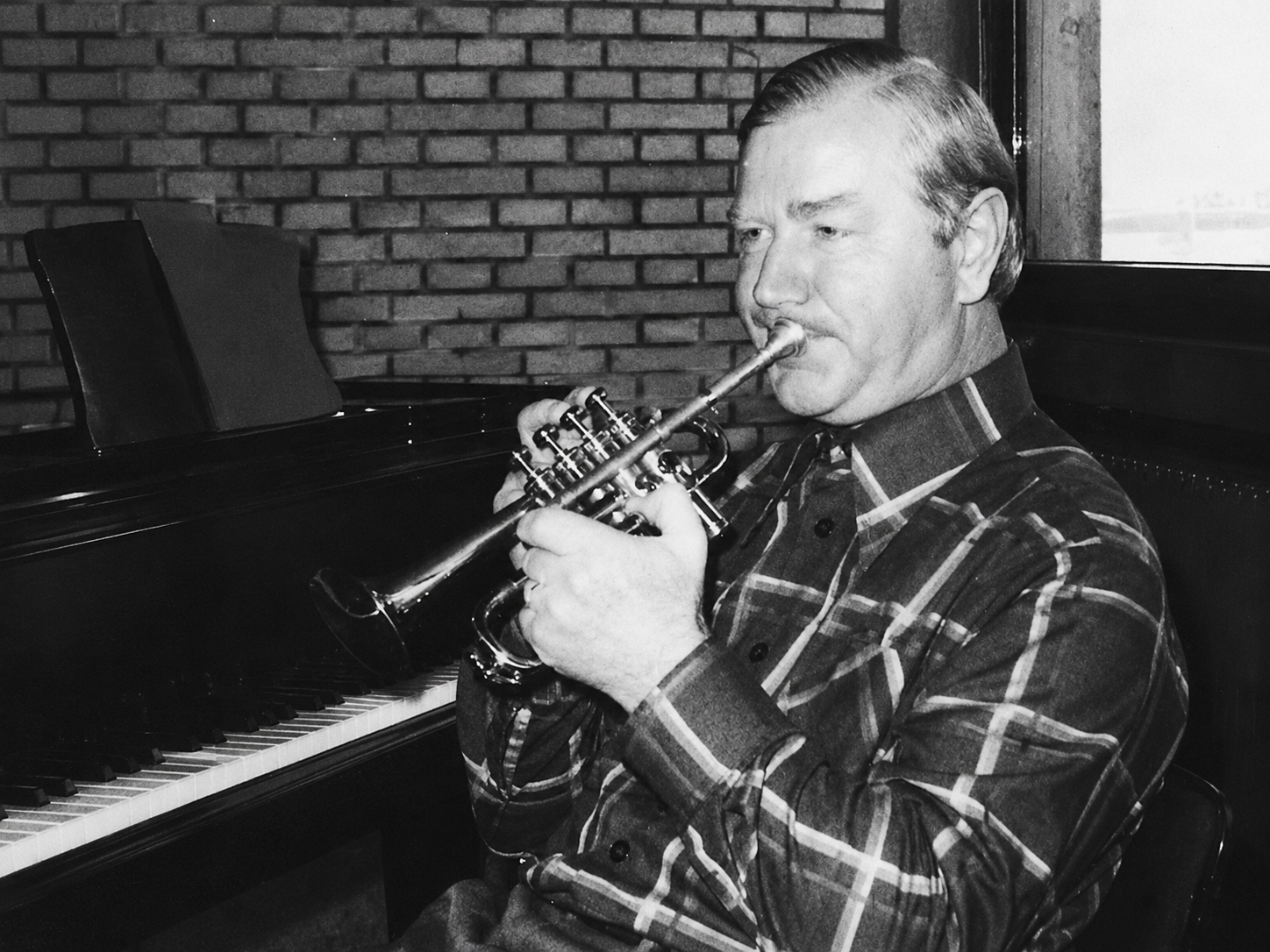
BB: Rolf Quinque, you are one of the brass players of whom it is said that «they know exactly how». Can you describe the path that led you to that point?
RQ: It has been a long way. Already as a child I was interested in the trumpet and at the age of 14 had my first regular lessons. But as a student I realized how strenuous trumpet playing is and I said to myself: «If you have to do this all your life, it won’t be so pleasant.» Furthermore, my teacher confronted me, as a student, with Bach’s difficult trumpet parts. This led me to reflect on embouchure and endurance, because endurance with the high trumpet is limited. In spite of zealous practising I needed every possible rest (for instance in Bach’s B minor Mass). I then began reading all the literature I could find on the subject and spent much time in libraries, learning everything I could about Reiche (J. S. Bach’s trumpeter), Altenburg and other famous trumpeters of past times. Without any doubt they knew how to play very high notes, and they must have played them with ease, otherwise they would never have been able to perform the difficult parts written for them. Thus I found a few indications that led to my present knowledge.
BB: How did you discover the skill of the Old Ones?
RQ: By reading and trying over and over again. Of course, the Old Ones’ methods were not the same as ours. For instance, their diaphragm support was different, because they did not need the strength required to play Bruckner or Strauss. Their tone could be thinner; they did not have to play so loudly. It is along these lines that my thoughts guided my efforts …
BB: And how could you know if you were on the right path with your «new» embouchure?
RQ: First I began to train like a sportsman, in order to strengthen the so-called trumpeter’s muscles (the cheek muscles) and those of the abdomen (diaphragm). For this purpose I developed compulsory exercises, some of which already existed in similar form. I repeated these exercises daily, constantly developing them. Strengthening the abdominal muscular system greatly relieves the lips. But the much-quoted expression «pressureless embouchure» is, in my opinion, nonsense. It should be called: embouchure with gentle pressure.
BB: When were you sure that you were on the right path?
RQ: At first I really believed I was on the wrong path, because the embouchure I had acquired in the traditional way deteriorated instead of improving. I could no longer play the high notes! The transition to the new embouchure was very difficult and not without risks. That is the main reason why many colleagues with fixed engagements cannot afford to attempt such a change, although a few have shown that it is possible even under those circumstances. But I had reached a point of no return: I simply had to continue. So I kept practising until finally I knew I was right and that mastery of the high register is based on athletic training.
BB: How did your practising differ before and after the change-over?
RQ: Formerly, practising and playing were simply a physical strain. Now, after the change-over, I feel like a well-trained sportsman using well-developed muscles. I work more rationally. And with time one becomes more mature — and also more intelligent …
BB: What is the basic conception of your present system of playing?
RQ: The basic conception is the conscious control of breathing and support. Above all, controlled breathing is essential. Then, of course, the abdominal muscles must be strengthened in order to provide the necessary diaphragm support. There are many exercises to achieve this.
BB: Did you develop your own system of physical training?
RQ: Yes — and not only for the abdominal muscles, but also for the cheek muscles. I intend to compile these «daily exercises» and publish them in a book soon.
BB: That will certainly be of great interest to all brass players. Could one say that, thanks to your change-over, you have developed a new approach to instrumental pedagogy?
RQ: Yes — especially for young people. The proof of my idea that strength is not essential for brass playing lies in my young pupils, who, under my guidance, develop surprising skill through relaxed blowing.
BB: Rolf Quinque, your long search for improvement has already helped many musicians on their way. Your activities, your music-making and, above all, your illuminating discoveries make trumpeters feel that there is hope for them too to abandon a tense way of playing and to attain the joy of relaxed music-making. We shall be happy to announce your books to our readers in the near future.
Thank you, Mr. Quinque, and good luck!