Discoveries for brass players, once a month. Join our free newsletter →

4 min. read

This article is for subscribers.

Bernard Soustrot

Portrait
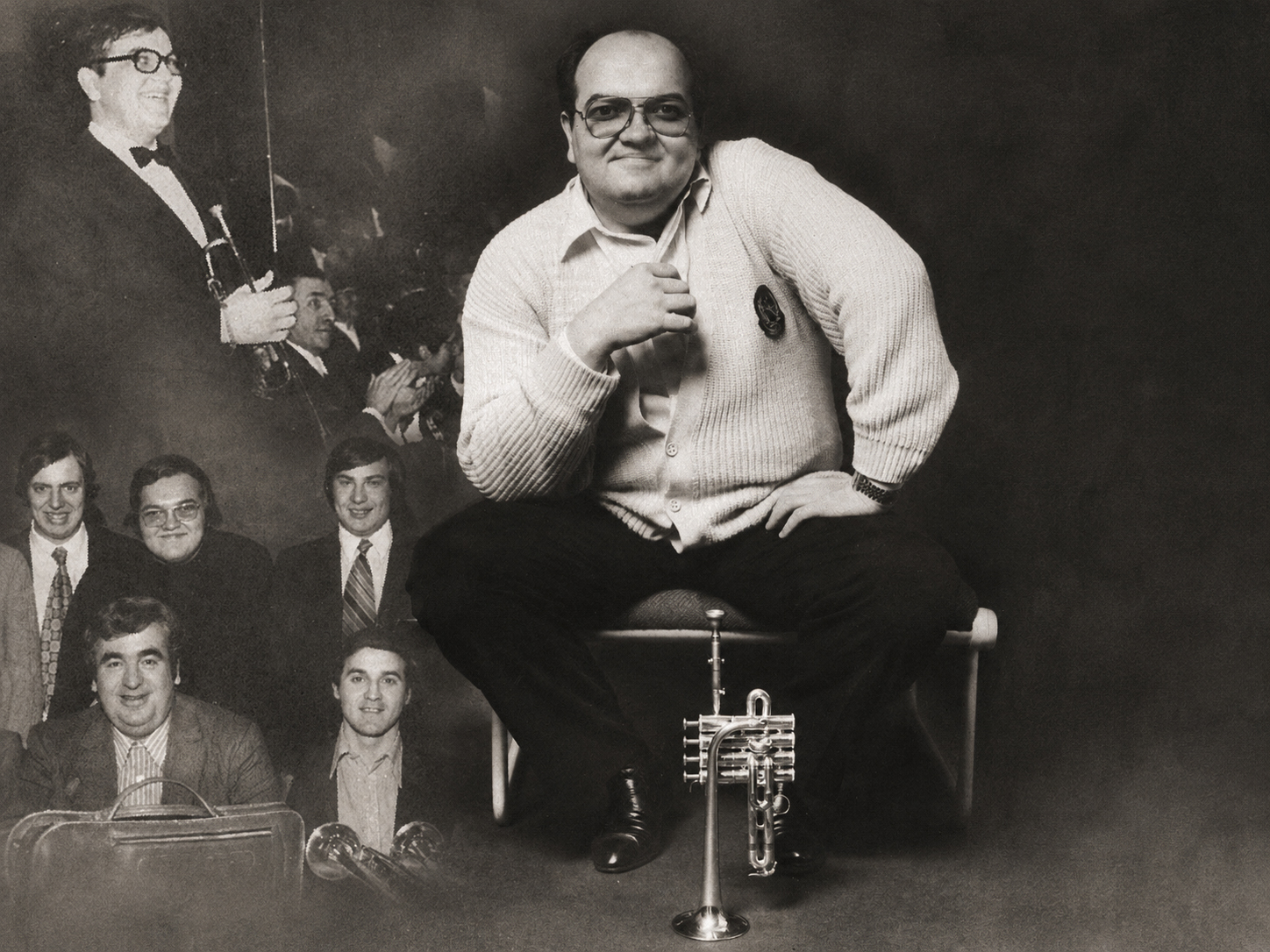
A portrait of trumpeter Bernard Soustrot, from his studies with Maurice Benterfa and Maurice André to an international solo career and the Narbonne brass competition.
Bernard Soustrot

Enthusiasm and admiration for his teacher have turned one of Maurice André’s best pupils into a renowned soloist and dynamic organiser.

Bernard was born in Lyon in 1954. His father and grandfather (trumpet and cornet respectively) were enlightened amateurs and it was his father (who for a long time conducted the Caluire and Rilleux wind bands) who gave him his first lessons. He started the piano at six and theory at nine.

I wanted to be like my father. My first instrument was his trumpet, a “Pihan” (a Lyon maker). But when he played in front of us (my brother Marc¹ and me), he always complained of poor endurance and of difficulty in the high register. One day, while I was playing this old instrument, I decided it really was too much like hard work so, acting on intuition, I poured some water through it. Imagine my surprise when I saw the black unsavoury mess that came out. Afterwards it was like a new instrument.

A few months later he enrolled at the Lamartine Group Music School and studied for a year with René Sapin, then with Maurice Benterfa, who took the job over in 1965. Bernard Soustrot was eleven but the friendship that was to grow between him and Maurice Benterfa was to reach its full fruition in 1986 when they set up the Narbonne International Brass Quintet Competition.

Meanwhile, his new teacher prepared him well. He entered the Lyon Conservatoire in 1967 and left, with his prize, two years later. He prepared for various local competitions before winning the 1st Grand Prix of the "Royaume de la Musique" (a national competition for young musicians) on 27th April 1969 at the age of fifteen. This first success was to enable him to attract attention in Paris.

Inspired by Maurice André

One day Maurice Benterfa, a great friend of Maurice André, took his protégés from Lyon to visit the famous virtuoso’s class in Paris. This was what inspired Bernard. He worked hard to get into the Paris Conservatoire and succeeded in 1971. In 1975 he won a 1st prize there by a unanimous decision. The foundations of his career were being laid — and with impressive speed: 3rd prize at the Prague Competition in 1974; solo trumpet at the South German Radio Orchestra (with Celibidache) in Stuttgart (1975-1976); many solo concerts, with Karl Münchinger among others; 1st prize at the “Maurice André” Competition run by Croisières Paquet; and, at the end of 1976, solo trumpet at the Radio France New Philharmonic in Paris (where he stayed until 1981).

This article is for subscribers.

CHF 5.00 per month · Cancel auto-renewal anytime.

Enjoy unlimited access to all digitized Brass Bulletin articles.

Brass Bulletin 60, IV / 1987 pages 76–79

All content is protected by copyright © Brass Bulletin 1987–2026

Share this article

Facebook LinkedIn
Loading…

Questions & Answers

How the Digital Edition works

What does the Digital Edition include?

The Digital Edition brings together the articles already digitized as searchable online texts—not simply as scans or PDF files—along with their original illustrations, notes, authorship, issue information, and available translations. Related-article suggestions currently include only this digitized material.

Are the digital articles identical to the originals?

We preserve the original text, language, illustrations, captions, footnotes, and editorial context as faithfully as possible. The presentation is adapted for comfortable online reading, and obvious transcription or scanning errors may be corrected. The substance and character of the published article remain unchanged.

Which languages are available?

Brass Bulletin was published in English, French, and German throughout its history. Italian and Spanish translations were added from issue No. 60 onward.

On the Italian and Spanish sites, articles from issues 1–59 are therefore shown in English by default.

How often are new articles added?

New articles are added almost daily, with approximately one complete issue digitized each week. The pace may vary depending on the preparation, image work, and editorial checking required.

Why aren’t all articles available digitally?

The complete Brass Bulletin collection contains 1,246 articles published between 1971 and 2003. The full index is already available online, allowing readers to discover every article in the collection, including those whose complete text has not yet been digitized.

Digitization began in February 2026. Each article is carefully prepared for online reading, checked, and connected to its issue, authors, subjects, and illustrations. At the current pace of digitization, the complete collection is expected to be available online by February 2028.

Why do some references mention articles that are not available yet?

References in the original articles are preserved even when the material they point to has not yet been digitized. This keeps the historical and editorial record intact. As more issues are added to the Digital Edition, an increasing number of these references will lead to articles that can be read online.

Can I suggest an article or report a transcription error?

Yes. If there is an article you would particularly like to see digitized, or if you notice a possible transcription error or missing detail, please contact us. Reader feedback helps us improve the Digital Edition and prioritize useful connections within the archive.

How can I support Brass Bulletin?

Your support helps fund the preparation, verification, and online publication of the complete collection.

Subscribe to the Digital Edition

Prefer to support us without subscribing?

Make a donation

How is the digitization progressing?

We’re gradually making the Brass Bulletin available online, article by article. You can read newly digitized articles as soon as they’re ready, even before an entire issue is complete.

Visit our Digitization Roadmap to browse recent additions and see estimated availability for upcoming issues. These estimates follow our recent pace and may change.

Search Brass Bulletin.