Discoveries for brass players, once a month. Join our free newsletter →
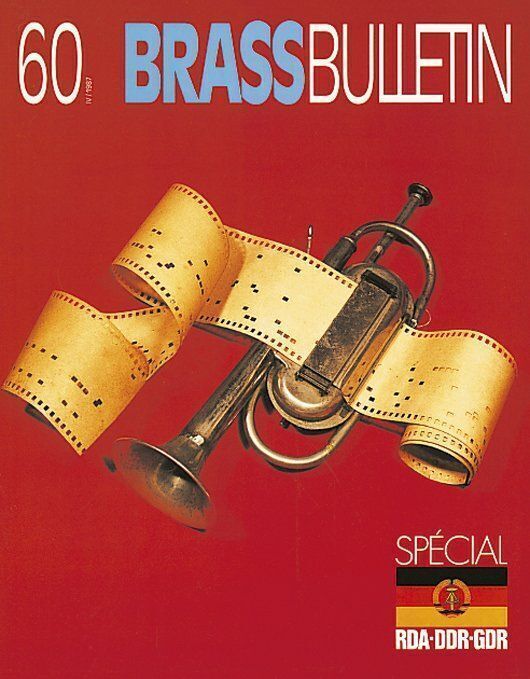
Brass Bulletin 60 - 4 / 1987
Issue
Brass Bulletin No. 60
Date
IV / 1987
Pages
120
Contents
15 articles

Out of print

All issues

Brass Bulletin No. 60

IV / 1987

Contents

15 articles
Free

Editorial

Jean-Pierre Mathez

pp. 3–7

Brass Bulletin opens 1987 with a focus on East Germany’s musical heritage and welcomes Italian and Spanish translations to its international brass community.

Free

The Miracle Mouthpiece

A Christmas story for brass players

Jean-Pierre Mathez

pp. 11–14 Short story

A Christmas tale for brass players turns a London second-hand shop find into a musician’s sudden rise to fame, followed by collapse when his mouthpiece vanishes.

Free

Special GDR

Brass instruments from Markneukirchen

Jean-Pierre Mathez

pp. 16–20 Instrument Makers History

Markneukirchen’s brass instrument makers developed from small horn workshops into a major manufacturing centre, reshaped by mechanisation and postwar organisation.

Free

Special GDR

Markneukirchen Musical Instrument Museum

Jean-Pierre Mathez

pp. 21–27 History

Photographs of historic brass instruments illustrate the variety of a collection of some 1,600 musical instruments housed in Markneukirchen’s Baroque museum.

Free

Special GDR

VEB Blechblas- und Signalinstrumentenfabrik

A tour of the factory in pictures

Jean-Pierre Mathez

pp. 28–32 Instrument Makers

Twelve photographs show master brass instrument makers at work at VEB Blechblas- und Signalinstrumentenfabrik, with views of instrument assembly and finishing.

Special GDR

The horn in the G.R.D

A chat with Peter Damm

Peter Damm

pp. 33–37 Horn Teaching

Peter Damm discusses horn training and orchestral life in East Germany, linking musical education, daily practice and the distinctive traditions of its orchestras.

Free

Special GDR

The Trombonists Conrad and Johannes Bauer

Bert Noglik

pp. 38–40 Trombone Encounters

Conrad and Johannes Bauer took different paths to improvised trombone music, developing distinct approaches before joining forces in the Doppelmoppel quartet.

Free

Special GDR

An interview with Ludwig Güttler

Ludwig Güttler

pp. 41–43 Trumpet Encounters Teaching

At Weimar in 1987, Ludwig Güttler discusses brass teaching, the limits of a Romantic orchestral repertoire and his new work with the Virtuosi Saxoniae.

Free

Special GDR

Hans-Joachim Krumpfer or: teaching as a vocation

Jean-Pierre Mathez

pp. 45–46 Trumpet Teaching

Hans-Joachim Krumpfer helped shape progressive instrumental teaching in East Germany through his work with children, educational publications and research.

Doctor Mouthpiece Series • Part 3

Flesh meets metal 2

The rim width

John Stork, Phyllis Stork

pp. 47–49 Equipment

Mouthpiece rim width and contour affect brass players’ response, flexibility and endurance, with different lip shapes calling for different rim designs.

Free

Kalison

Instrument makers in Europe

Jean-Pierre Mathez

pp. 52–64 Instrument Makers

Founded in Milan in 1928, the family firm Kalison developed its brass production across three generations, with horns and tubas shaped by professional musicians.

Free

Maurice André, better than ever!

Jean-Pierre Mathez

pp. 66–72 Trumpet Technique

For his return to Grand Echiquier in 1987, Maurice André discusses his choice of repertoire, concert preparation and daily work on trumpet sound and technique.

Bernard Soustrot

Portrait

Jean-Pierre Mathez

pp. 76–79 Trumpet Encounters

A portrait of trumpeter Bernard Soustrot, from his studies with Maurice Benterfa and Maurice André to an international solo career and the Narbonne brass competition.

Part 3

Jazz Improvisation

The melodic minor scale 1

Charlie Shoemake

pp. 82–85 Repertoire Teaching

The melodic minor scale supplies jazz improvisers with dominant seventh chords on two degrees, linking bebop practice with exercises in every key and starting position.

Brass Techniques Series • Part 7

The Eyes

Jean-Pierre Mathez

pp. 116–118 Technique

Clear scores, good eyesight, suitable lighting and a relaxed reading angle help brass players turn visual information into more precise musical performance.

Loading…

Questions & Answers

How the Digital Edition works

What does the Digital Edition include?

The Digital Edition brings together the articles already digitized as searchable online texts—not simply as scans or PDF files—along with their original illustrations, notes, authorship, issue information, and available translations. Related-article suggestions currently include only this digitized material.

Are the digital articles identical to the originals?

We preserve the original text, language, illustrations, captions, footnotes, and editorial context as faithfully as possible. The presentation is adapted for comfortable online reading, and obvious transcription or scanning errors may be corrected. The substance and character of the published article remain unchanged.

Which languages are available?

Brass Bulletin was published in English, French, and German throughout its history. Italian and Spanish translations were added from issue No. 60 onward.

On the Italian and Spanish sites, articles from issues 1–59 are therefore shown in English by default.

How often are new articles added?

New articles are added almost daily, with approximately one complete issue digitized each week. The pace may vary depending on the preparation, image work, and editorial checking required.

Why aren’t all articles available digitally?

The complete Brass Bulletin collection contains 1,246 articles published between 1971 and 2003. The full index is already available online, allowing readers to discover every article in the collection, including those whose complete text has not yet been digitized.

Digitization began in February 2026. Each article is carefully prepared for online reading, checked, and connected to its issue, authors, subjects, and illustrations. At the current pace of digitization, the complete collection is expected to be available online by February 2028.

Why do some references mention articles that are not available yet?

References in the original articles are preserved even when the material they point to has not yet been digitized. This keeps the historical and editorial record intact. As more issues are added to the Digital Edition, an increasing number of these references will lead to articles that can be read online.

Can I suggest an article or report a transcription error?

Yes. If there is an article you would particularly like to see digitized, or if you notice a possible transcription error or missing detail, please contact us. Reader feedback helps us improve the Digital Edition and prioritize useful connections within the archive.

How can I support Brass Bulletin?

Your support helps fund the preparation, verification, and online publication of the complete collection.

Subscribe to the Digital Edition

Prefer to support us without subscribing?

Make a donation

How is the digitization progressing?

We’re gradually making the Brass Bulletin available online, article by article. You can read newly digitized articles as soon as they’re ready, even before an entire issue is complete.

Visit our Digitization Roadmap to browse recent additions and see estimated availability for upcoming issues. These estimates follow our recent pace and may change.

Search Brass Bulletin.