Explore institutional access →

2 min. read

Special GDR

The Trombonists Conrad and Johannes Bauer

The Trombonists Conrad and Johannes Bauer

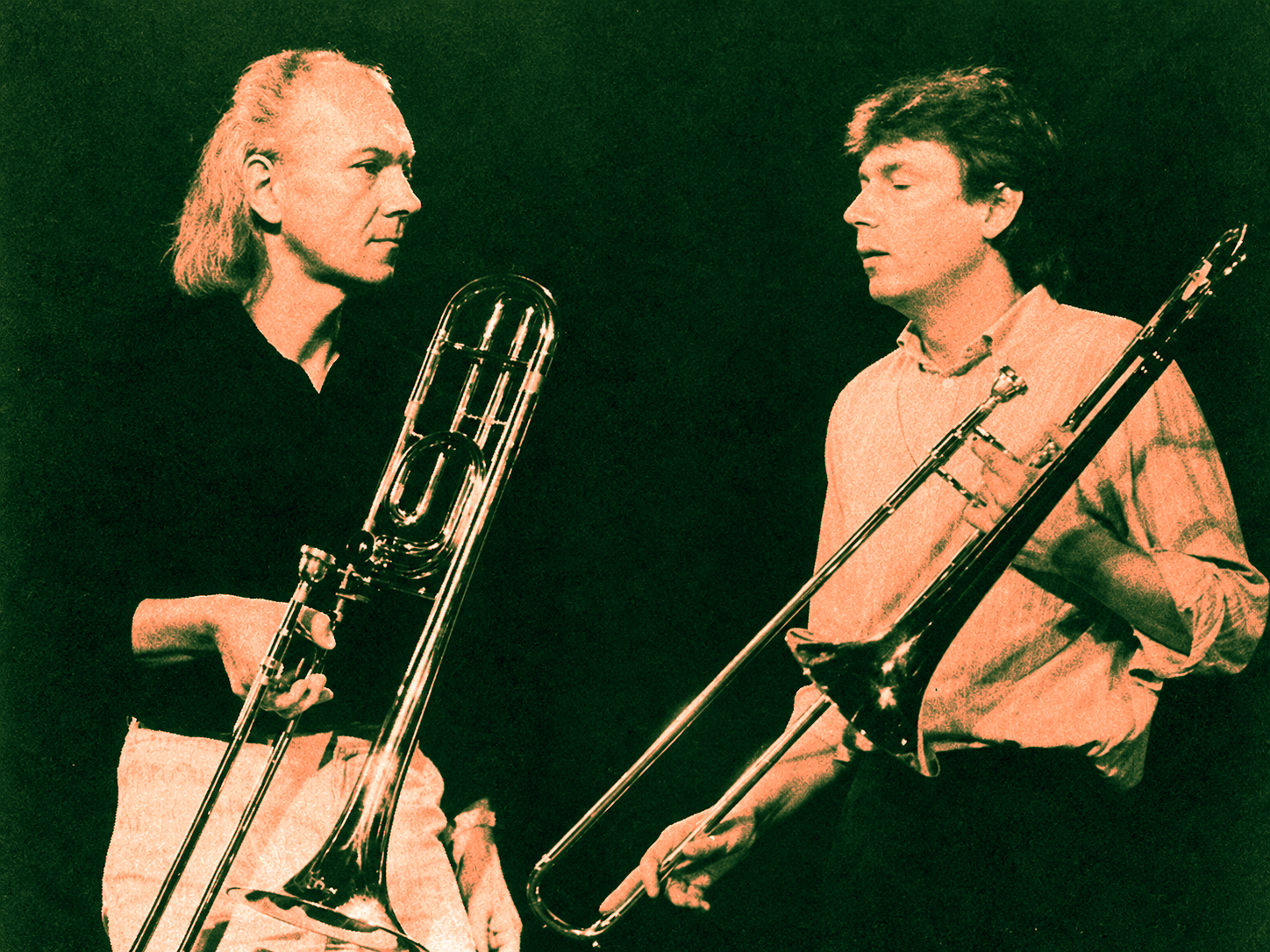
Conrad and Johann Bauer

A remarkable thing: two brothers, eleven years apart, become involved in music by different routes, learn the same instrument and devote themselves almost exclusively to improvised music.

When Conrad Bauer was already a professional musician, he advised his younger brother Johannes to study an instrument other than the trombone so that they would later be able to play in a band together. Johannes stuck with the trombone, but later they did play together after all — though with a line-up no-one could have imagined at the time: two trombones and two guitars.

Each appears as a performer in his own right, and occasionally they appear together. They do not compete. Each has an unmistakable musical personality. Mutual respect enables them to get on with one another. Their personalities are strong enough that they need neither minimise nor emphasise the differences.

Conrad

Over the years Conrad has arrived at a rather complex trombone style, drawing on all he has learnt. His playing has to do with maturity and maturity has to do with age. When young the brothers were used to hearing songs and music at home (their father was a minister). But Conrad’s real fascination was with the music he heard on the radio and in dance halls. With this in mind he started to teach himself various instruments, played the guitar for a while and sang. He bought a trumpet at the age of sixteen with money earned working in the mines during the holidays. The opportunity of lessons with a good teacher led him to change to trombone. After studying at the Dresden College of Music he played dance music, rock and soul at first, often interspersed with elements of jazz.

The living flow of his music defies all categorisation. The rhythmic tension, drive and instrumental intensity obviously come from the world of jazz. But Conrad’s music is rooted in the present and the many resources he draws on extend beyond jazz and its laws. A strenuous course of study and practice has led him to extend the instrument’s technical possibilities to an almost unimaginable degree. By means of a combination of different techniques — circular breathing and multiphonics, for example — and constant refinement of them he has succeeded in developing an individual vocabulary. For Conrad, however, virtuosity never becomes an end in itself; it is only one of many means of communicating his ideas and emotions.

Johannes

Johannes, the younger of the two, born in 1954, resembles Conrad in the intensity which he brings to his playing. The difference is in his working methods and musical results. Johannes did not become well known because of his brother but he did not have to assert himself against him either. There are influences, of course. Conrad introduced Johannes to the good trombone teacher who had first helped him, for example; and, while he was a student in Berlin, Johannes also played rock and soul music. But from 1979 he devoted himself exclusively to jazz, or improvised music. Since 1980 he has conducted workshops with improvising musicians, for whom he also provides written out material.

Together again

Something of a novelty is the Doppelmoppel quartet, founded by Conrad, Johannes and the guitarists Uwe Kropinski and Helmut “Joe” Sachse in the early eighties. The two trombonists, each of whom normally goes his own way, are reunited in this group where everything is possible: shared exhilaration and defiant contradiction, stylistic diversity and strict purism, sheer joy in music and concentrated communication. Conrad and Johannes Bauer have quite different things to say on the same instrument. Where they resemble one another is in their power of persuasion.

Brass Bulletin 60, IV / 1987 pages 38–40

All content is protected by copyright © Brass Bulletin 1987–2026

Share this article

Facebook LinkedIn
Loading…

Questions & Answers

How the Digital Edition works

What does the Digital Edition include?

The Digital Edition brings together the articles already digitized as searchable online texts—not simply as scans or PDF files—along with their original illustrations, notes, authorship, issue information, and available translations. Related-article suggestions currently include only this digitized material.

Are the digital articles identical to the originals?

We preserve the original text, language, illustrations, captions, footnotes, and editorial context as faithfully as possible. The presentation is adapted for comfortable online reading, and obvious transcription or scanning errors may be corrected. The substance and character of the published article remain unchanged.

Which languages are available?

Brass Bulletin was published in English, French, and German throughout its history. Italian and Spanish translations were added from issue No. 60 onward.

On the Italian and Spanish sites, articles from issues 1–59 are therefore shown in English by default.

How often are new articles added?

New articles are added almost daily, with approximately one complete issue digitized each week. The pace may vary depending on the preparation, image work, and editorial checking required.

Why aren’t all articles available digitally?

The complete Brass Bulletin collection contains 1,246 articles published between 1971 and 2003. The full index is already available online, allowing readers to discover every article in the collection, including those whose complete text has not yet been digitized.

Digitization began in February 2026. Each article is carefully prepared for online reading, checked, and connected to its issue, authors, subjects, and illustrations. At the current pace of digitization, the complete collection is expected to be available online by February 2028.

Why do some references mention articles that are not available yet?

References in the original articles are preserved even when the material they point to has not yet been digitized. This keeps the historical and editorial record intact. As more issues are added to the Digital Edition, an increasing number of these references will lead to articles that can be read online.

Can I suggest an article or report a transcription error?

Yes. If there is an article you would particularly like to see digitized, or if you notice a possible transcription error or missing detail, please contact us. Reader feedback helps us improve the Digital Edition and prioritize useful connections within the archive.

How can I support Brass Bulletin?

Your support helps fund the preparation, verification, and online publication of the complete collection.

Subscribe to the Digital Edition

Prefer to support us without subscribing?

Make a donation

How is the digitization progressing?

We’re gradually making the Brass Bulletin available online, article by article. You can read newly digitized articles as soon as they’re ready, even before an entire issue is complete.

Visit our Digitization Roadmap to browse recent additions and see estimated availability for upcoming issues. These estimates follow our recent pace and may change.

Search Brass Bulletin.