Explore institutional access Explore institutional access

3 min. read

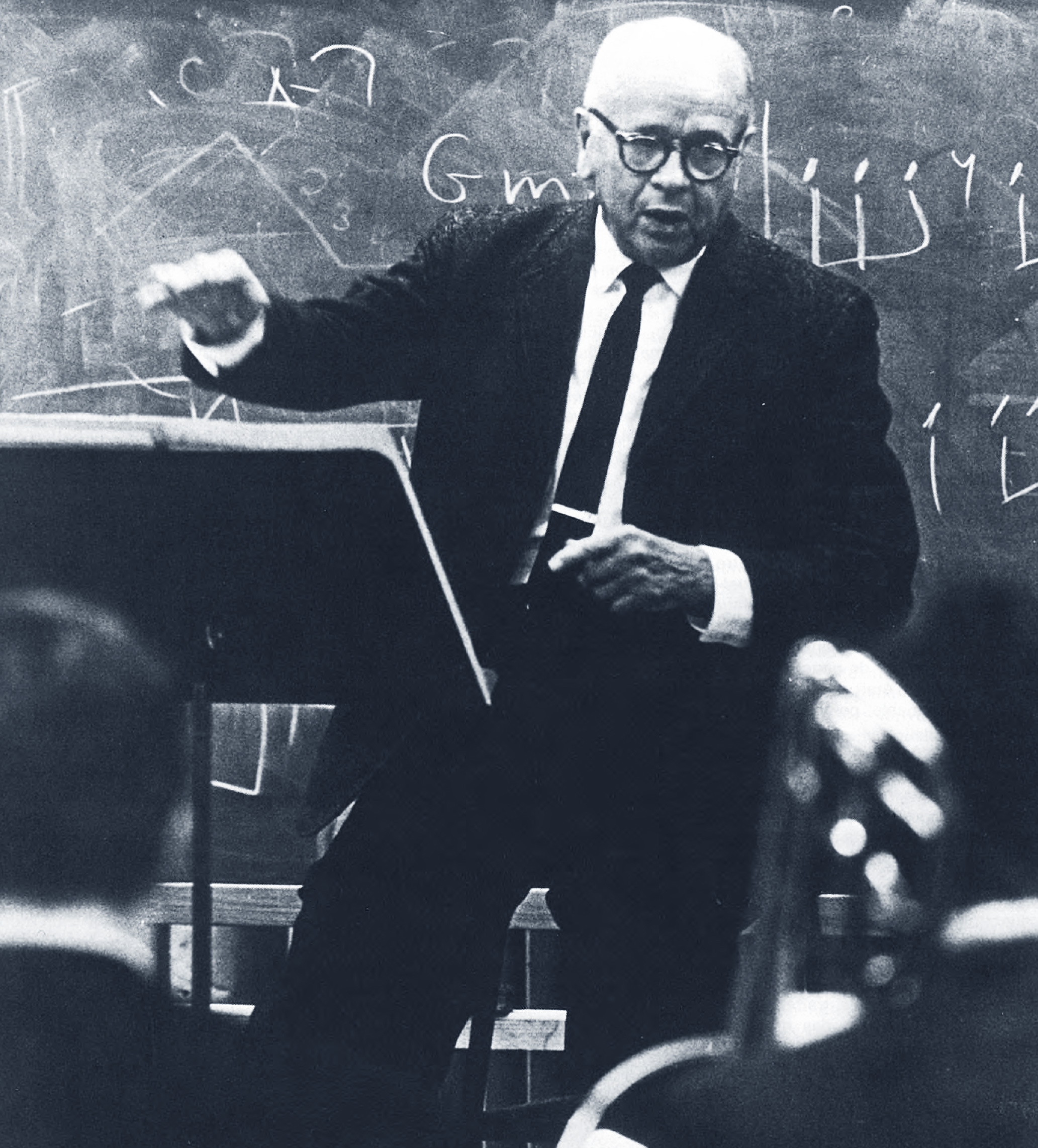
Emory Brace Remington

A Profile

Born December 22, 1891, Emory Brace Remington took up the trombone at age fourteen.

His own remarks about that beginning are perhaps most appropriate: "All along I was fascinated by the trombone. I'd seen pictures of it and that was all I'd talk about. Finally, the next door neighbor came home with an instrument from a pawnshop and gave it to me. I didn't know the first thing — I thought you just went up and down on the slide."

In 1921, he became a member of the Eastman School of Music faculty and first trombonist in the Eastman Theater Orchestra (which was later called the Rochester Civic Orchestra and then the Rochester Philharmonic). For the next twenty-eight years, he never missed a concert.

After his retirement from the orchestra in 1949, he continued to teach his beloved pupils for another twenty-two years until his death, December 10, 1971, making a grand total of fifty years at Eastman. He taught, as a conservative guess, over one thousand students, spanning three generations. His influence and the influence of his legion of students has been enormous.

A typical lesson with "the Chief" (as he became affectionately known) consisted of his own special warm-ups, etudes involving scale and arpeggio patterns in all keys, vocalises, dramatic — orchestral style etudes, and perhaps a solo piece or a few orchestral excerpts.

Emory Brace Remington

Emory Brace Remington

As the student became more advanced, the material increased in difficulty at a pace that was demanding but not overwhelming. The number of pages that the student prepared was not assigned, and within reason, could be varied by the individual.

Remington's principal teaching device was to sing virtually every note in every lesson. Again, his own words are most descriptive: "If I had a special distinction, it was that I tried to make the trombone sing with a human quality. In the old days, no one asked fundamental questions like tongue placement, breath control and so on. I just played as it seemed right to me. There was very little material then that treated the vocal line. It was marches, boom, boom, dah, dah, a lot of the German school, very smeary on the slide. The old school was to spit it out. I was strong on articulation, in the mouth like a singer. I didn't blow into the horn, I sang into it, as little resistance as possible. I've always treated the instrument as just another voice."

He had a baritone voice of uneven quality but the ability to convey phrasing, articulation, and sound quality in an uncanny manner. He estimated that he sang six to seven hours a day. If the student listened carefully, the various aspects of playing could be deduced from this continual vocalization.

The only time that he did not "sing along" was when a solo was played just prior to performance, or the occasional opening phrase of an etude. After a few measures, he would usually say: "Hold it! Not like that; more like this", and launch into song. Then student and teacher would begin again together.

On rare occasions when the student captured exactly the right qualities of the first phrase, "the Chief" would enter on the second. This was the highest form of praise and was worth more than any of his spoken encouragements.

Technical explanations were completely absent. It may be difficult for some to fully understand, but this was the essence of his "osmosis" style of teaching. Each student was free to learn as much or as little as was desired.

He treated all his students the same. There was no star system. The talented players were allowed to develop their gifts at the rapid pace on which they thrived. The average players were gently "pushed" to higher levels of attainment. The problem players were usually coerced, without their realizing, into non-performance areas of the profession.

If Remington’s method had a weak point, and this is debatable, it was his reluctance to make technical suggestions to his students. While it is true that some of his former pupils were helped by other teachers more adept at the technical aspects of teaching, this manner of working with people was foreign to his humanistic nature.

He realized (as the teachers of today should) that only a few would ever make their living as performers and that false encouragement and long, painful adjustment periods would usually lead to frustration and disappointment.

As Howard Hanson, former Director of the Eastman School, so eloquently said:

Remington did not teach trombone, he taught people.

Brass Bulletin 21, I / 1978 pages 37–39

All content is protected by copyright © Brass Bulletin 1978–2026

Share this article

Facebook LinkedIn
Loading…

Questions & Answers

How the Digital Edition works

What does the Digital Edition include?

The Digital Edition brings together the articles already digitized as searchable online texts—not simply as scans or PDF files—along with their original illustrations, notes, authorship, issue information, and available translations. Related-article suggestions currently include only this digitized material.

Are the digital articles identical to the originals?

We preserve the original text, language, illustrations, captions, footnotes, and editorial context as faithfully as possible. The presentation is adapted for comfortable online reading, and obvious transcription or scanning errors may be corrected. The substance and character of the published article remain unchanged.

Which languages are available?

Brass Bulletin was published in English, French, and German throughout its history. Italian and Spanish translations were added from issue No. 60 onward.

On the Italian and Spanish sites, articles from issues 1–59 are therefore shown in English by default.

How often are new articles added?

New articles are added almost daily, with approximately one complete issue digitized each week. The pace may vary depending on the preparation, image work, and editorial checking required.

Why aren’t all articles available digitally?

The complete Brass Bulletin collection contains 1,246 articles published between 1971 and 2003. The full index is already available online, allowing readers to discover every article in the collection, including those whose complete text has not yet been digitized.

Digitization began in February 2026. Each article is carefully prepared for online reading, checked, and connected to its issue, authors, subjects, and illustrations. At the current pace of digitization, the complete collection is expected to be available online by February 2028.

Why do some references mention articles that are not available yet?

References in the original articles are preserved even when the material they point to has not yet been digitized. This keeps the historical and editorial record intact. As more issues are added to the Digital Edition, an increasing number of these references will lead to articles that can be read online.

Can I suggest an article or report a transcription error?

Yes. If there is an article you would particularly like to see digitized, or if you notice a possible transcription error or missing detail, please contact us. Reader feedback helps us improve the Digital Edition and prioritize useful connections within the archive.

How can I support Brass Bulletin?

Your support helps fund the preparation, verification, and online publication of the complete collection.

Subscribe to the Digital Edition

Prefer to support us without subscribing?

Make a donation

Search Brass Bulletin.