Explore institutional access →

4 min. read

Special GDR

The horn in the G.R.D

A chat with Peter Damm

Peter Damm discusses horn training and orchestral life in East Germany, linking musical education, daily practice and the distinctive traditions of its orchestras.
The horn in the G.R.D

Peter Damm

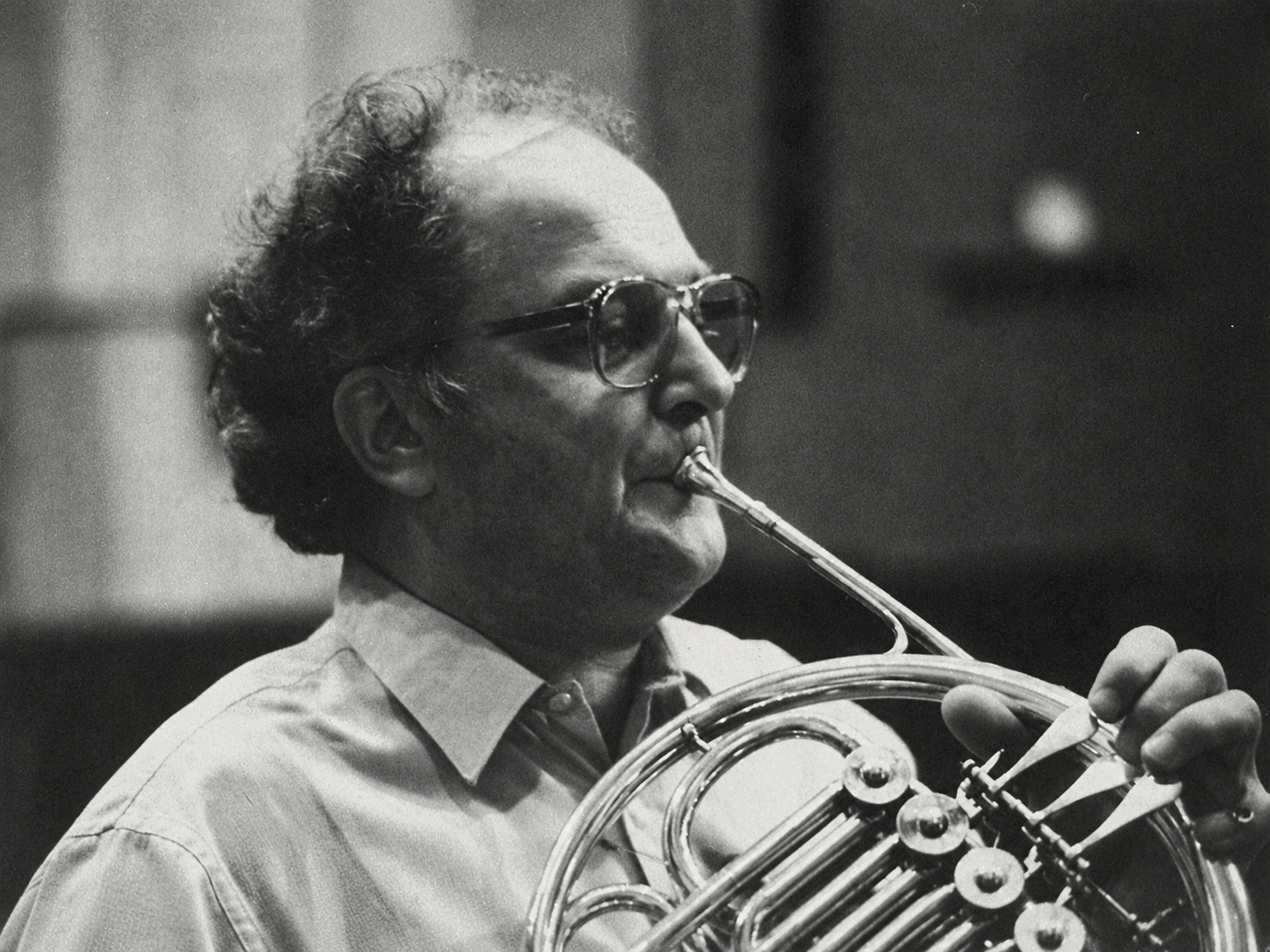
Peter Damm is one of the great horn virtuosos of our time. Himself a product of the G.D.R. training system, he discusses here some interesting aspects of it.

BRASS BULLETIN: How does one become a musician (horn player) in the G.D.R.?

Peter Damm: Any reasonably gifted child can have a complete musical education here provided his talent is properly guided by his family and/or the educational authorities. From the teacher’s point of view I don’t agree with children of seven or eight starting a brass instrument (mainly because of anatomical problems). Personally I started with the violin and later, at a memorable concert, fell for the charm of the horn, which then became my main instrument. But the violin — which I could handle quite well — had given me a good start for my musical career.

B. B.: What are the professional prospects in your country?

P. D.: In the G.D.R. there are around eighty professional orchestras of various sizes. Currently that means about 45 horn vacancies. A student who has talent and works hard will find plenty of opportunities here.

B. B.: Are there any foreign influences in your teaching system?

P. D.: You can’t really say there are foreign influences here. But my colleagues and I analyse all the factors that come from outside and, if appropriate, use them in our teaching. “All roads lead to Rome”, as the proverb says. My teacher Karl Biehlig in Weimar was teaching the minimum-pressure embouchure as early as 1951! To train a good musician, of course, that’s not enough. You have to develop every facet of musical expression, best possible organisation of daily practice, and theoretical knowledge. Of course a teacher’s own style will directly influence his pupils (at least to start with). But the pupil has to develop his own personality, and realise that he will never have learned all there is to know. In Weimar we learned to let the sound vibrate. Some have taken this so far as to develop a vibrato, others produce just a slight movement. At the time, in the fifties, this was unheard of here and caused a lot of resentment. I don’t accept the term vibrato for my own playing; I let the notes sing. I try to emulate the expressivity of the singing voice by means of “living breath” (the human voice is alive, and has warmth).

B. B.: Do the G.D.R. orchestras have individual characteristic sounds?

P. D.: Yes. Each orchestra has an easily identifiable characteristic sound. Compare the Vienna Philharmonic with the Dresden Staatskapelle, or the Berlin Philharmonic with the Leipzig Gewandhaus, and you’ll see what I mean. As much as a century ago this tradition was being preserved by the orchestra’s own institute, then by a music college founded by the orchestra, and now by the orchestra school. The same is true of the other orchestras.

Continue reading

Access the full Digital Edition.

Brass Bulletin 60, IV / 1987 pages 33–37

All content is protected by copyright © Brass Bulletin 1987–2026

Share this article

Facebook LinkedIn
Loading…

Questions & Answers

How the Digital Edition works

What does the Digital Edition include?

The Digital Edition brings together the articles already digitized as searchable online texts—not simply as scans or PDF files—along with their original illustrations, notes, authorship, issue information, and available translations. Related-article suggestions currently include only this digitized material.

Are the digital articles identical to the originals?

We preserve the original text, language, illustrations, captions, footnotes, and editorial context as faithfully as possible. The presentation is adapted for comfortable online reading, and obvious transcription or scanning errors may be corrected. The substance and character of the published article remain unchanged.

Which languages are available?

Brass Bulletin was published in English, French, and German throughout its history. Italian and Spanish translations were added from issue No. 60 onward.

On the Italian and Spanish sites, articles from issues 1–59 are therefore shown in English by default.

How often are new articles added?

New articles are added almost daily, with approximately one complete issue digitized each week. The pace may vary depending on the preparation, image work, and editorial checking required.

Why aren’t all articles available digitally?

The complete Brass Bulletin collection contains 1,246 articles published between 1971 and 2003. The full index is already available online, allowing readers to discover every article in the collection, including those whose complete text has not yet been digitized.

Digitization began in February 2026. Each article is carefully prepared for online reading, checked, and connected to its issue, authors, subjects, and illustrations. At the current pace of digitization, the complete collection is expected to be available online by February 2028.

Why do some references mention articles that are not available yet?

References in the original articles are preserved even when the material they point to has not yet been digitized. This keeps the historical and editorial record intact. As more issues are added to the Digital Edition, an increasing number of these references will lead to articles that can be read online.

Can I suggest an article or report a transcription error?

Yes. If there is an article you would particularly like to see digitized, or if you notice a possible transcription error or missing detail, please contact us. Reader feedback helps us improve the Digital Edition and prioritize useful connections within the archive.

How can I support Brass Bulletin?

Your support helps fund the preparation, verification, and online publication of the complete collection.

Subscribe to the Digital Edition

Prefer to support us without subscribing?

Make a donation

How is the digitization progressing?

We’re gradually making the Brass Bulletin available online, article by article. You can read newly digitized articles as soon as they’re ready, even before an entire issue is complete.

Visit our Digitization Roadmap to browse recent additions and see estimated availability for upcoming issues. These estimates follow our recent pace and may change.

Search Brass Bulletin.