3 min. read
Bad Säckingen, Trumpet museum
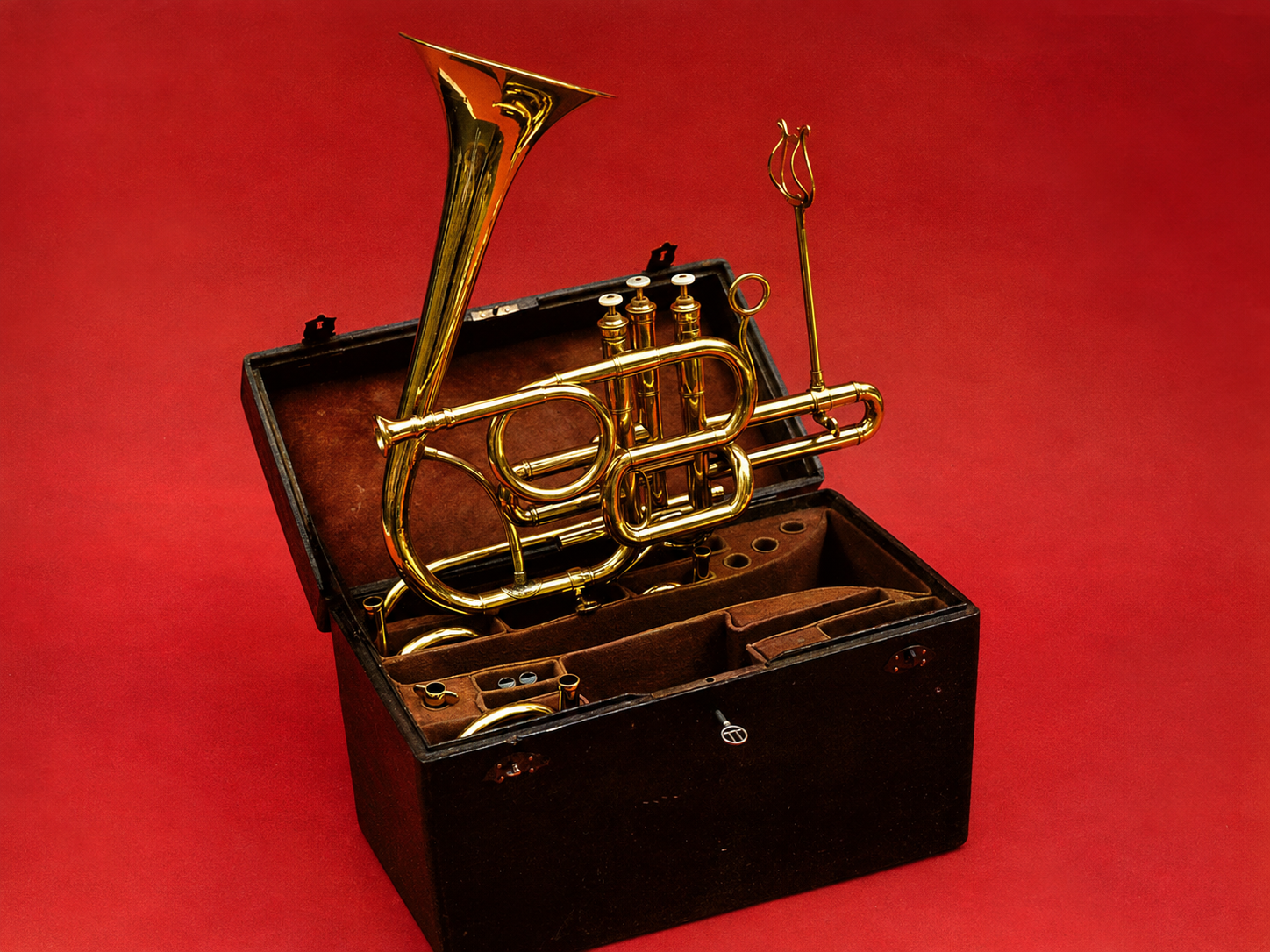
Cornet with adjustable vertical bell. A. Courtois (F) c. 1850 (p. 60).
Bad Säckingen, a charming German town on the Rhine a few kilometres upstream from Basle, has succeeded in creating a surprising musical attraction by wisely and skilfully combining its two — rather coincidental — trump cards.
The first trump card is the fame which the town has acquired in the last century and a half as the setting for the legend "Der Trompeter von Säckingen" by the German poet Viktor Scheffel (1826-1886), which the Alsatian composer Victor-Ernest Nessler (1841-1890) used as the libretto for his extraordinarily successful and long-lived opera of the same name. Both legend and opera are now part of German popular tradition. Millions of people immediately associate Säckingen with the trumpet. While all this is rather sentimental and based on out of date romanticism, it is valuable publicity material and needed someone who knew how to make the most of it.
A passion for the trumpet
The second trump card is the collaboration of two friends, the American trumpeter and musicologist Edward H. Tarr, who has for a long time lived near Basle, and Ernst W. Buser a passionate collector with great flair, who have for many years shared both friendship and knowledge. Ernst W. Buser has gradually built up a magnificent collection of wind instruments, illustrations and documents of great historical and musicological value.
Edward H. Tarr, for his part, has become one of the world's greatest experts on the history of the trumpet.
Permanent and reciprocal stimulation has combined these two men's talents and will now bear fruit in the setting up of this Trumpet Museum.
Under the title "The Trumpet", Edward Tarr¹ and Ernst Buser mounted the first exhibition devoted to this instrument in 1979 in the castle made famous by the legend. Parallel to this was an international masterclass. This strengthened contacts with the city fathers of this dynamic community and it seemed quite natural that the class should become an annual event. This in turn led to the grand idea of setting up the museum.
Brass Bulletin 53, I / 1986 pages 17–27
All content is protected by copyright © Brass Bulletin 1986–2026