Discoveries for brass players, once a month. Join our free newsletter →

4 min. read

This article is free.

Salvation Army in Japan

Salvation Army in Japan

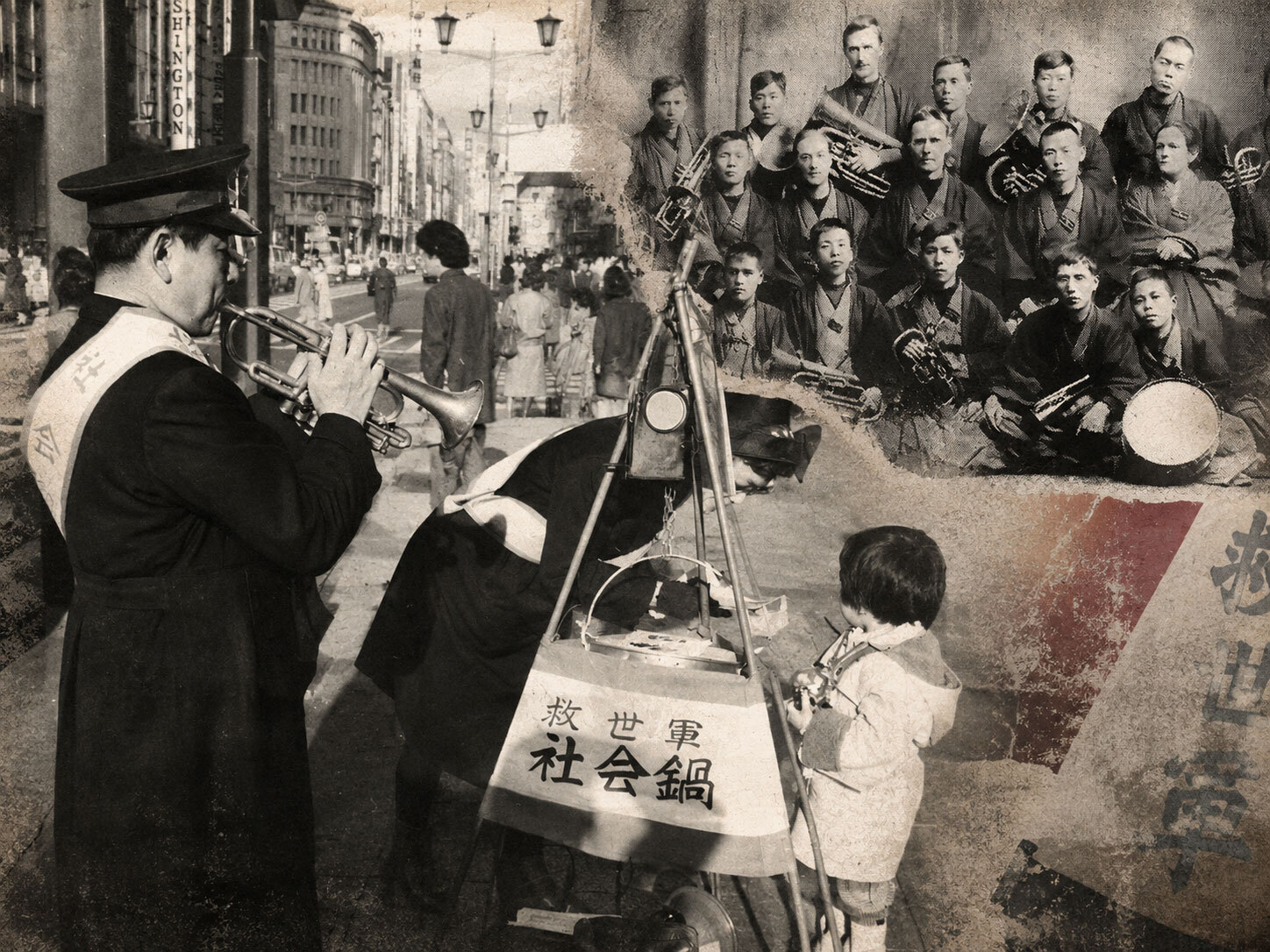
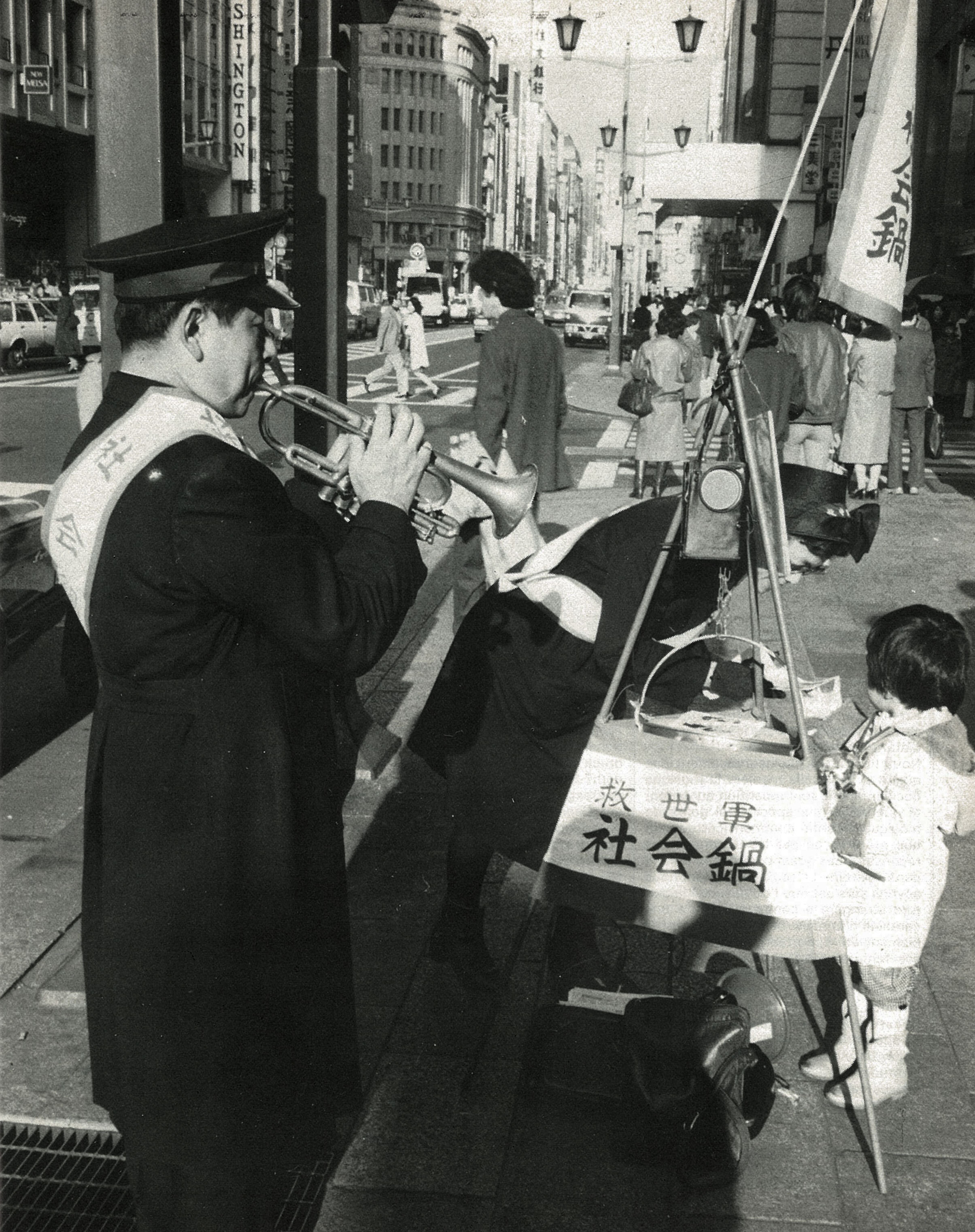
Towards the end of the year trumpeters like the one in the photograph can be seen in towns all over Japan playing hymns on the streets. The trumpeter belongs to the Salvation Army of course and Salvation Army fund-raising scenes like this have been part of the Japanese winter for the past 80 years or so.

The trumpeter is Mr. Harita. Not only is he Kanto-Tohoku Divisional Commander, but he is also a qualified musician. He graduated from the Tokyo National University of Fine Arts and Music in 1962. The photograph was taken on the Ginza, the main street in the heart of the Tokyo metropolis.

There is a special reason for Pipers’ interest in Mr. Harita. The history of the Salvation Army in Japan dates back 89 years, to the time when the Japanese began importing Western-style music from Europe.

Mr. Harita plays hymn.

Mr. Harita plays hymn.

Japan has recovered both economically and culturally from the shock of defeat in 1945. After stagnating during the war, music in Japan is flourishing now. In 40 years it has reached heights undreamed of before the war.

Taking school wind music as an example, we find that Japan has well over 7000 elementary, middle and high school concert bands at present. They owe their existence to the postwar boom in wind music and the development of good-quality, moderately-priced Japanese-made instruments (popular models for schools). The flourishing music scene in Japan today is quite incredible compared with the situation 100 years ago. At that time Western-style music had hardly reached this Far Eastern archipelago.

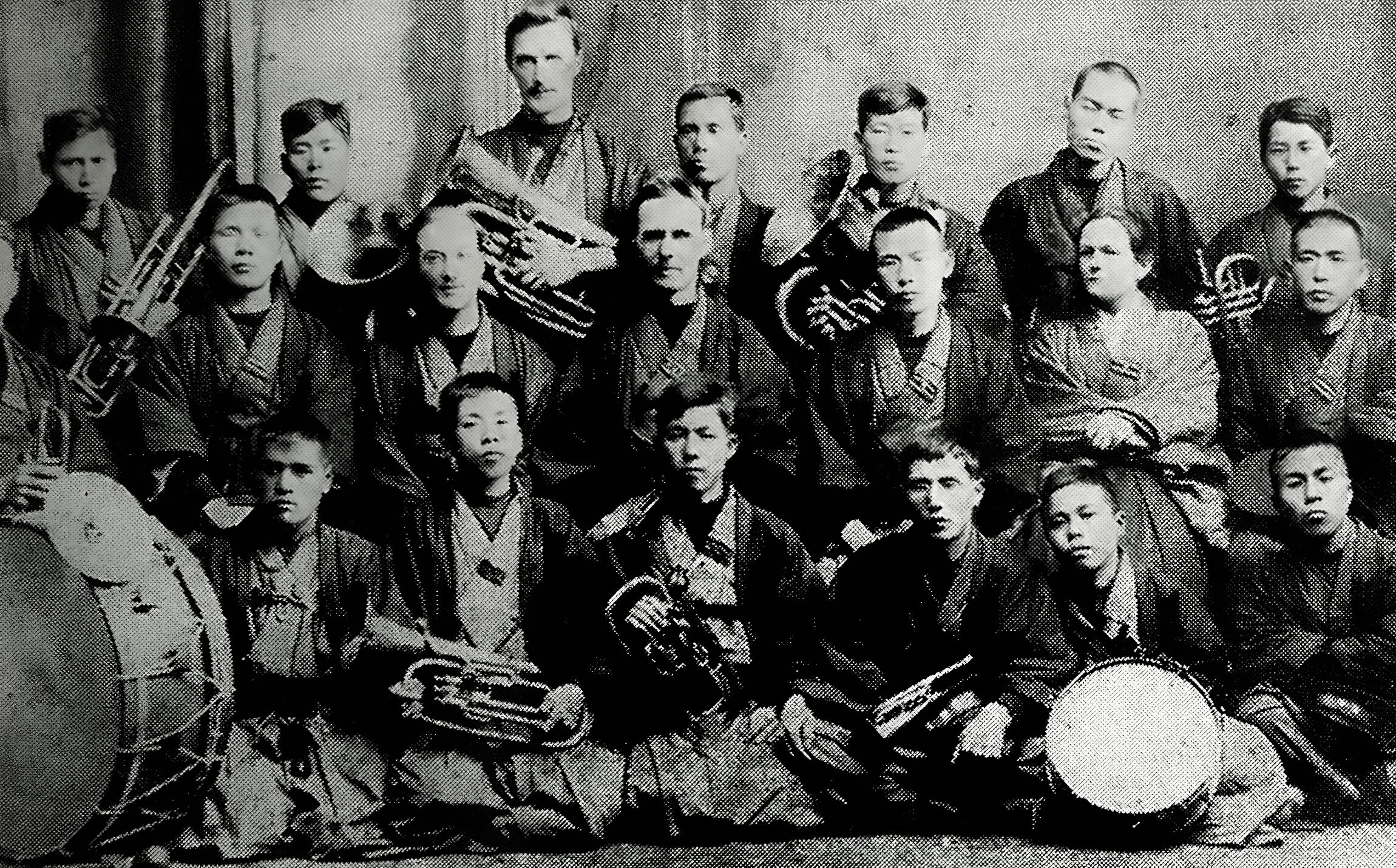
The photo of 1902

The photo of 1902

The process of a foreign culture’s assimilation and development is a dramatic one. And it has a significant impact on the receiver — in Japan or anywhere else. But Japan’s case is particularly interesting because the country had been almost totally cut off from the outside world during the long years of the Tokugawa shogunate (300 years).

When exactly did Western-style music come to Japan? Who brought it here? What type of music did different nationalities bring? What kind of impression did the music make on the Japanese?

Unfortunately we do not really know. The answers are buried in history. But one thing that is certain is that extensive contact with Western-style music, i.e. with foreign culture, began about 100 years ago. The music was probably brought by the many European and American military bands who came to Japan after the country opened its doors to the outside world. The Salvation Army Bands which are the subject of this article were another of the means by which this foreign culture was brought to Japan.
After the mission work

After the mission work

There is an old Eastern saying that we can learn new things from studying the past, and as editor of a wind magazine it is exciting and enjoyable to research the period when Western-style wind instruments first came to Japan.

Let us return to Mr. Harita. We visited him at the Salvation Army headquarters where he looked out some old papers for us. We were not disappointed. We found some rare old photographs with a very human appeal.

The Salvation Army, founded in London in 1865, soon began extending its activities overseas. Its development as a worldwide organization began in 1880. Plans for Japan were first laid around 1890 and realized as early as 1895.

A strange group of foreigners landed at Yokohama on the morning of September 4, 1895. They were all wearing yukata (the Japanese-style sleeping robe) tied with narrow belts, in the calm assurance that this was standard Japanese dress. It is reported that Japanese who happened to see this odd-looking group were convulsed with laughter.

The misunderstanding was soon cleared up. The group’s ship had called at Hong Kong on its way to Japan and Edward Wright, their leader, had ordered clothes for everyone from a Japanese tailor there. But there had been language problems and instead of the ordinary clothes the tailor had made Japanese-style “pyjamas” with the narrow belts used in bed.
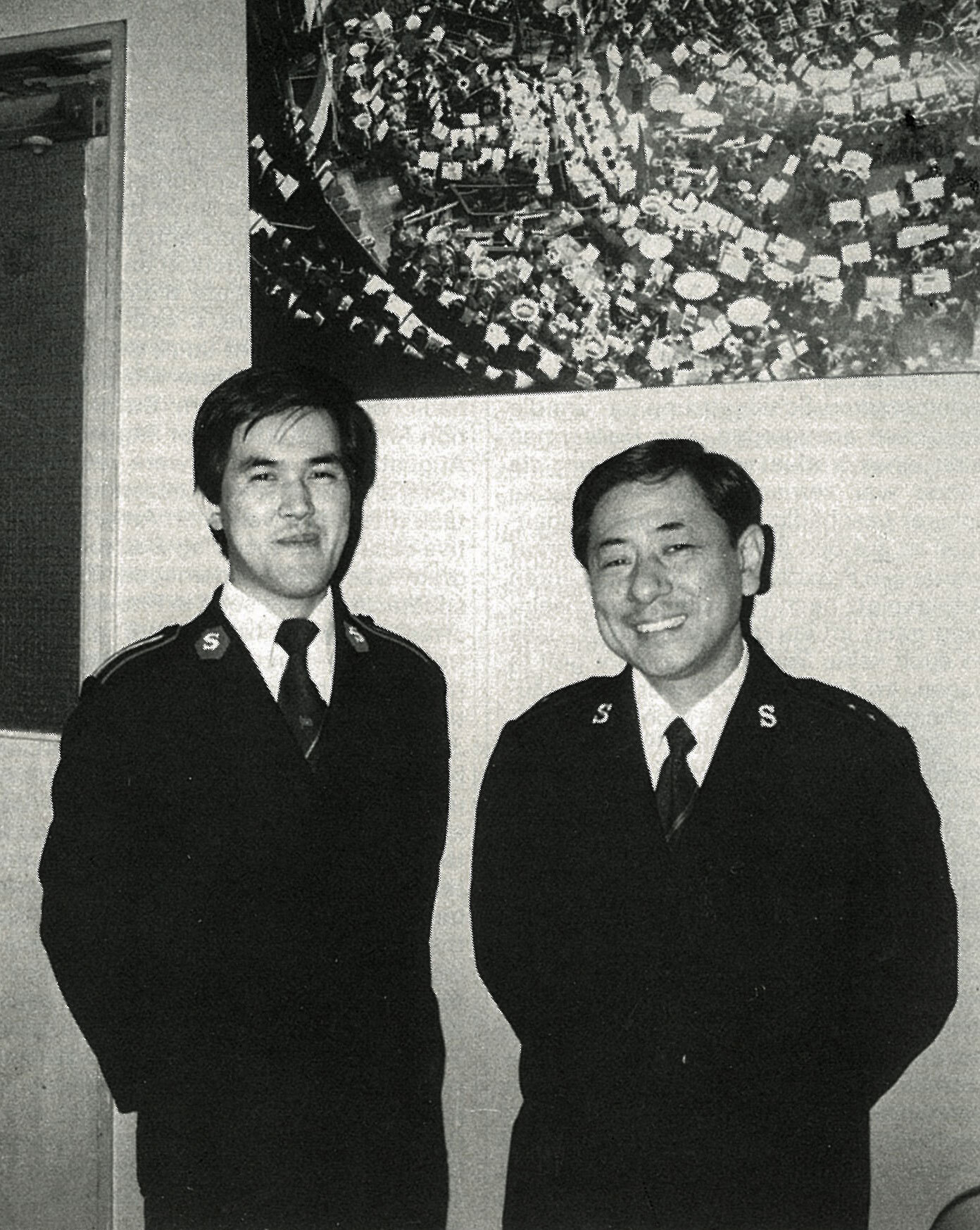
Commander N. Harita (right) and H. Suzuki. Mr. Suzuki is the band master of Japan Staff Band.

Commander N. Harita (right) and H. Suzuki. Mr. Suzuki is the band master of Japan Staff Band.

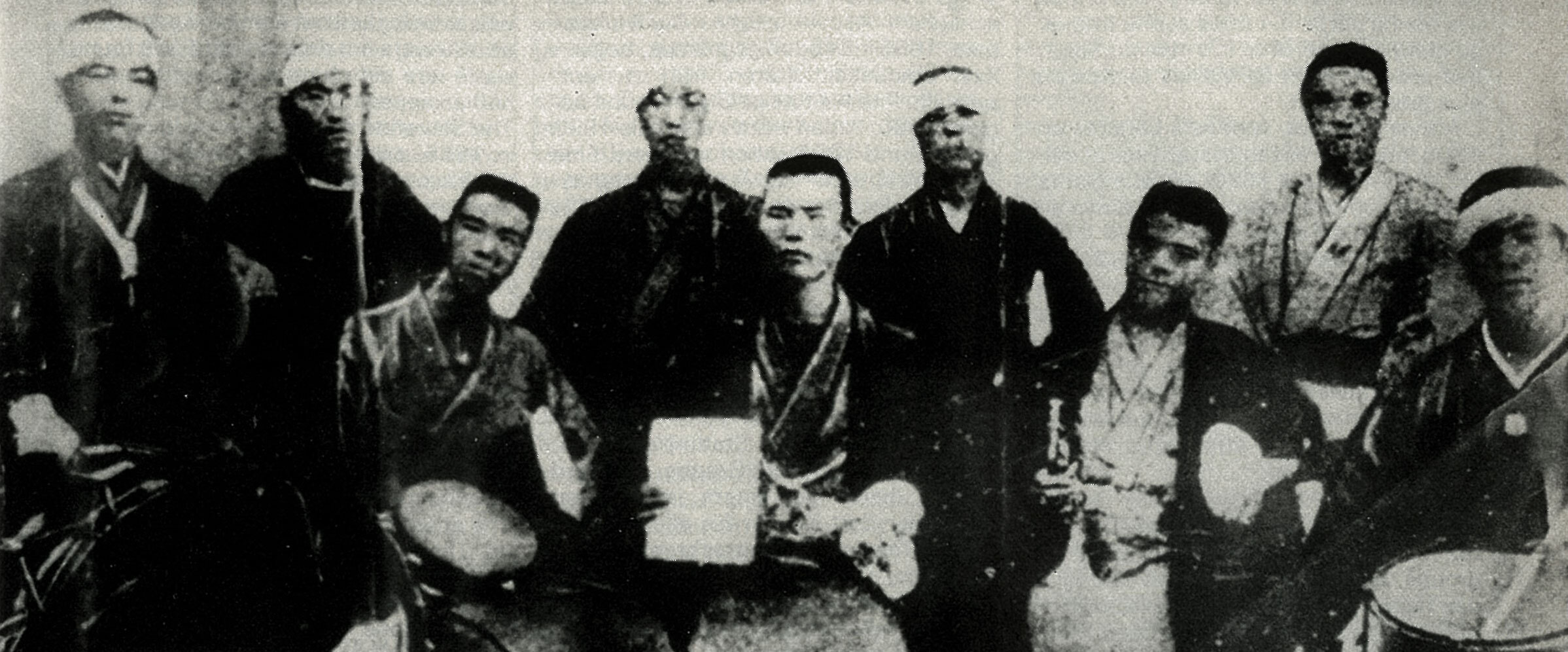
In the summer of 1900 the Salvation Army initiated a campaign for the emancipation of geisha, and prostitutes (who were not allowed to leave their place of employment). Officers and men advanced on red-light districts in an attempt to help these unfortunate women. Brothel owners in Yoshiwara, a well-known red-light district, bought up all the Salvation Army pamphlets before the prostitutes had chance to see them. But the Salvation Army’s efforts never flagged and on August 5 the owners were reduced to hiring a gang of several dozen men to attack them. The Salvation Army suffered five casualties, their flag was torn, and a drum was severely damaged. The sorry spectacle can be seen in Photo A. Soon after this prostitutes were given the freedom to leave their employment if they so wished. Perhaps we should add that there are no re-light districts in Japan any more either.

In February 1902 a band was formed under Colonel H. Bullard. It organized 35 evangelical rallies in 23 different parts of the country. It was probably the first time that most Japanese had ever heard brass instruments. It is interesting that the Europeans in the band are alto wearing kimono. These two photographs are testimony of one of the routes by which Western-style music entered Japan. They are also a reminder of a custom rarely seen in Japanese cities today — men wearing kimono.

Our task of researching the past has just begun. It will require infinite patience and perseverance, but it must be done. We shall proceed little by little.

Date & photographs: by courtesy of the Salvation Army Japan Territorial Head Quarters.
Translation: by Ann Hoshino.
Pipers Magazine Nr. 6 (January, 1982)

Brass Bulletin 52, IV / 1985 pages 30–34

All content is protected by copyright © Brass Bulletin 1985–2026

Share this article

Facebook LinkedIn
Loading…

Questions & Answers

How the Digital Edition works

What does the Digital Edition include?

The Digital Edition brings together the articles already digitized as searchable online texts—not simply as scans or PDF files—along with their original illustrations, notes, authorship, issue information, and available translations. Related-article suggestions currently include only this digitized material.

Are the digital articles identical to the originals?

We preserve the original text, language, illustrations, captions, footnotes, and editorial context as faithfully as possible. The presentation is adapted for comfortable online reading, and obvious transcription or scanning errors may be corrected. The substance and character of the published article remain unchanged.

Which languages are available?

Brass Bulletin was published in English, French, and German throughout its history. Italian and Spanish translations were added from issue No. 60 onward.

On the Italian and Spanish sites, articles from issues 1–59 are therefore shown in English by default.

How often are new articles added?

New articles are added almost daily, with approximately one complete issue digitized each week. The pace may vary depending on the preparation, image work, and editorial checking required.

Why aren’t all articles available digitally?

The complete Brass Bulletin collection contains 1,246 articles published between 1971 and 2003. The full index is already available online, allowing readers to discover every article in the collection, including those whose complete text has not yet been digitized.

Digitization began in February 2026. Each article is carefully prepared for online reading, checked, and connected to its issue, authors, subjects, and illustrations. At the current pace of digitization, the complete collection is expected to be available online by February 2028.

Why do some references mention articles that are not available yet?

References in the original articles are preserved even when the material they point to has not yet been digitized. This keeps the historical and editorial record intact. As more issues are added to the Digital Edition, an increasing number of these references will lead to articles that can be read online.

Can I suggest an article or report a transcription error?

Yes. If there is an article you would particularly like to see digitized, or if you notice a possible transcription error or missing detail, please contact us. Reader feedback helps us improve the Digital Edition and prioritize useful connections within the archive.

How can I support Brass Bulletin?

Your support helps fund the preparation, verification, and online publication of the complete collection.

Subscribe to the Digital Edition

Prefer to support us without subscribing?

Make a donation

How is the digitization progressing?

We’re gradually making the Brass Bulletin available online, article by article. You can read newly digitized articles as soon as they’re ready, even before an entire issue is complete.

Visit our Digitization Roadmap to browse recent additions and see estimated availability for upcoming issues. These estimates follow our recent pace and may change.

Search Brass Bulletin.