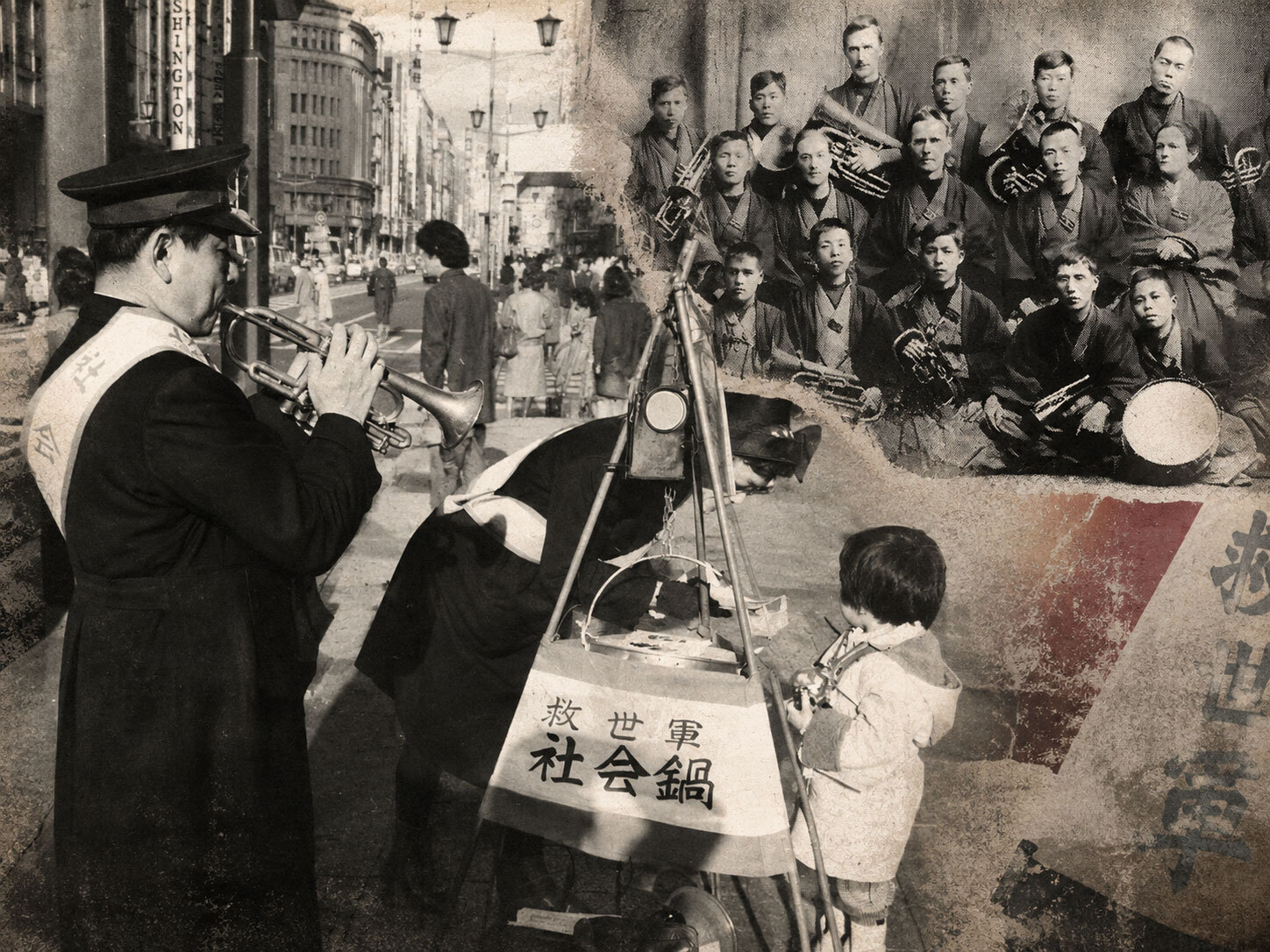
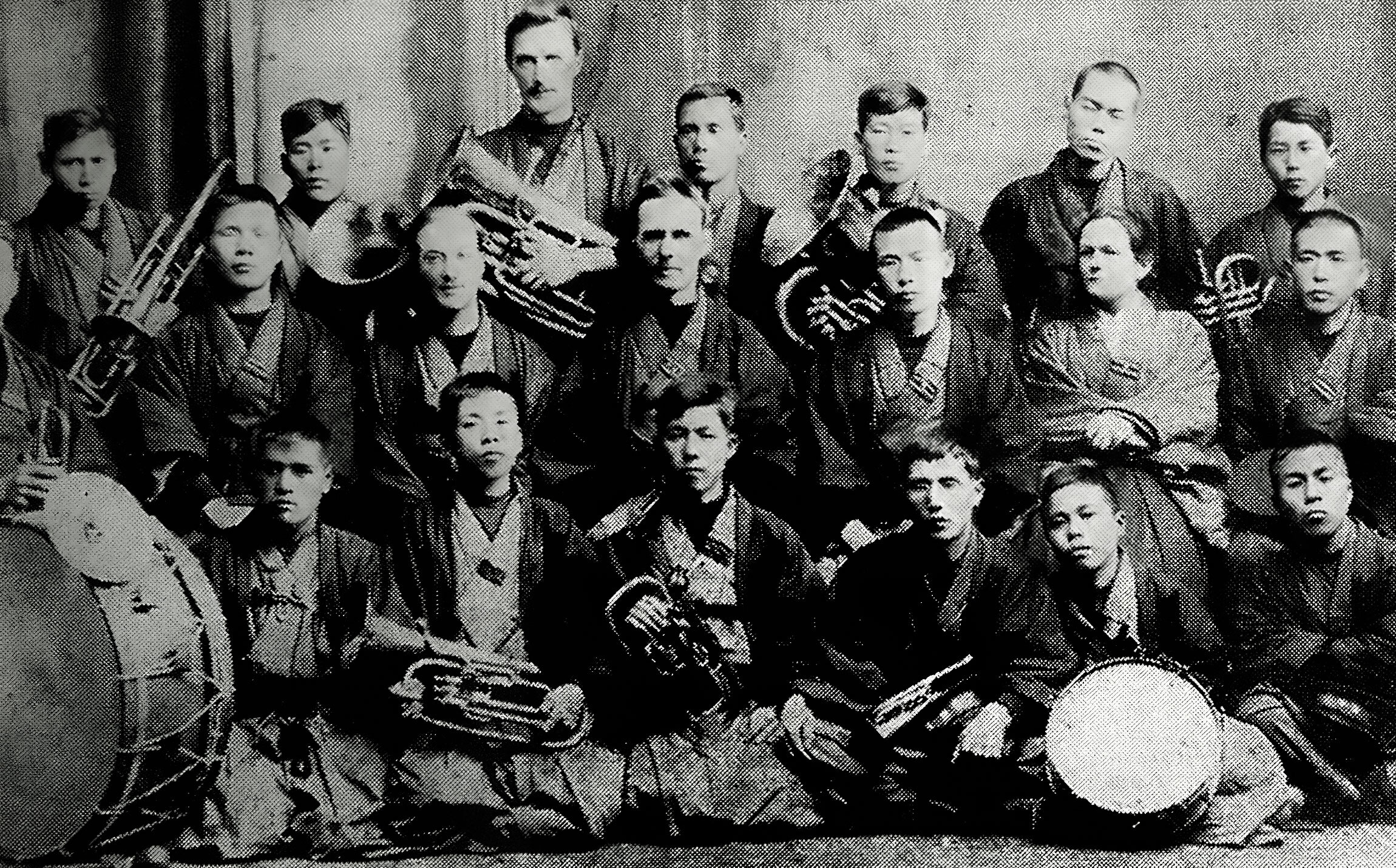
The photo of 1902
The process of a foreign culture’s assimilation and development is a dramatic one. And it has a significant impact on the receiver — in Japan or anywhere else. But Japan’s case is particularly interesting because the country had been almost totally cut off from the outside world during the long years of the Tokugawa shogunate (300 years).
When exactly did Western-style music come to Japan? Who brought it here? What type of music did different nationalities bring? What kind of impression did the music make on the Japanese?
Unfortunately we do not really know. The answers are buried in history. But one thing that is certain is that extensive contact with Western-style music, i.e. with foreign culture, began about 100 years ago. The music was probably brought by the many European and American military bands who came to Japan after the country opened its doors to the outside world. The Salvation Army Bands which are the subject of this article were another of the means by which this foreign culture was brought to Japan.
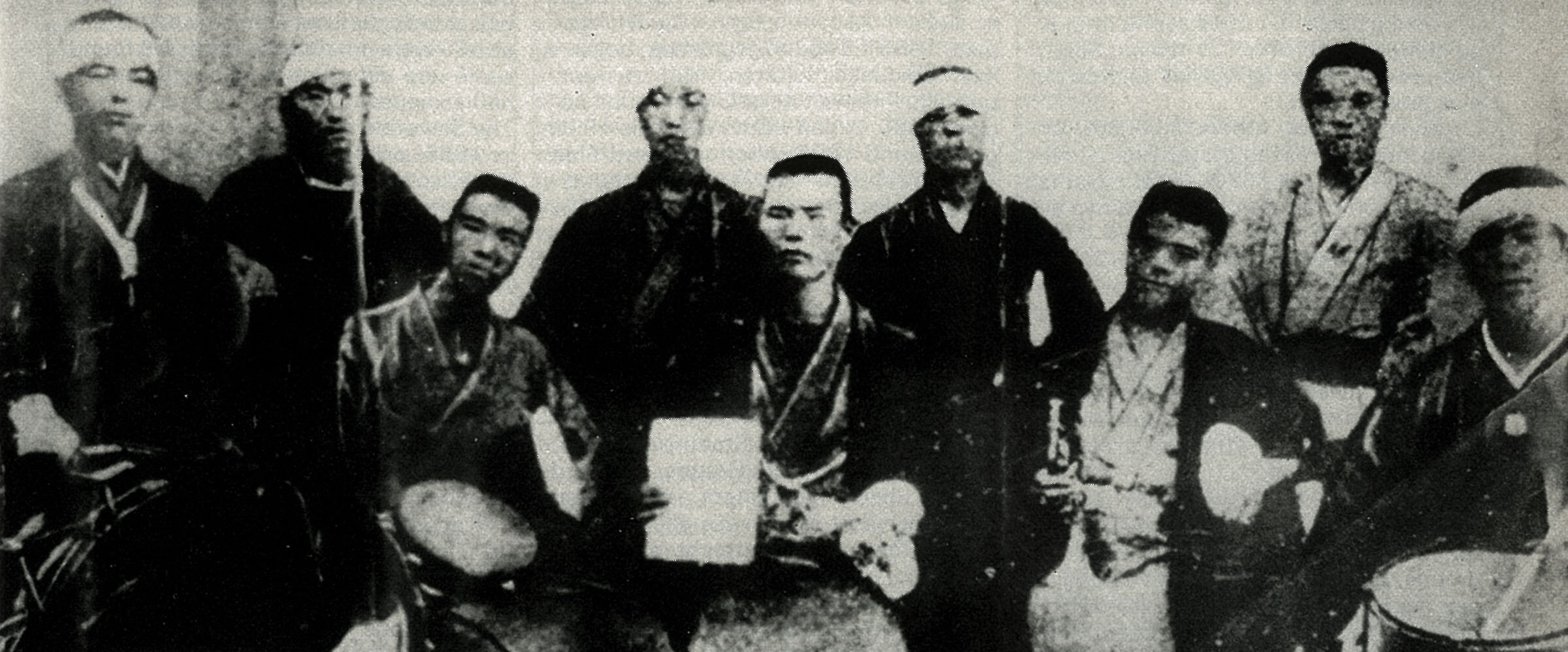
After the mission work
There is an old Eastern saying that we can learn new things from studying the past, and as editor of a wind magazine it is exciting and enjoyable to research the period when Western-style wind instruments first came to Japan.
Let us return to Mr. Harita. We visited him at the Salvation Army headquarters where he looked out some old papers for us. We were not disappointed. We found some rare old photographs with a very human appeal.
The Salvation Army, founded in London in 1865, soon began extending its activities overseas. Its development as a worldwide organization began in 1880. Plans for Japan were first laid around 1890 and realized as early as 1895.
A strange group of foreigners landed at Yokohama on the morning of September 4, 1895. They were all wearing yukata (the Japanese-style sleeping robe) tied with narrow belts, in the calm assurance that this was standard Japanese dress. It is reported that Japanese who happened to see this odd-looking group were convulsed with laughter.
The misunderstanding was soon cleared up. The group’s ship had called at Hong Kong on its way to Japan and Edward Wright, their leader, had ordered clothes for everyone from a Japanese tailor there. But there had been language problems and instead of the ordinary clothes the tailor had made Japanese-style “pyjamas” with the narrow belts used in bed.
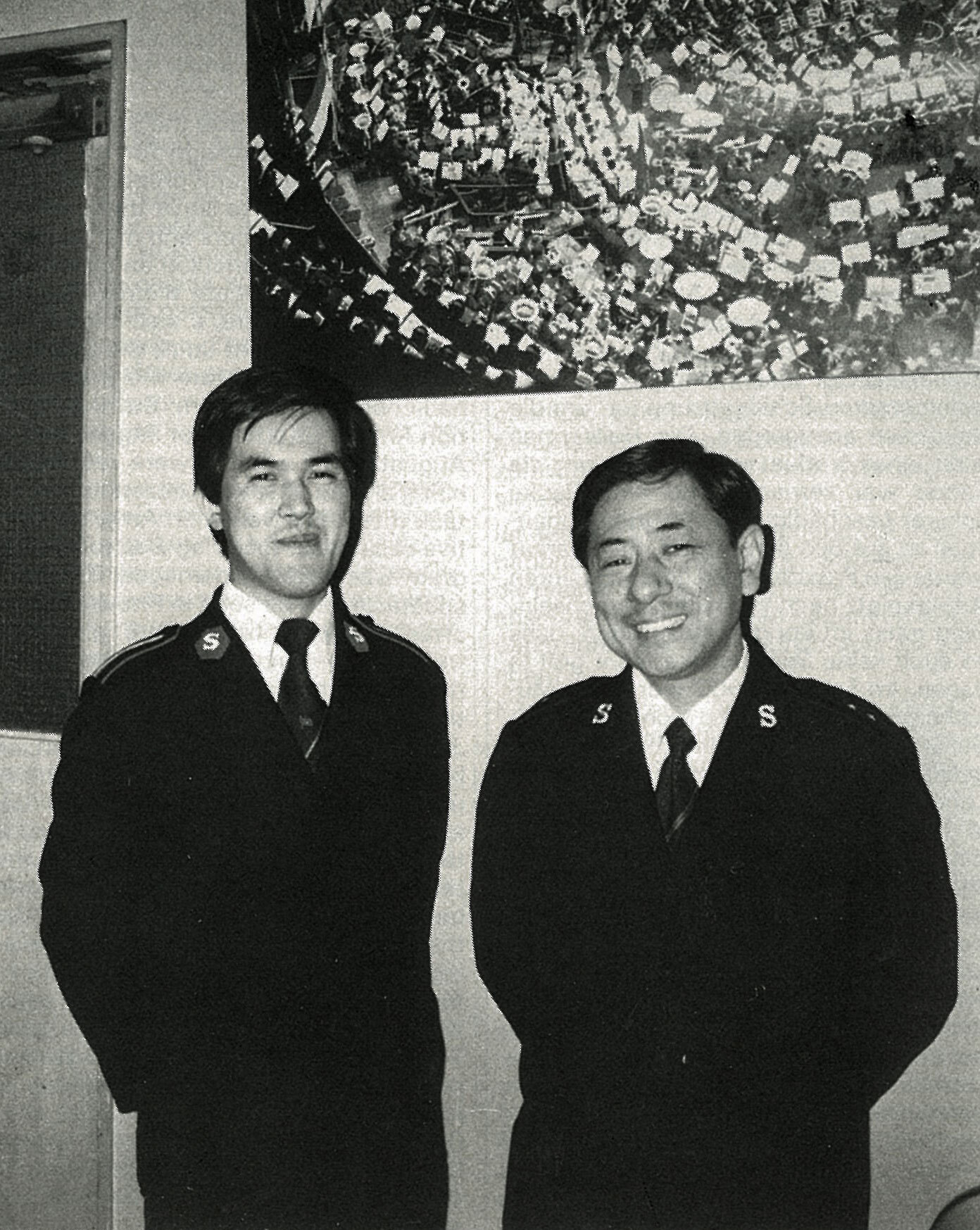
Commander N. Harita (right) and H. Suzuki. Mr. Suzuki is the band master of Japan Staff Band.
In the summer of 1900 the Salvation Army initiated a campaign for the emancipation of geisha, and prostitutes (who were not allowed to leave their place of employment). Officers and men advanced on red-light districts in an attempt to help these unfortunate women. Brothel owners in Yoshiwara, a well-known red-light district, bought up all the Salvation Army pamphlets before the prostitutes had chance to see them. But the Salvation Army’s efforts never flagged and on August 5 the owners were reduced to hiring a gang of several dozen men to attack them. The Salvation Army suffered five casualties, their flag was torn, and a drum was severely damaged. The sorry spectacle can be seen in Photo A. Soon after this prostitutes were given the freedom to leave their employment if they so wished. Perhaps we should add that there are no re-light districts in Japan any more either.
In February 1902 a band was formed under Colonel H. Bullard. It organized 35 evangelical rallies in 23 different parts of the country. It was probably the first time that most Japanese had ever heard brass instruments. It is interesting that the Europeans in the band are alto wearing kimono. These two photographs are testimony of one of the routes by which Western-style music entered Japan. They are also a reminder of a custom rarely seen in Japanese cities today — men wearing kimono.
Our task of researching the past has just begun. It will require infinite patience and perseverance, but it must be done. We shall proceed little by little.
Date & photographs: by courtesy of the Salvation Army Japan Territorial Head Quarters.
Translation: by Ann Hoshino.
Pipers Magazine Nr. 6 (January, 1982)