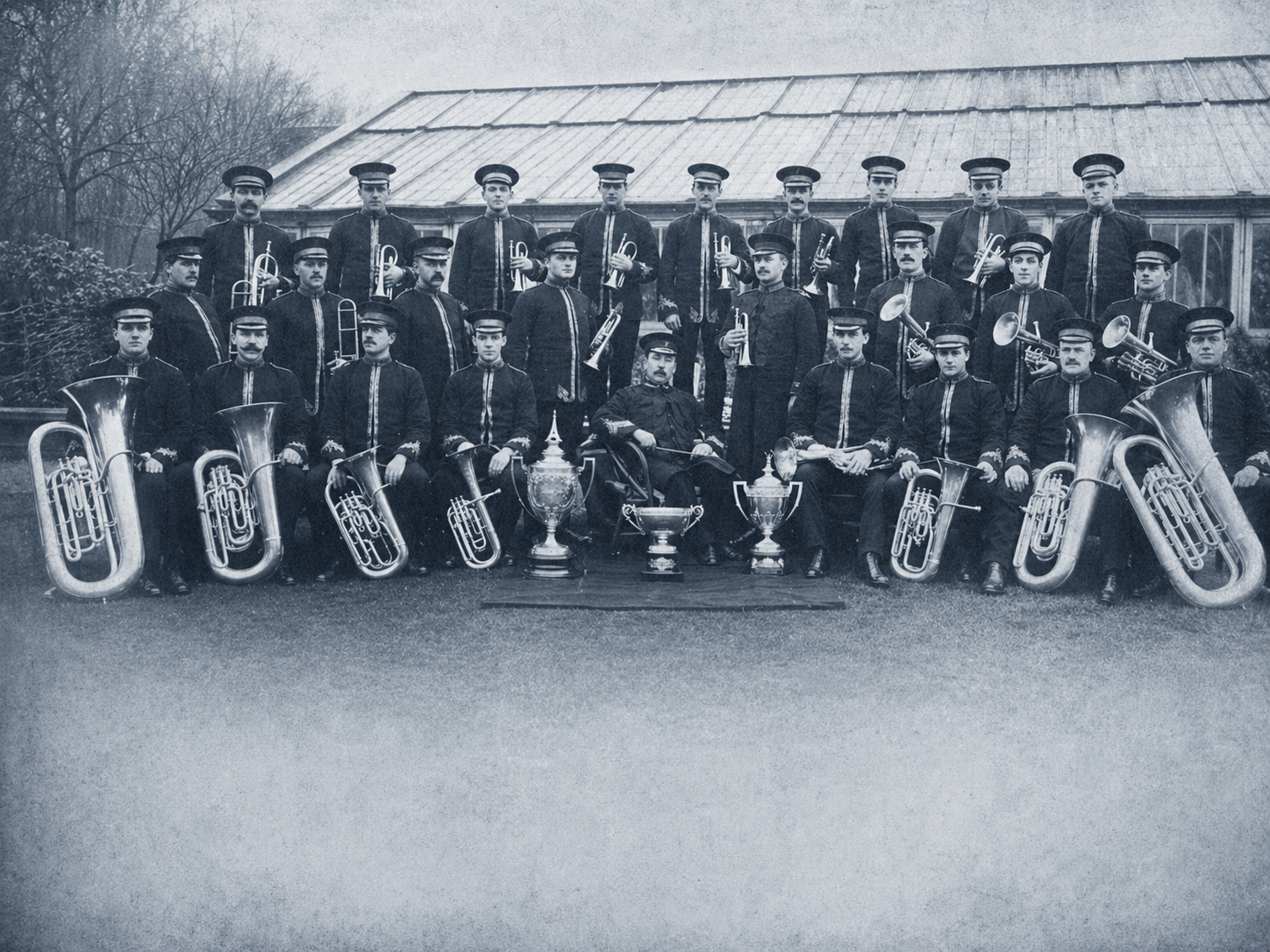
Currently the British Brass Band (on which most of the world's all-brass ensembles are patterned) comprises the following instruments: 1 soprano cornet in Eb 8 cornets in Bb 1 flügel horn in Bb 3 tenor (alto) horns in Eb 2 baritones in Bb 2 tenor trombones in Bb 1 bass trombone in Bb/F 2 euphoniums in Bb 2 bass tubas in Eb 2 bass tubas in Bb percussion
The 19th century Industrial Revolution coincided approximately with the beginning of the British Brass Band Movement. Factory owners became aware of the value of a band as a social adjunct to a factory, attracting workers and helping to advertize products. Additionally, towns and villages, temperance and religious societies (notably the Salvation Army which has its own widely reputed music editions) sponsor brass bands. Men whose hands were perhaps too rough to play string instruments, and who had little interest in the flourishing choral societies of that period, found satisfaction in playing brass instruments; moreover the early repertoire largely comprised operatic and choral selections, so enabling parallel editions with melodic interplay. There was therapeutic value too in those artisans of the 19th century playing music because it helped them forget their uncongenial working and living conditions, besides being a healthy and purposeful hobby.
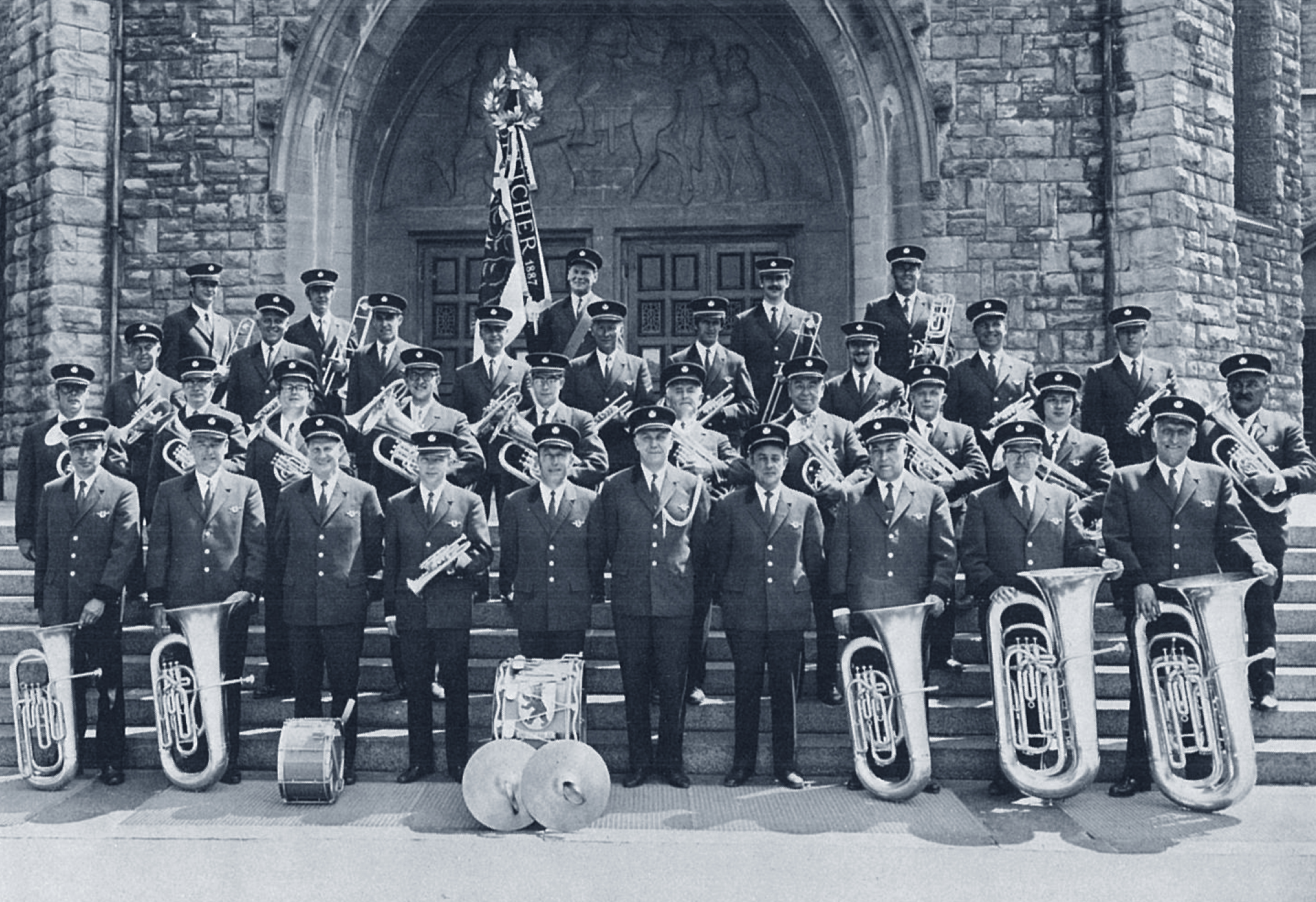
Brass Band Speicher (AR), Switzerland (1971). Conductor: Ernst Graf.
Increased leisure time and the institution of contests (band competitions) have enhanced the awareness and popularity of brass bands. Since those early beginnings the Movement has spread rapidly: many countries have their own national brass band championships, and competitions for individual brass soloists and small ensembles; and those events are often adjudicated by eminent musicians from the general music sphere besides experts within the Movement.
Innumerable orchestral brass players have originated from brass bands, indeed the all-brass ensemble is sometimes referred to as a "nursery" for them; certainly it is a practical training ground, and more than a few conductors and teachers began their careers in this way. There is welcome liaison between bands and orchestras with interchange of personnel, and several orchestral conductors and players direct brass bands — with mutual benefits. There is also co-operation with choral groups, as the frequency of "Brass and Voices" concerts indicates throughout Europe and beyond; and compositions have been specially written for choir and band together by outstanding composers, e.g. Joseph Horovitz ("Samson") and Gilbert Vinter ("The Trumpets"). Handel’s "Messiah" was arranged most effectively with brass band accompaniment by the late Dr. Denis Wright. The piano and organ are used as solo instruments with brass band accompaniment occasionally too, including classical arrangements from Grieg, Tchaikovsky and Mendelssohn.
Although a few brass bands and smaller brass groups have acquired professional status, the Brass Band Movement is mainly amateur, and it contains unique enthusiasm and spirit which are envied throughout the world of music. Although in earlier times the accent was primarily on technique, during the past several years musicianship has improved remarkably, enhancing this art form and encouraging more arrangers and composers to write for the medium. The last three decades particularly have brought a welcome repertoire expansion, raising standards and helping brass bands to become less musically insular (a problem in earlier times) and a consequential part of music's mainstream today. Participation of world-class conductors at band festivals has stimulated progress and brought even more recognition.
Among outstanding British composers who have written for the Brass Band are Elgar, Holst, Vaughan Williams, Bantock, John Ireland, Arthur Bliss, Herbert Howells and Edmund Rubbra. Well known arrangers and composers within the Movement include William and Drake Rimmer, J. Ord Hume, J. A. Greenwood, Eric Ball, Dr. Denis Wright, Frank Wright, Gilbert Vinter, Elgar Howarth and Edward Gregson. There is also a growing number of arrangers/composers in Europe, America, Australia and New Zealand who are writing substantial material for brass bands.
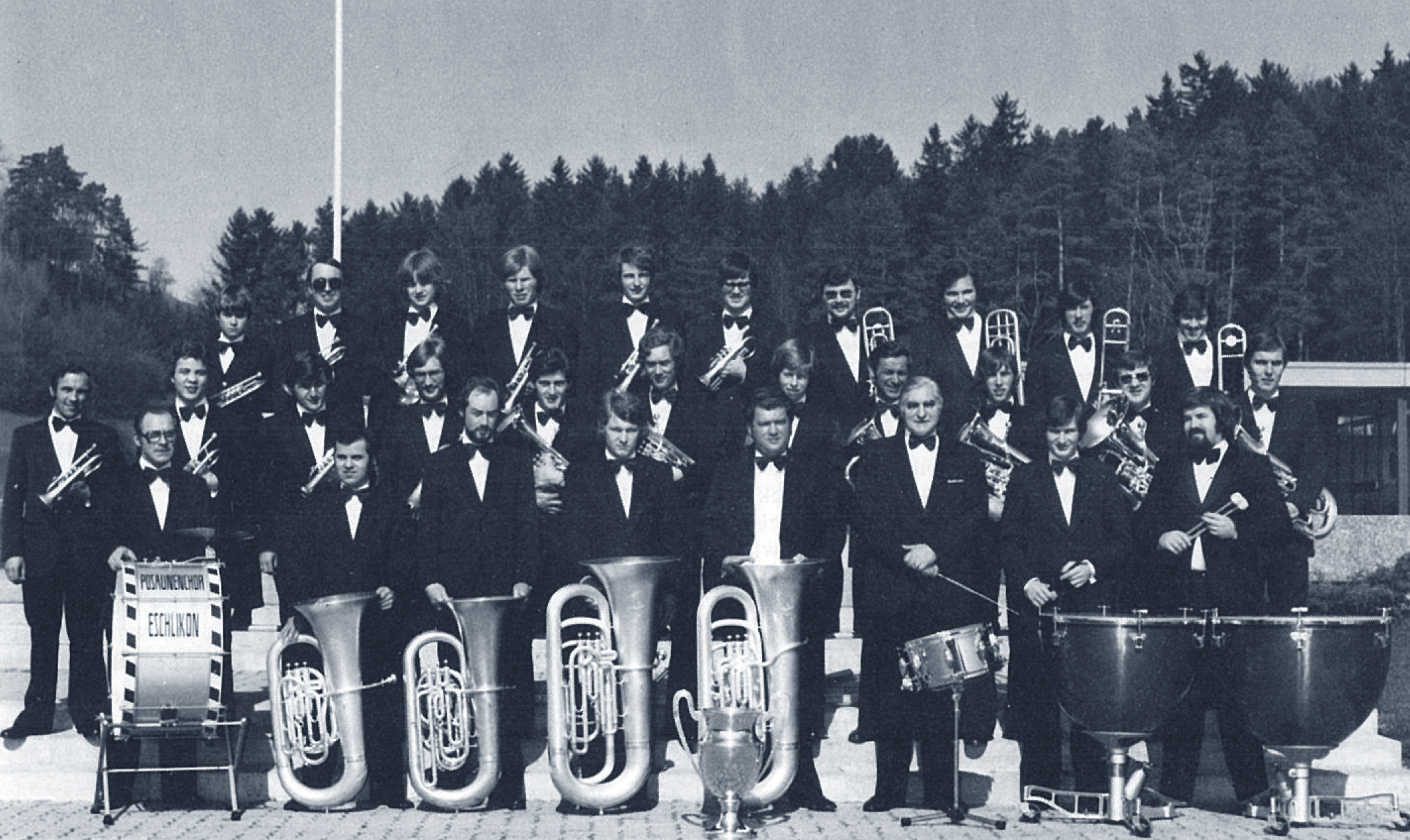
Brass Band Eschlikon, Switzerland(1978). Conductor: Ernst Egger.
The Movement has its own national and international journals to which established writers and musicians contribute, and there is a flourishing brass band interest in schools too. Young people who might not be interested in the piano, woodwind and string instruments are often attracted to brass bands which offer much quicker initial musical expression than other ensembles; young brass players without previous musical experience can play simple harmonized melodies within three months of commencement. And brass band performance has its own particular form of discipline and fellowship which contributes to character and harmonious personal relationships.
In many cases it is only via brass band arrangements that people hear classical and other music of quality, which may explain why the Brass Band is sometimes called "The People's Orchestra". Works such as the overture to "Le Roi d'Ys" (Lalo, arr. Frank Wright), Tchaikovsky's Fifth Symphony (arr. Eric Ball) and "Academic Festival Overture" (Brahms, arr. Denis Wright) are excellent examples of orchestral items arranged for brass which have been acclaimed by some of the world's most distinguished music critics. There is a healthy open-air quality in its distinctive sound, tonal warmth and wide dynamic range, all combining to give it universal appeal. Nor does the Brass Band lack tone colour; most shades of musical expression are possible: as Lilia Fox says in her book "Instruments of Processional Music" (Lutterworth Press, 1967): "...the incomparable sound of brass which can play the clown, call to battle, and open the gates of Heaven, all in one piece of music." With good reason the Brass Band was described as "a singularly beautiful musical medium" by Eric Blom, esteemed writer and music critic; and it is the gateway to a worthwhile musical experience.
Some of the world's best known music academies award diplomas for brass band conducting and performance on brass band instruments, and many education authorities sponsor evening classes for adults to have instruction in this art form.
The sight and sound of a good brass band playing march music is irresistible to children and adults alike, and besides imparting a delightful rhythm sense and feeling of well-being, it builds morale! But brass band repertoire is not limited to marches only: jazz, dance music, arrangements of the classics, operatic selections and show numbers, original compositions and solos are presented in this context, exemplifying versatility and usefulness. Membership includes all professions and crafts, and there are no social barriers; company directors and lawyers play next to carpenters and factory workers, and family associations develop — often with two and even three generations appearing in the same ensemble! Band tradition becomes almost a way of life. Civic and national celebrations, parades, pageantry, gatherings of many kinds, concerts: all are enhanced by contributions from brass bands.
To summarize briefly: the Brass Band constitutes a substantial, creative activity for many thousands of musicians — male and female — of all ages, and its cultural importance has international significance. Brass bands take their place beside professional orchestras and choirs in concerts, prestigious radio and television broadcasts, for example, providing service that contributes positively to the quality of life itself.
Truly the Brass Band is Music of the People!
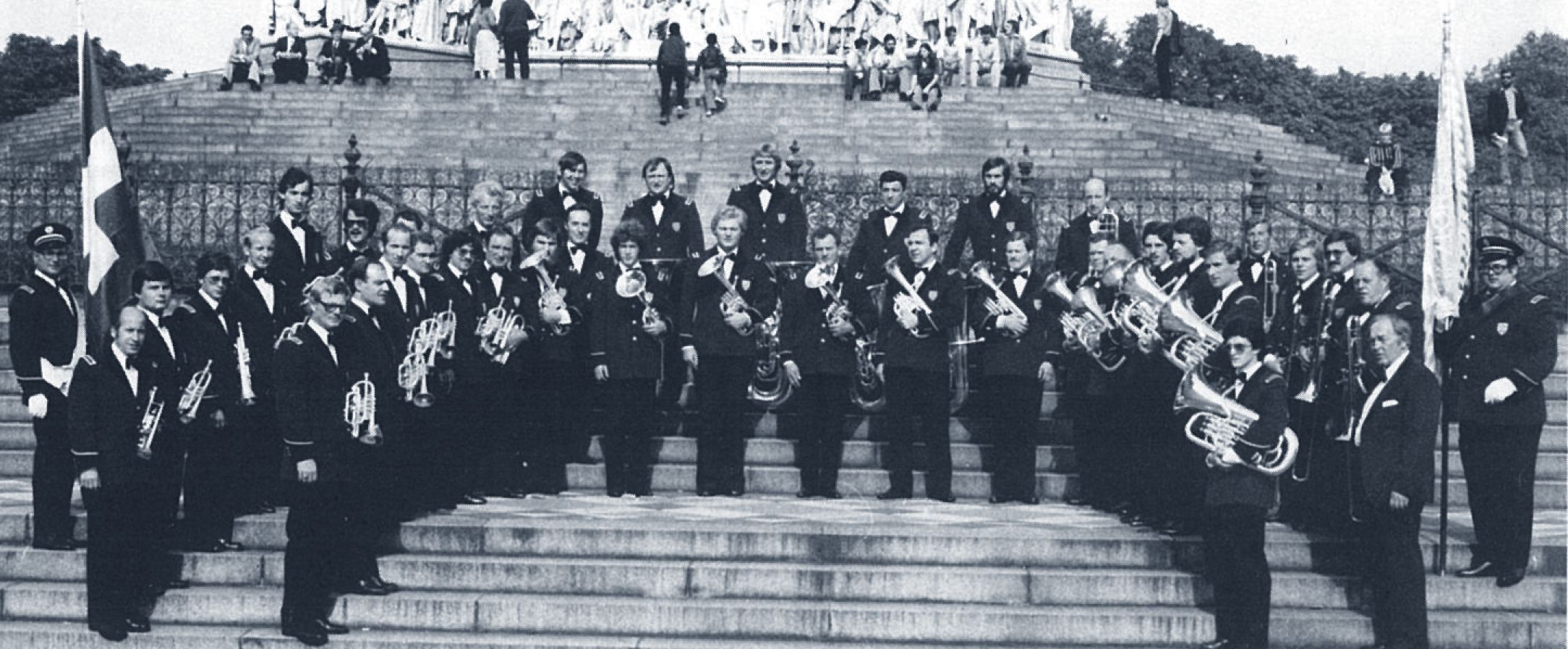
Brass Band Frohsinn Schütz, Switzerland. Conductor: André Winkler.