4 min de lectura
Harry James (1916-1983)
Young Man With A Horn
Por Michel Laplace
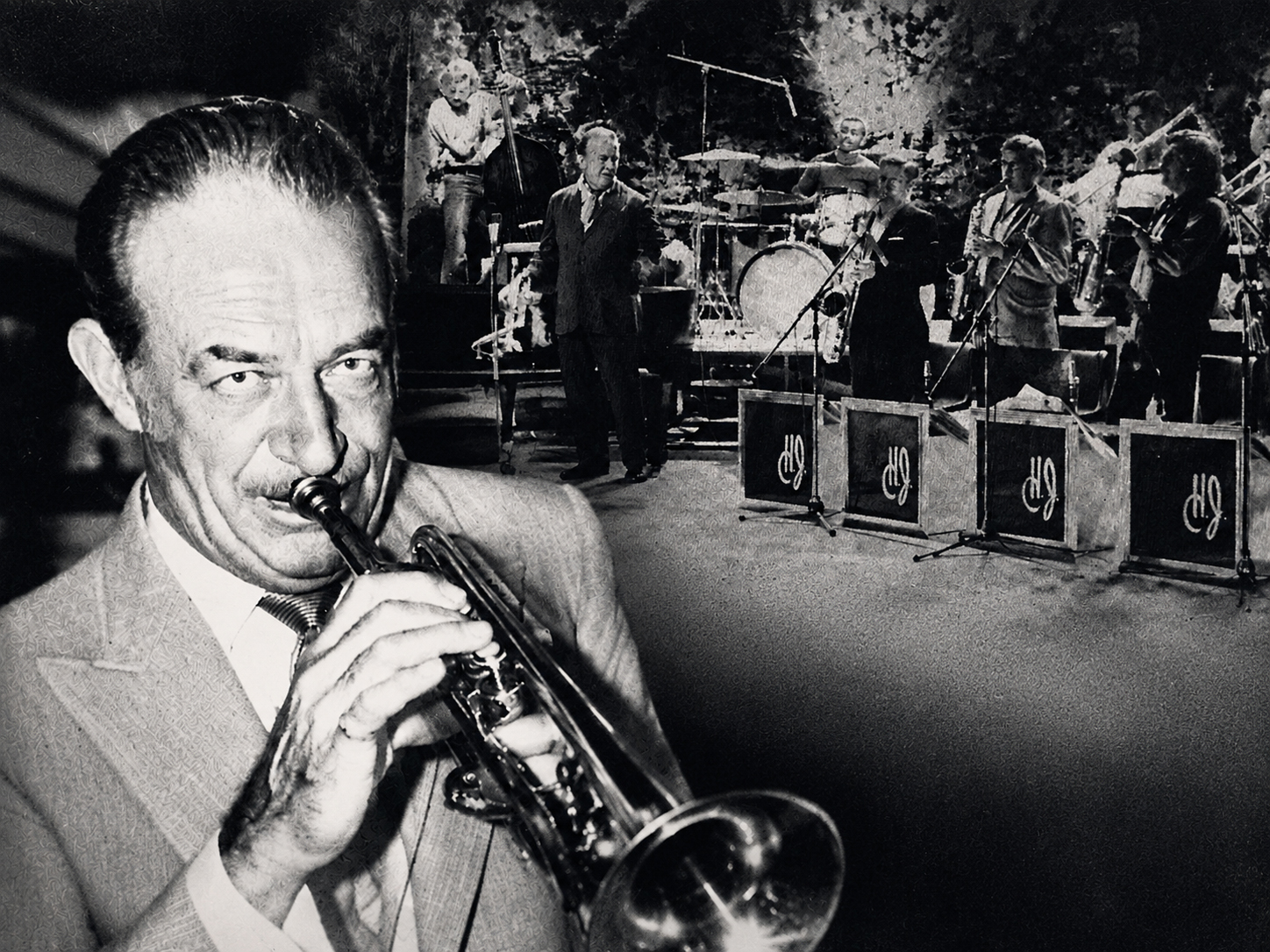
Harry James
A curtain opens to reveal a trumpet bell whose music glows with fire... Harry James. A whole generation of listeners and trumpet players will long remember the man who introduced them to the charms of the “concert trumpet”, even to jazz. In this field of music there are both creators and “popularisers” (with no pejorative connotations), each with his own essential role to play. Harry assimilated jazz but he was best known as the star leading his own band, distilling a form of expression both seductive and accessible to the tastes of the white audience.
Harry was born into a family of musicians in the state of Georgia in 1916. His father Everette James, a circus musician from New Orleans, started him on drums when he was very young, then on trumpet when he was ten. Harry seems to have been a member of that generation which did not arrive at the trumpet via the cornet. His father moved to Beaumont, Texas, where he taught in school and gave private music lessons. This was when Harry first became the star of his high-school band. Although Everette slanted the boy prodigy’s education towards a “legitimate” career, the “young man with a horn” was drawn to jazz. In 1931 Louis Armstrong was drawing the crowds and bringing true recognition to the trumpet. That year Harry played for various local bands, including that of the violinist Joe Gill who took him to New Orleans. By 1932 he was professional and was clearly set on the path of dance music and jazz. His first job with a well known band came in 1935 when the phenomenon from Texas caught the attention of the drummer Ben Pollack. Harry stayed with Pollack for a year and, thanks to him, recorded his first solos (“Deep Elm”).
But what really made him familiar to a wide audience was when he joined clarinettist Benny Goodman’s very popular band (January 1937 to December 1938). The trumpet section was one of the most famous in the history of jazz and light music: Harry James, Ziggy Elman and Chris Griffin!
In 1937 the black players Lionel Hampton and Teddy Wilson invited him to sessions where he proved to be an excellent jazz player, very close to the black style¹. On 16th January 1938 he took part in the legendary Goodman concert in Carnegie Hall. Surely everyone has heard Harry’s virtuoso playing in “Sing, Sing, Sing”? Despite the talent of Bunny Berigan, his greatest rival, Harry continued to climb and in 1939 he was rated number one in all the polls. This led to his recording on 11th January 1939 with the Metronome All-Stars, a group intended to reassemble the favourite players of the readers of the magazine “Metronome”: Bunny Berigan, Sonny Dunham and Harry James on trumpet; Tommy Dorsey and Jack Teagarden on trombone! A whole era when syncopation was in the hands of the greatest brass virtuosos, regardless of style — the Golden Age! Yet Harry remained clear-headed, as the drummer Jo Jones relates: “In a poll conducted by one of the big magazines (“Down Beat”) they offered Harry James the Oscar. He refused it and said, ‘Take that back and give it to Louis Armstrong’...”
In 1939 Harry started to look around: he recorded “Ciribiribin” which shows jazz influence in the phrasing combined with almost “classical” features. (Ex. 1)
Continue reading
Accede a la edición digital completa.
Brass Bulletin 45, I / 1984 páginas 14–17
Todo el contenido está protegido por derechos de autor © Brass Bulletin 1984–2026