18 min. read
Brass in the Operas of Berlioz
This article is an extract from a thesis entitled “The Orchestra in the Operas of Berlioz”, presented by the author at the École Pratique des Hautes Études in Paris in April 1983.
References in the text use the initial letters of the opera titles (T = “The Trojans”, BC = “Benvenuto Cellini”, BB = “Beatrice and Benedict”) followed by the number of the page quoted (T 643 = “The Trojans”, p. 643).
All references to “The Trojans” and “Beatrice and Benedict” apply to the new Bärenreiter edition. As for “Benvenuto Cellini”, which has not yet appeared in that edition, references are to the old Breitkopf + Härtel edition of 1901.
Introduction
Of all families in the orchestra it was the brass that grew most in the time of Berlioz, gaining ground and winning itself a place almost equal to that of the other sections in the orchestra. At first it made its mark through its volume of sound and its force, which far surpassed those of the other sections.
In addition to this the brass contributed indirectly to an expansion in the other families for they had to confront this mass of sound and reinforce themselves in their turn. The brass abandoned the role it had had in the classical orchestra, a role which was limited to fanfares and sustained horn notes, to become instead a solid foundation for the tutti, and it is the brass that confers that breadth which seizes the listener physically and which turns a symphony concert into an irresistible experience involving the whole person.
Berlioz was neither the first nor the only composer to use the brass in this new Romantic way but, as everywhere else in his orchestral language, he was the one who did it in the most conscious, varied and effective way. These instruments are not quite the equivalent of woodwind or strings, in either their agility of movement or their melodic expressiveness, but they can be used in an enormous number of ways, from the traditional use with military or solemn associations to the gentlest reverie.
The brass are less homogeneous as a group than the woodwind or the strings and even their composition and number vary from one piece to another. Only the horns are almost permanent while the others come and go according to requirements. In BB, which as a comic opera uses a small orchestra, Berlioz uses none at all in several numbers (nos. 6, 12) and makes do with only two horns in others (nos. 4, 7, 8), reserving the use of the full brass for the overture, the finale and scene 14.
In BC trombones are used only from Act 2 onwards. Their frequent and almost permanent use characterises the “Trojans” orchestra which is intended to be more sombre in colour. The combination of horns with cornets and trumpets normally gives a more brilliant and penetrating effect while horns with trombones give a heavier, and also darker and more subdued effect. The combination of trumpets and trombones, without horns, practically never occurs.
For dynamic graduation in brass Berlioz does not rely exclusively on the players to increase and reduce the sound; he “writes it in”, adding and suppressing instruments gradually. A piece which illustrates this technique in a remarkable way is the “March and Hymn”, no. 4 of “The Trojans”, where the brass plays a central role and where every gradation, from two instruments to twelve (ex. 1) can be found, always matching the desired intensity and volume.
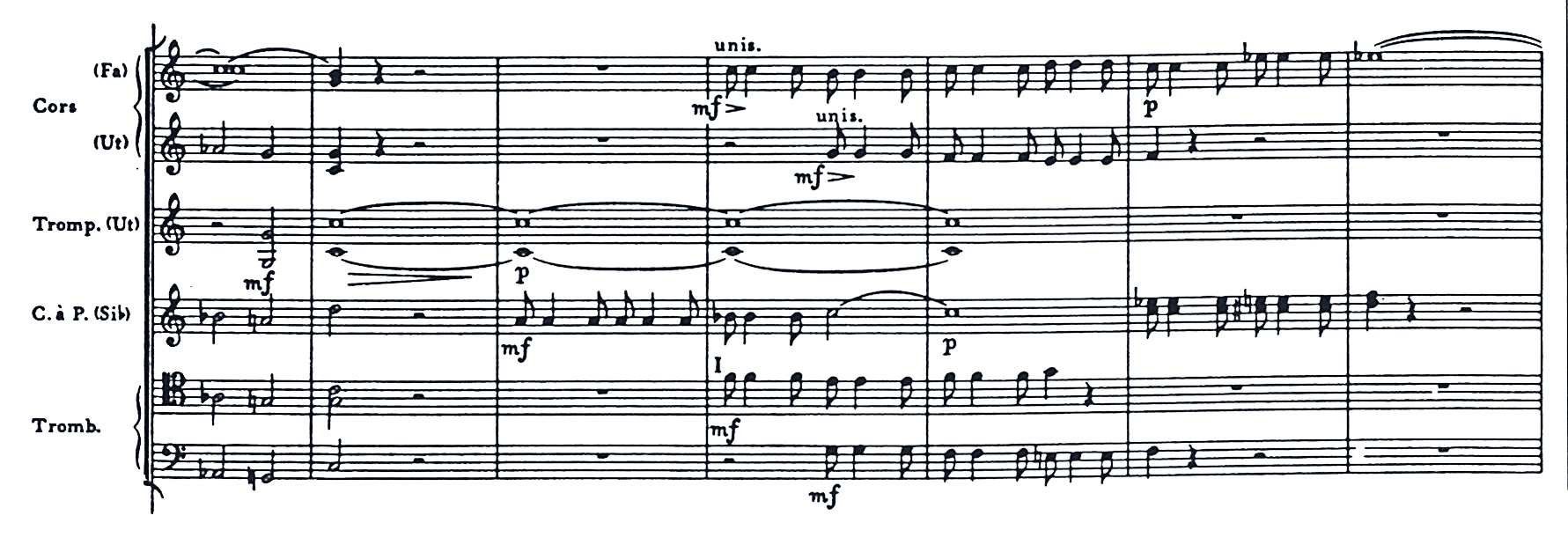
Example 1
March and Hymn, no. 4 of The Trojans
Brass Bulletin 45, I / 1984 pages 18–30
All content is protected by copyright © Brass Bulletin 1984–2026