5 min. read
Jean-Baptiste Prin (1669-1742)
A tromba marine virtuoso
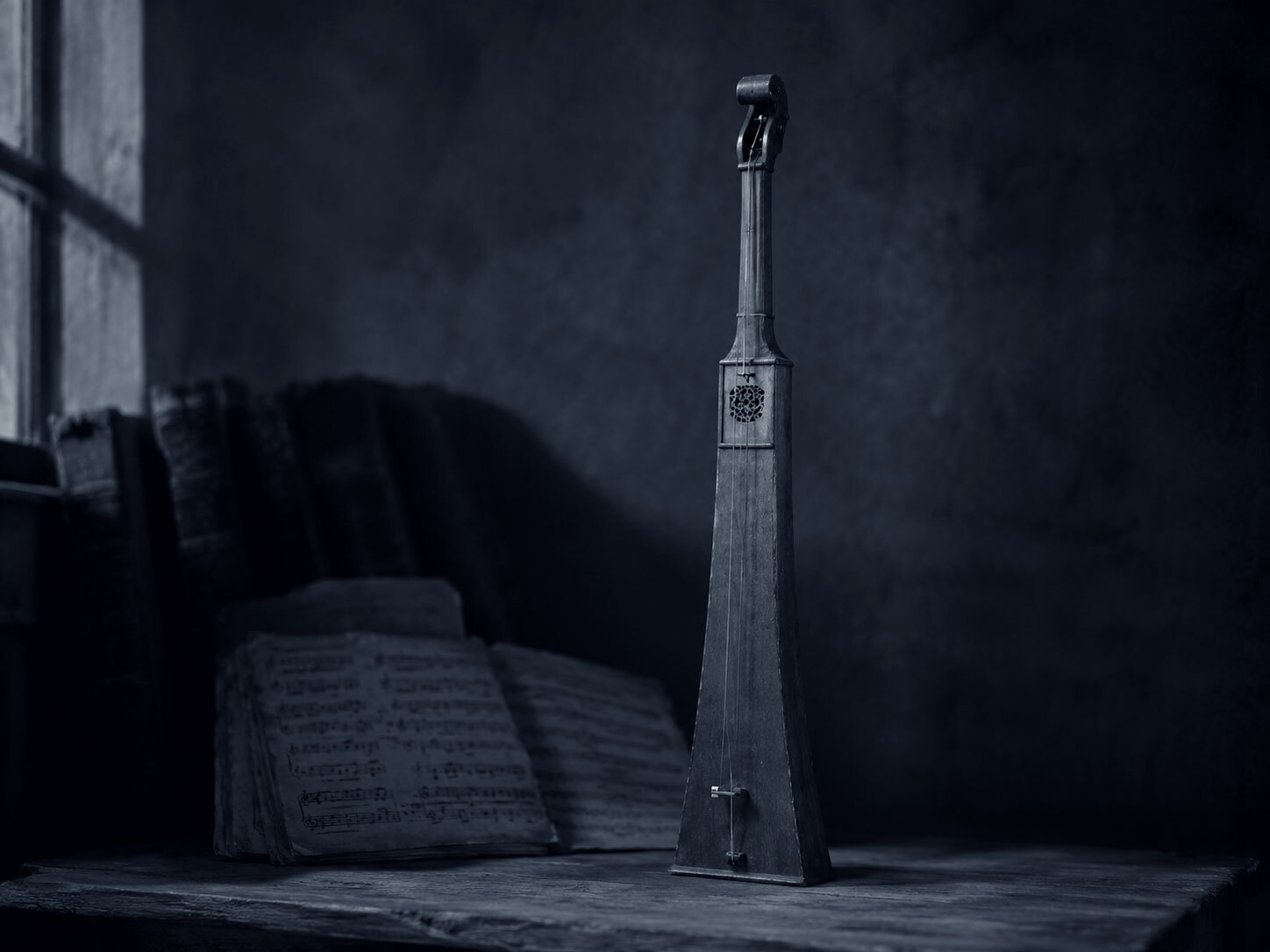
The tromba marine
The importance for trumpeters of today of his work as collector and composer.
What stimulated me to take up a study of J. B. Prin was the recording of a suite L’Echo de Psyché based on pieces by him, made by Guy Touvron (trumpet) with Wolfgang Karius (organ) and Nicholas Bardach (timpani) (Schwann VMS 2970 LC).
About the man we know little: Prin was born in England in 1669 and died in Strasbourg after 1742. He appeared as a dancer in Paris and Lyon after 1698. He was known primarily as a tromba marina virtuoso. He left his collection of music as well as his instrument to the town of Lyon.
Of course an article on the tromba marina would be out of place in a brass magazine. Closer inspection, however, reveals something particularly interesting for us trumpeters: Prin’s musical bequest consists primarily of a collection of original trumpet works.
But in order to understand why Prin collected and arranged original trumpet works from various sources we ought first to take a brief look at the tromba marina. Prin’s German contemporary Johann Gottfried Walter describes it thus:
“A musical instrument consisting of three boards and, like a triangle, quite wide and open at the foot, but tapering narrowly, with a long neck... It has only one heavy gut string which is bowed at the top with a fiddle bow and stopped at certain places by the player’s left thumb, so that it sounds like a trumpet, but softer and more pleasant” (Johann Gottfried Walter: Musikalisches Lexicon..., Leipzig 1732, facsimile published by R. Schaal, Kassel and Basle, 1953 in Documenta musicologica, Series 1, vol. 3, p. 619).
From Illustration 2 we can see that the bridge was shaped like a shoe. It was fixed only on one side (a) while the free end (b) drummed rapidly against the belly of the instrument as the string vibrated, thus causing the blaring sound. The single string was tuned to C or D and had to be fingered so as to produce harmonics. Thus only the notes of the natural harmonic series could be produced, with the same compass and choice of notes as the natural trumpets of the time. This is all the information we need.
Brass Bulletin 39, III / 1982 pages 53–58
All content is protected by copyright © Brass Bulletin 1982–2026