Ofrezca Brass Bulletin en su universidad, conservatorio o biblioteca Descubra el acceso institucional

18 min de lectura

Brass in the Operas of Berlioz

Berlioz turned a changing brass section into a dramatic force, using horns, trombones, cornets and saxhorns to shape colour, distance, ceremony and fear.
Brass in the Operas of Berlioz

This article is an extract from a thesis entitled “The Orchestra in the Operas of Berlioz”, presented by the author at the École Pratique des Hautes Études in Paris in April 1983.

References in the text use the initial letters of the opera titles (T = “The Trojans”, BC = “Benvenuto Cellini”, BB = “Beatrice and Benedict”) followed by the number of the page quoted (T 643 = “The Trojans”, p. 643).

All references to “The Trojans” and “Beatrice and Benedict” apply to the new Bärenreiter edition. As for “Benvenuto Cellini”, which has not yet appeared in that edition, references are to the old Breitkopf + Härtel edition of 1901.

Introduction

Of all families in the orchestra it was the brass that grew most in the time of Berlioz, gaining ground and winning itself a place almost equal to that of the other sections in the orchestra. At first it made its mark through its volume of sound and its force, which far surpassed those of the other sections.

In addition to this the brass contributed indirectly to an expansion in the other families for they had to confront this mass of sound and reinforce themselves in their turn. The brass abandoned the role it had had in the classical orchestra, a role which was limited to fanfares and sustained horn notes, to become instead a solid foundation for the tutti, and it is the brass that confers that breadth which seizes the listener physically and which turns a symphony concert into an irresistible experience involving the whole person.

Berlioz was neither the first nor the only composer to use the brass in this new Romantic way but, as everywhere else in his orchestral language, he was the one who did it in the most conscious, varied and effective way. These instruments are not quite the equivalent of woodwind or strings, in either their agility of movement or their melodic expressiveness, but they can be used in an enormous number of ways, from the traditional use with military or solemn associations to the gentlest reverie.

The brass are less homogeneous as a group than the woodwind or the strings and even their composition and number vary from one piece to another. Only the horns are almost permanent while the others come and go according to requirements. In BB, which as a comic opera uses a small orchestra, Berlioz uses none at all in several numbers (nos. 6, 12) and makes do with only two horns in others (nos. 4, 7, 8), reserving the use of the full brass for the overture, the finale and scene 14.

In BC trombones are used only from Act 2 onwards. Their frequent and almost permanent use characterises the “Trojans” orchestra which is intended to be more sombre in colour. The combination of horns with cornets and trumpets normally gives a more brilliant and penetrating effect while horns with trombones give a heavier, and also darker and more subdued effect. The combination of trumpets and trombones, without horns, practically never occurs.

For dynamic graduation in brass Berlioz does not rely exclusively on the players to increase and reduce the sound; he “writes it in”, adding and suppressing instruments gradually. A piece which illustrates this technique in a remarkable way is the “March and Hymn”, no. 4 of “The Trojans”, where the brass plays a central role and where every gradation, from two instruments to twelve (ex. 1) can be found, always matching the desired intensity and volume.
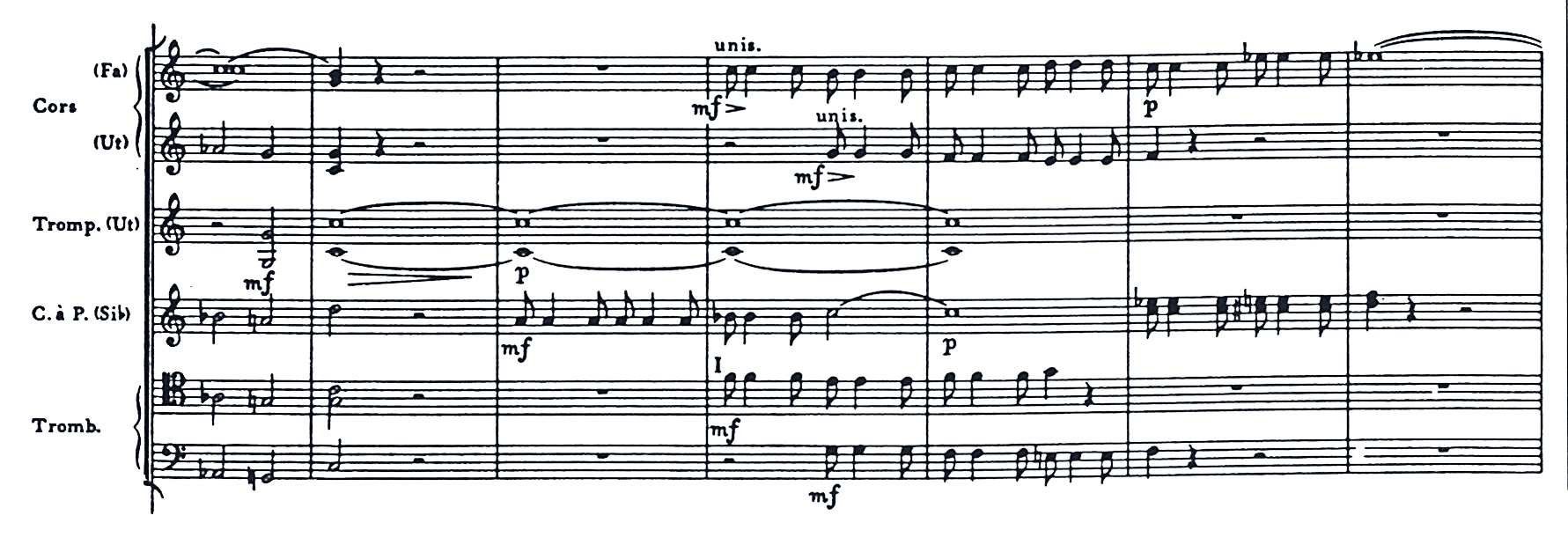
Example 1March and Hymn, no. 4 of The Trojans

Example 1

March and Hymn, no. 4 of The Trojans

Continue reading

Accede a la edición digital completa.

Brass Bulletin 45, I / 1984 páginas 18–30

Todo el contenido está protegido por derechos de autor © Brass Bulletin 1984–2026

Compartir este artículo

Facebook LinkedIn
Cargando…

Preguntas y respuestas

Cómo funciona la edición digital

¿Qué incluye la edición digital?

La edición digital reúne los artículos ya digitalizados como textos legibles y consultables en línea —no simplemente como escaneos o archivos PDF— junto con sus ilustraciones originales, notas, autoría, información del número y traducciones disponibles. Las sugerencias de artículos relacionados incluyen actualmente solo este material digitalizado.

¿Los artículos digitales son idénticos a los originales?

Conservamos con la mayor fidelidad posible el texto original, el idioma, las ilustraciones, los pies de imagen, las notas y el contexto editorial. La presentación se adapta para facilitar la lectura en línea y pueden corregirse errores evidentes de transcripción o escaneado. El contenido y el carácter del artículo publicado permanecen inalterados.

¿Qué idiomas están disponibles?

Brass Bulletin se publicó en inglés, francés y alemán a lo largo de toda su historia. Las traducciones al italiano y al español se añadieron a partir del número 60. Por este motivo, en los sitios italiano y español los artículos de los números 1 a 59 se muestran en inglés de forma predeterminada.

¿Con qué frecuencia se añaden nuevos artículos?

Se añaden nuevos artículos casi a diario, con aproximadamente un número completo digitalizado cada semana. El ritmo puede variar según el trabajo de preparación, tratamiento de imágenes y revisión editorial necesario.

¿Por qué no están disponibles todos los artículos en formato digital?

La colección completa de Brass Bulletin contiene 1.246 artículos publicados entre 1971 y 2003. El índice completo ya está disponible en línea y permite descubrir todos los artículos de la colección, incluidos aquellos cuyo texto íntegro todavía no ha sido digitalizado.

La digitalización comenzó en febrero de 2026. Cada artículo se prepara cuidadosamente para la lectura en línea, se revisa y se vincula con su número, sus autores, sus temas y sus ilustraciones. Al ritmo actual de digitalización, se prevé que la colección completa esté disponible en línea en febrero de 2028.

¿Por qué algunas referencias mencionan artículos que todavía no están disponibles?

Las referencias de los artículos originales se conservan aunque el material al que remiten aún no haya sido digitalizado. De este modo se mantiene intacto el contexto histórico y editorial. A medida que se incorporen más números a la edición digital, un número creciente de estas referencias conducirá a artículos que podrán leerse en línea.

¿Puedo sugerir un artículo o informar de un error de transcripción?

Sí. Si hay algún artículo que le gustaría especialmente ver digitalizado, o si detecta un posible error de transcripción o algún dato que falta, póngase en contacto con nosotros. Los comentarios de los lectores nos ayudan a mejorar la edición digital y a establecer prioridades útiles dentro del archivo.

¿Cómo puedo apoyar a Brass Bulletin?

Su apoyo ayuda a financiar la preparación, verificación y publicación en línea de la colección completa.

Suscríbase a la Edición Digital

¿Prefiere apoyarnos sin suscribirse?

Haga una donación

¿Cómo avanza la digitalización?

Estamos poniendo Brass Bulletin a disposición de los lectores en línea, artículo por artículo. Pueden leer los artículos recién digitalizados en cuanto estén listos, incluso antes de que se complete un número entero.

Consulten nuestro calendario de digitalización para descubrir las últimas novedades y las fechas estimadas de disponibilidad de los próximos números. Estas estimaciones se basan en nuestro ritmo reciente y pueden cambiar.

Busca en Brass Bulletin.