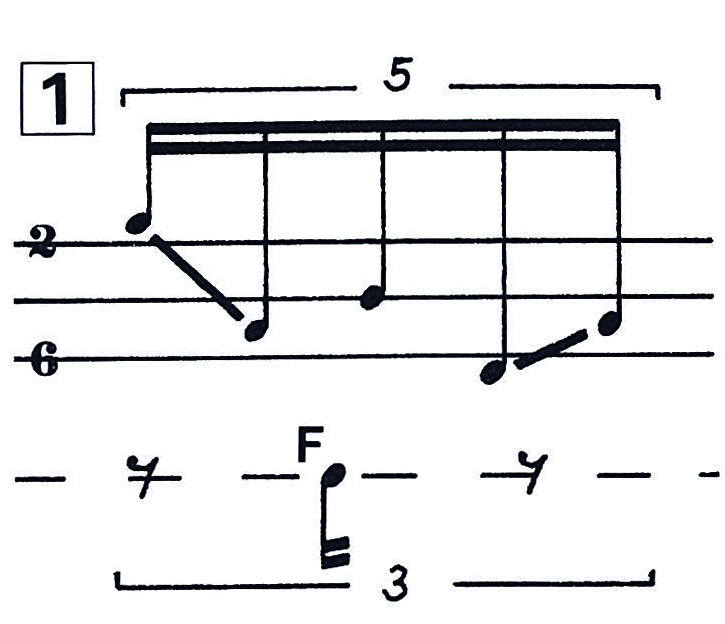
B) The stave for the overtones lies below the stave for the slide. It is a good idea to retain the standard five-line stave but to use it only to notate overtone relationships. As a standard solution I suggest starting with pedal B♭ and fitting the overtones into the stave in such a way that the eighth partial above pedal B♭ (i.e: C in the treble stave) fits on to the line which is normally C in the tenor stave. A reversed tenor clef will indicate this procedure; in addition, to show that this indicates only relative pitch, dependent on the slide position, a rhombic note-shape is used. (Ex. 2)
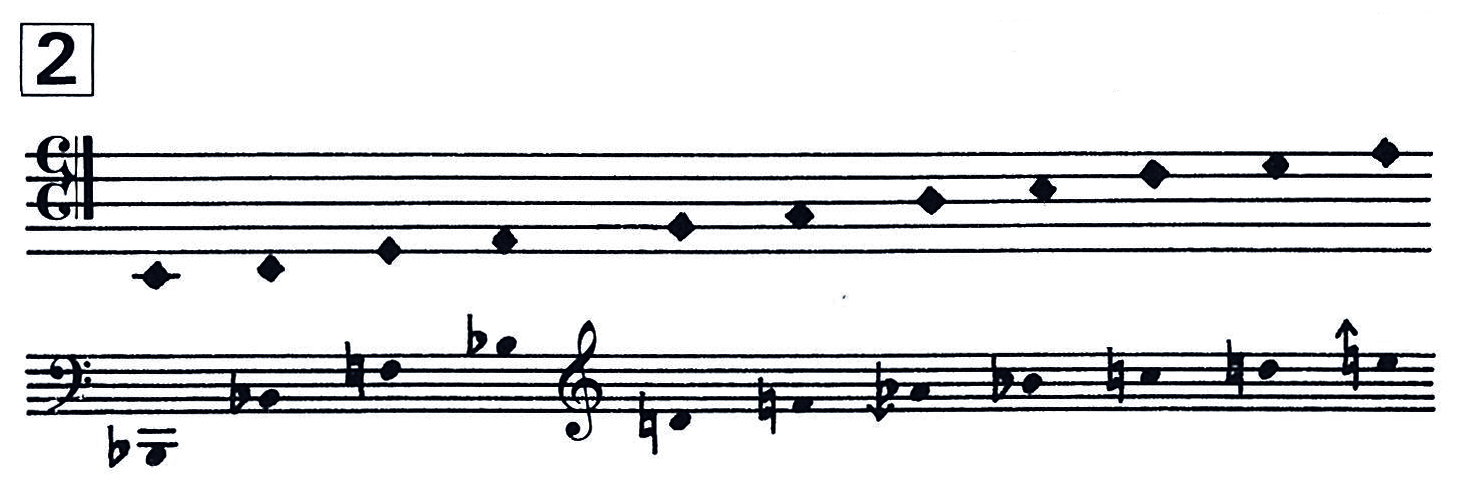
Example 2
Combining these two staves now makes it possible to notate clearly anything which it is technically possible to play. In addition a small stave carrying cue-notes can be used at appropriate points to provide help by indicating the absolute pitch at a given moment. Further instructions can easily be integrated into this basic system. As a rule care should be taken to incorporate anything affecting lips and breathing into stave B and anything affecting movements into stave A. Specifically, this means that the following belong to A:
a) slide vibrato,
b) use of the valves (valve trills);
and the following to B:
c) diaphragm vibrato,
d) flutter-tonguing,
e) lip trills (between overtones),
f) blowing sounds,
g) singing into the instrument (notated on the cue-note stave).
The use of any other leger lines should be avoided as far as possible. Where these are unavoidable — to indicate rhythmically independent use of a mute mounted on a stand, (h), for example — they can easily be introduced above or below the main staves.
The final example — two bars from my composition “Cercar” (1983) for trombone solo — shows that the notation system suggested here ensures a comprehensible presentation even in quite complex situations.² (The small letters refer to the playing techniques listed above.) (Ex. 3)
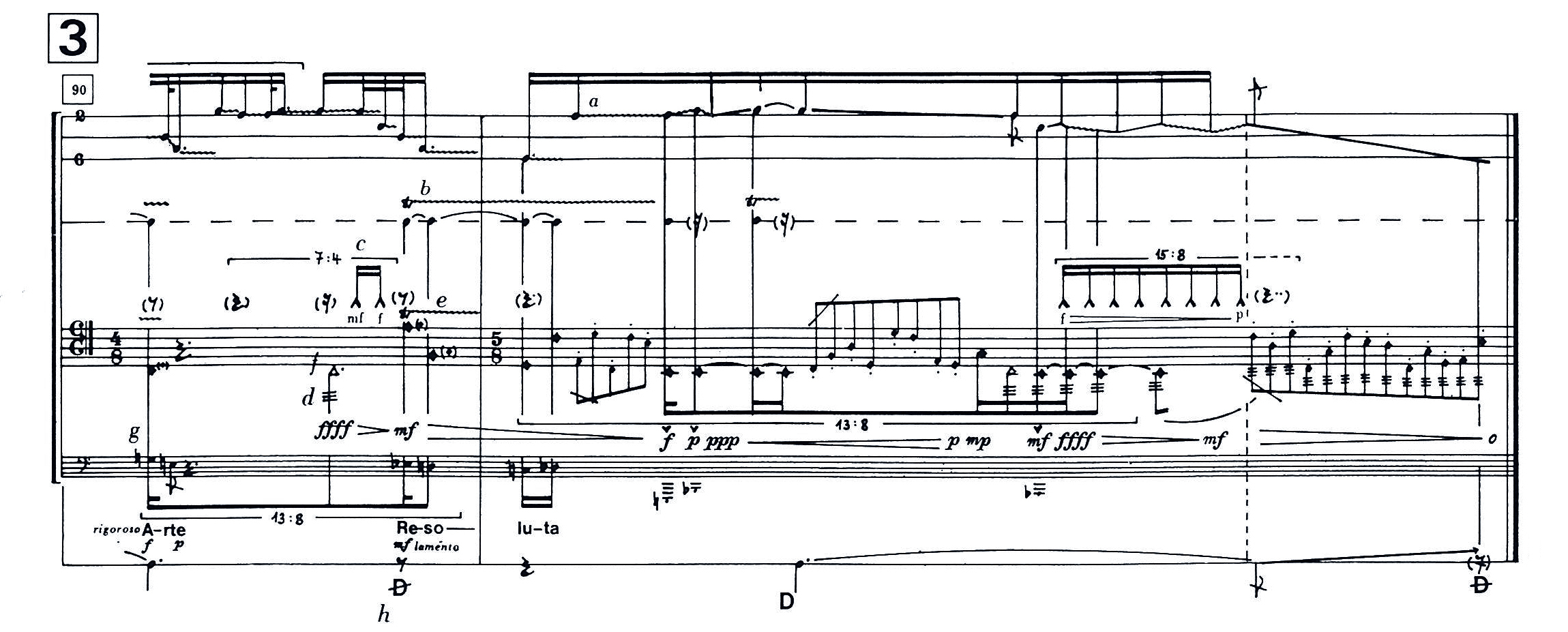
Example 3