Explore institutional access Explore institutional access

7 min. read

On the early history of valves and valve instruments in Germany (1814-1833)
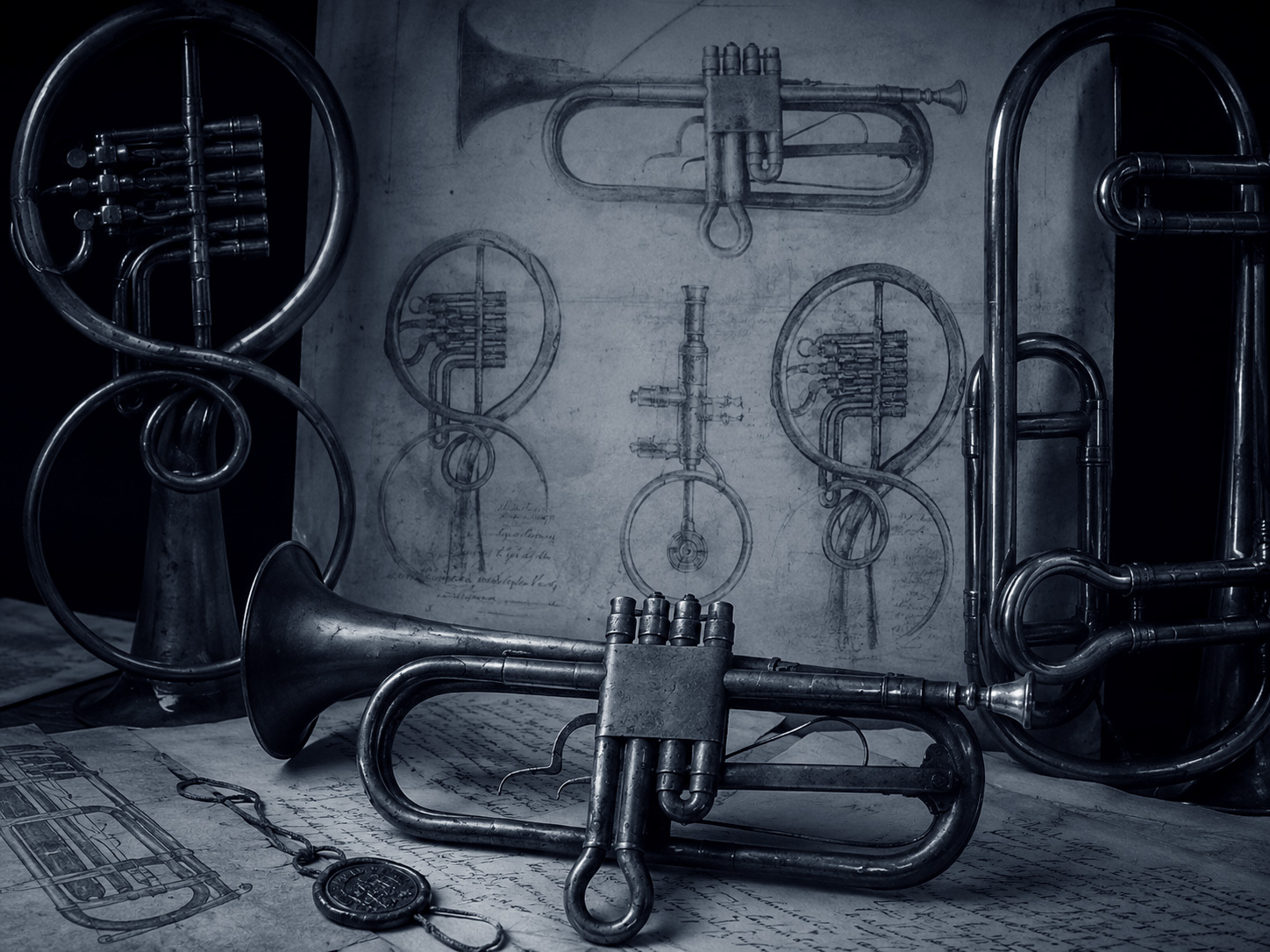
Part 4 – End

By Herbert Heyde

Poverty, patents and workshop rivalries shaped the first German valve instruments, from Blühmel and Stoelzel to the Vienna and Mainz systems.
On the early history of valves and valve instruments in Germany (1814-1833)

Blühmel and Stoelzel personally

It has not been possible to acquire more information about Blühmel's life than what we have described in the previous chapters. It is, however, interesting to consider Blühmel's application for a patent for woodwind instruments of 1 October 1828 on account of his biographical note at the beginning of his application:

"When I was young I learned to know woodwind instruments and later I had to perform many repairs on such instruments, since people relied upon me to be knowledgeable of wind instruments."

Blühmel was a miner in Waldenburg, Silesia; he learned about woodwind instruments and, on account of his mining work, had to exchange the violin for the Waldhorn and the trumpet. This was probably the moment when he became a Berghautboist (mountain-oboist). He died before 1845.

The following quotations show that Blühmel lived in needy circumstances: In a letter of 8 April 1818, addressed to the State Minister, Blühmel asks

"the charitable promoter of all that is useful and good, for financial aid..., in order to enable me to return to Silesia a little less wretched on account of pecuniary difficulties."

On April 14 State Minister von Bülow ordered the Public Treasury to pay Blühmel "100 Thaler from the Fund for Industrial Purposes against receipt.”

Blühmel recognizes in the same letter that the 400 Thaler of indemnity paid by Stoelzel are

"a very paltry compensation for all the trouble and expenses I invested in my invention over many years. However, considering Stoelzel's destitute situation I could not claim more."

Continue reading

Access the full Digital Edition.

Brass Bulletin 27, III / 1979 pages 51–61

All content is protected by copyright © Brass Bulletin 1979–2026

Share this article

Facebook LinkedIn
Loading…

Questions & Answers

How the Digital Edition works

What does the Digital Edition include?

The Digital Edition brings together the articles already digitized as searchable online texts—not simply as scans or PDF files—along with their original illustrations, notes, authorship, issue information, and available translations. Related-article suggestions currently include only this digitized material.

Are the digital articles identical to the originals?

We preserve the original text, language, illustrations, captions, footnotes, and editorial context as faithfully as possible. The presentation is adapted for comfortable online reading, and obvious transcription or scanning errors may be corrected. The substance and character of the published article remain unchanged.

Which languages are available?

Brass Bulletin was published in English, French, and German throughout its history. Italian and Spanish translations were added from issue No. 60 onward.

On the Italian and Spanish sites, articles from issues 1–59 are therefore shown in English by default.

How often are new articles added?

New articles are added almost daily, with approximately one complete issue digitized each week. The pace may vary depending on the preparation, image work, and editorial checking required.

Why aren’t all articles available digitally?

The complete Brass Bulletin collection contains 1,246 articles published between 1971 and 2003. The full index is already available online, allowing readers to discover every article in the collection, including those whose complete text has not yet been digitized.

Digitization began in February 2026. Each article is carefully prepared for online reading, checked, and connected to its issue, authors, subjects, and illustrations. At the current pace of digitization, the complete collection is expected to be available online by February 2028.

Why do some references mention articles that are not available yet?

References in the original articles are preserved even when the material they point to has not yet been digitized. This keeps the historical and editorial record intact. As more issues are added to the Digital Edition, an increasing number of these references will lead to articles that can be read online.

Can I suggest an article or report a transcription error?

Yes. If there is an article you would particularly like to see digitized, or if you notice a possible transcription error or missing detail, please contact us. Reader feedback helps us improve the Digital Edition and prioritize useful connections within the archive.

How can I support Brass Bulletin?

Your support helps fund the preparation, verification, and online publication of the complete collection.

Subscribe to the Digital Edition

Prefer to support us without subscribing?

Make a donation

Search Brass Bulletin.