20 min. read
Part 2 – End
300 Years of the Horn
in the Dresden Court Orchestra
By Peter Damm
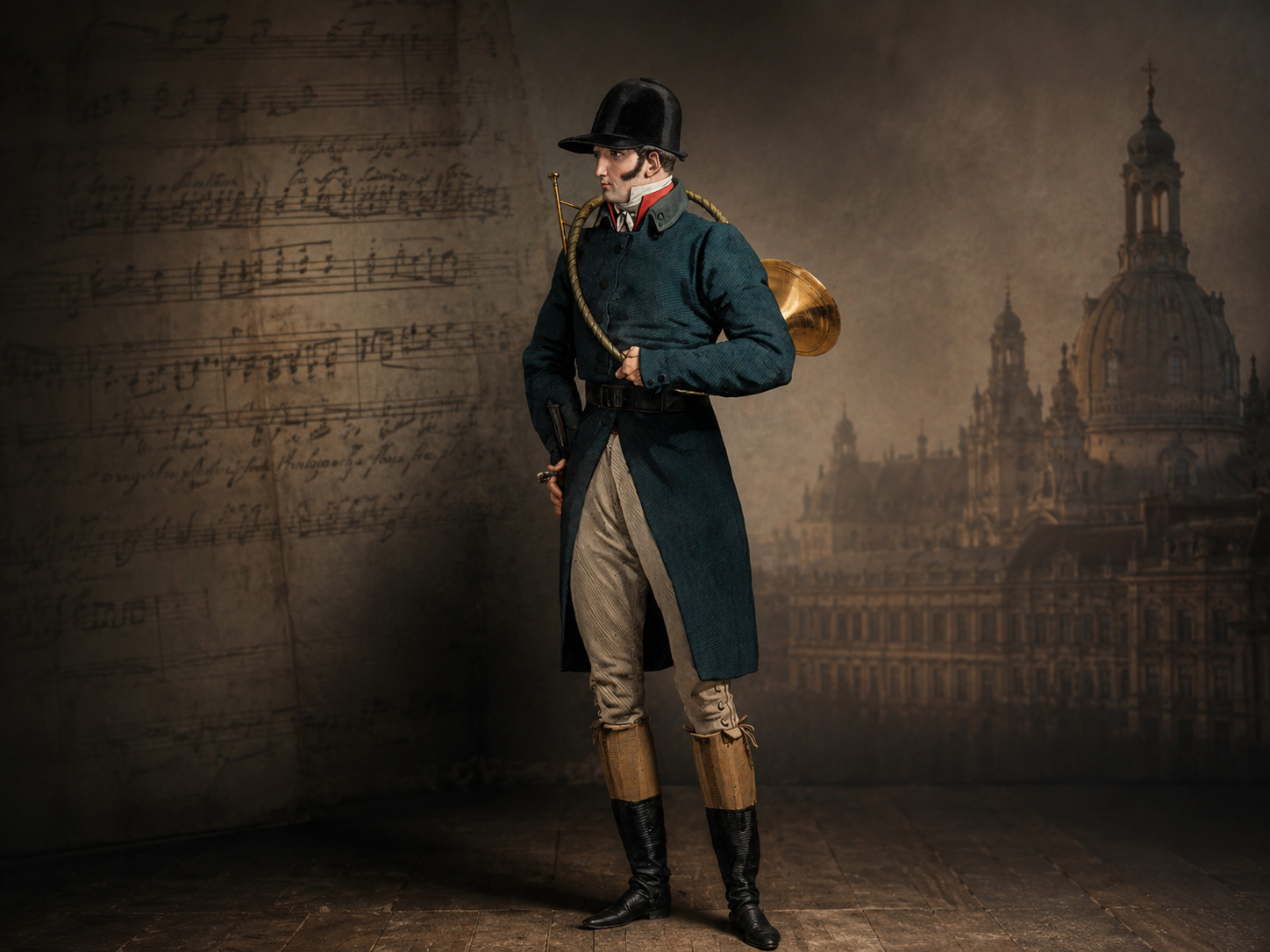
And now something of the history of the horn in the Dresden Court Orchestra, now the Dresden Staatskapelle.²³
Our orchestra is one of the oldest there is. The deed of foundation of the orchestra was signed by Moritz of Saxony as early as 1548. After a difficult period music at the Dresden court found fresh impetus during the reign of Friedrich August I.
Between 1709 and 1719 the orchestra was enlarged and reorganised. Especially noteworthy are the services rendered by Jean-Baptiste Volumier (c. 1670–1728) who had been educated at the French court and came to Dresden as concert master in 1709. Volumier combined a French idea of perfection and an Italian sense of sound, qualities which transmitted themselves to the orchestra and made its playing so famous. Volumier introduced an orchestral discipline stemming from Lully.
In addition to the Court Orchestra Dresden possessed other bands whose members were occasionally brought in to reinforce the Court Orchestra. Lack of evidence prevents us from establishing anything about the musicians in these other groups. This applies to the brothers Czermak in Dlabacz, mentioned by Horace Fitzpatrick,²⁴ as well as to the "Crown Prince's Horn Player" Tobias Butz, mentioned by M. Fürstenau.²⁵
By the beginning of the 18th century the Regimental Oboes of the Saxon Infantry too, in addition to four oboes and two bassoons, also had two horns. When playing for balls and other festivities they used a combination consisting of "2 violins, 1 violone, 1 flute or oboe, 2 Waldhörner and 2 lutes".²⁶
Throughout the period which began with the arrival of J.B. Volumier in 1709 and lasted until after the era of Johann Adolf Hasse the Electoral Court Orchestra was one of the most perfect and best constituted ensembles of its time, as Jean-Jacques Rousseau said.²⁷ In the orchestral lists we find names from all over Europe including artists from Italy and France as well as some from Bohemia.
One of the Bohemians was Johann Adalbert Fischer from Pressnitz, now Breznice in Czechoslovakia. Franz Adam Samm was not, as previously thought, from Bohemia for he says himself that he came from Arnstein in Franconia.²⁸ Was it the influence of the concert master Jean-Baptiste Volumier, who was educated at the French court and so knew the cultivated sound and splendid effect of horns, that led to the two horn players being employed? Or was it a genuine interest in art that made the young Elector Friedrich August I (King Augustus II of Poland) introduce horns into his court orchestra?
Brass Bulletin 32, IV / 1980 pages 19–41
All content is protected by copyright © Brass Bulletin 1980–2026