Explore institutional access →

4 min. read

Part 1

Jazz Improvisation

Major scales

Jazz Improvisation

Prefatory Notes

Thomas Stevens: In my introductory article on your work as a teacher of Jazz improvisation (BRASS BULLETIN 57) the readers were informed that they would need a basic knowledge of music theory (major and minor scales, intervals and chords) as a prerequisite for studying your method. Is there anything else you wish to say before beginning what we hope will be an informative series of articles?

Charles Shoemake: The student should understand there are two basic ways to play Jazz. One is to play “by ear” without a working knowledge of scales and chords while the other is to play “by ear” with such knowledge. Both of these approaches have produced successful performers, but I prefer the second method because in the long term it provides a more solid basis for the musician’s creations, and although it may take longer to learn and require a more disciplined approach, the knowledge derived from such a course of study will better prepare the student to be able to adjust to new and sometimes more sophisticated developments in this art form as they occur.

T.S.: That being said, BRASS BULLETIN would like you to begin your series using the agreed upon format, which is to present the subject of Jazz improvisation in the same way you would if a student were to begin studies with you having absolutely no prior knowledge or experience in Jazz.

Part 1

We begin our studies with a very elementary diatonic approach. (Advanced scales and chords will follow later.)

The major scale

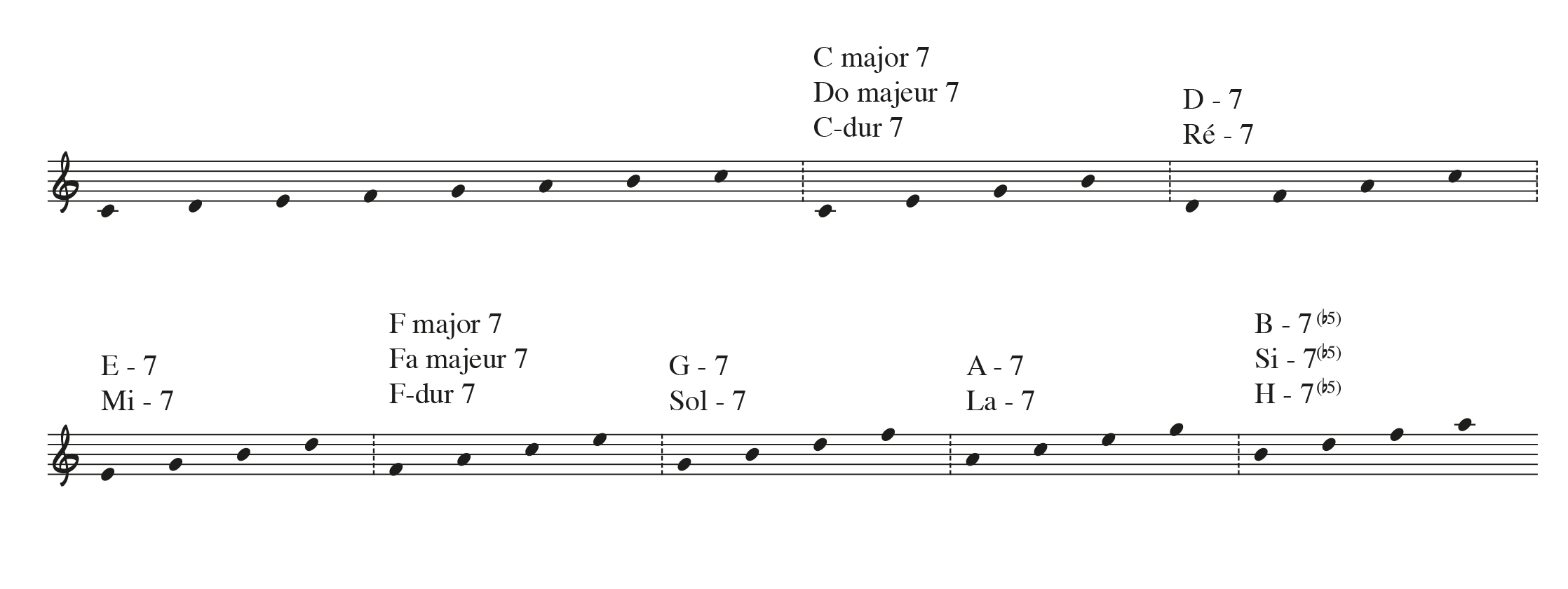
There are twelve major scales, each containing seven pitches. Four pitch chords can be formed by ascending the scale diatonically, using each diatonic scale pitch as the “root” of a chord (Example 1).

Example 1Key of C major

Example 1

Key of C major

The student should write out this example, transposing it into all major keys. The resultant types of chords are four in number, as follows: the major seventh chord (maj 7) consisting, always counting from the bottom pitch, or “root”, of a major third, minor third, major third; the minor seventh (−7) made up of minor third, major third, minor third; the dominant seventh (written simply 7) consisting of major third, minor third, minor third; and the minor seventh with flatted fifth (−7♭5) which some musicians call a half diminished chord (Ø). One should note that the types of four pitch chords will always occupy similar numerical positions in each key (I=major seventh (maj 7th) II=minor 7 (−7), etc.) (Example 2).

Example 2

Example 2

Interval exercise

Now that we understand how the basic four pitch chords are formed, we can see how important a working knowledge of intervals is. I have devised an exercise that should be helpful in this area (Example 3).

Tonality

A C F B♭ E♭ A♭ D♭ G♭ B E A D G

Pitch numbers

B 1 ♯1 ♭2 2 ♯2 ♭3 3 4 ♯4 ♭5 5 ♯5 ♭6 6 ♭7 7 (1)

The student should place his thumb on any number from group B (pitch numbers). Then place a finger on a letter from group A (tonality). The idea is to determine the correct pitch as quickly as possible. For example, if the thumb is placed on the number six, and the finger on “C” in the group above, the correct pitch would be “A” since it is the sixth pitch in the key of “C”. If the thumb is placed on the number four and the finger on “F”, the correct pitch would be “B♭” since it is the fourth interval up from “F”. One can also reverse the process. For example, place the finger on “B♭”, and the thumb on number flat seven (♭7) from the group below. The correct pitch would be “A♭”. This exercise should be practiced until there is no hesitation in recognizing any interval from any of the twelve keys listed in the group.

Chord-scale relationship

There are no chords, either simple or complex, which are not formed from some type of scale. Consequently, the ability to look at any type of chord and know which scale corresponds to it is of enormous importance.

I have spoken of the four different types of basic chords found in the major scale, and the positions they occupy therein. One should memorize the basic chord positions as a first step in the knowledge of harmony needed for improvisation (Chart).

  
C major 7(1st chord of C major scale; 4th chord of G major scale)
F major 7(1st chord of F major scale; 4th chord of C major scale)
B♭ major 7(1st chord of B♭ major scale; 4th chord of F major scale)
E♭ major 7(1st chord of E♭ major scale; 4th chord of B♭ major scale)
A♭ major 7(1st chord of A♭ major scale; 4th chord of E♭ major scale)
D♭ major 7(1st chord of D♭ major scale; 4th chord of A♭ major scale)
G♭ major 7(1st chord of G♭ major scale; 4th chord of D♭ major scale)
B major 7(1st chord of B major scale; 4th chord of G♭ major scale)
E major 7(1st chord of E major scale; 4th chord of B major scale)
A major 7(1st chord of A major scale; 4th chord of E major scale)
D major 7(1st chord of D major scale; 4th chord of A major scale)
G major 7(1st chord of G major scale; 4th chord of D major scale)

What the above means is that when you see a major seventh chord in any piece of music you have a choice of two correct major scales from which to create your improvised melodies. I have included two examples by two well-known Jazz performers, Art Farmer and Phil Woods, which illustrate how this works (Example 4). Farmer treats the D♭ maj 7 as the IV chord in “A♭”. Woods uses notes that come from both the “G” and “D” major scales over the G maj 7th.
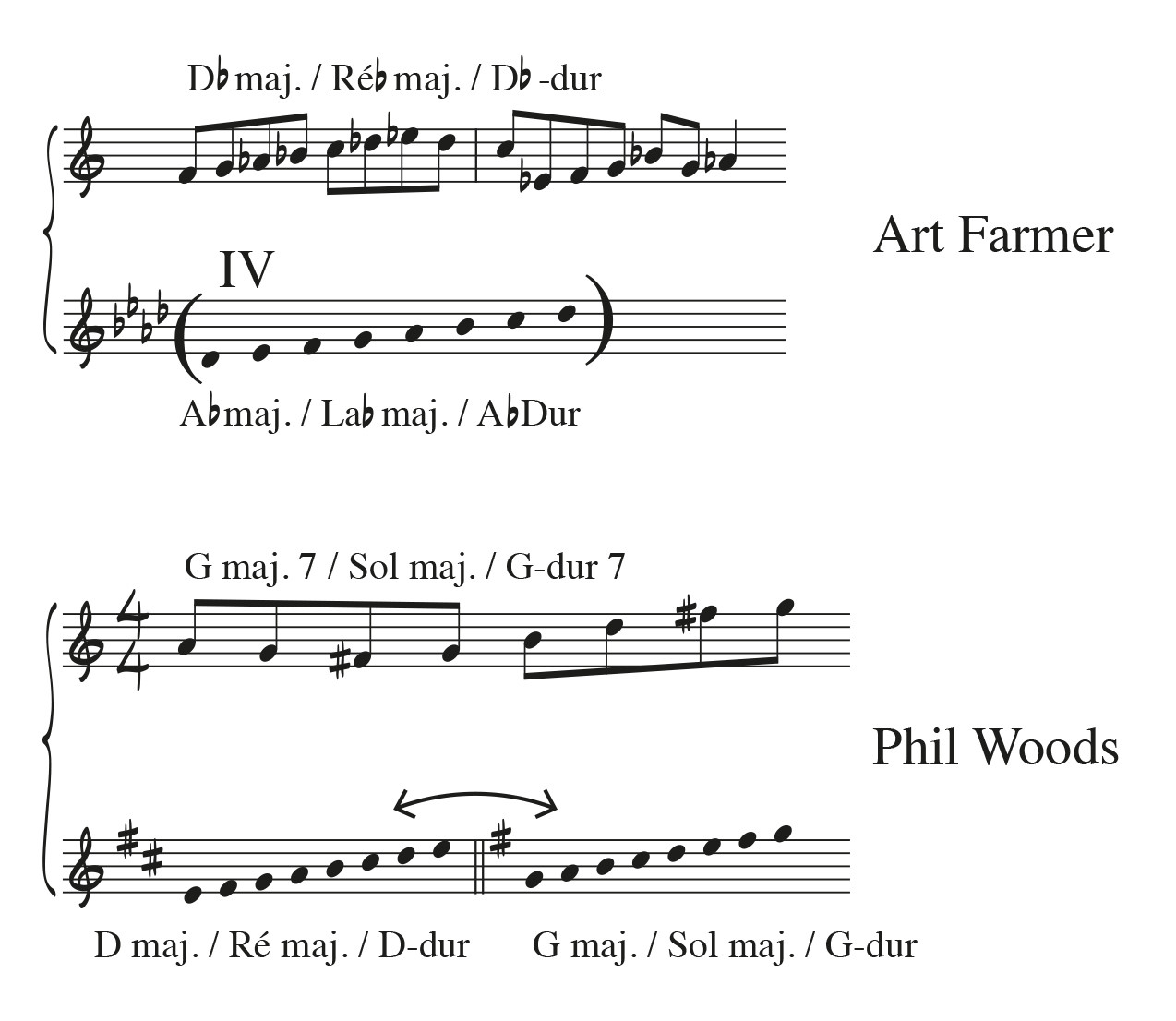
Example 4

Example 4

At this point, some of this must appear to be slightly abstract, but things will hopefully become clearer as the series develops. Who knows? Maybe it will become more confusing! It is extremely difficult for me to put in writing a system which relies so much on the interaction between the student and the teacher, but I’m going to try my best!

(to be continued)

Brass Bulletin 58, II / 1987 pages 13–16

All content is protected by copyright © Brass Bulletin 1987–2026

Share this article

Facebook LinkedIn
Loading…

Questions & Answers

How the Digital Edition works

What does the Digital Edition include?

The Digital Edition brings together the articles already digitized as searchable online texts—not simply as scans or PDF files—along with their original illustrations, notes, authorship, issue information, and available translations. Related-article suggestions currently include only this digitized material.

Are the digital articles identical to the originals?

We preserve the original text, language, illustrations, captions, footnotes, and editorial context as faithfully as possible. The presentation is adapted for comfortable online reading, and obvious transcription or scanning errors may be corrected. The substance and character of the published article remain unchanged.

Which languages are available?

Brass Bulletin was published in English, French, and German throughout its history. Italian and Spanish translations were added from issue No. 60 onward.

On the Italian and Spanish sites, articles from issues 1–59 are therefore shown in English by default.

How often are new articles added?

New articles are added almost daily, with approximately one complete issue digitized each week. The pace may vary depending on the preparation, image work, and editorial checking required.

Why aren’t all articles available digitally?

The complete Brass Bulletin collection contains 1,246 articles published between 1971 and 2003. The full index is already available online, allowing readers to discover every article in the collection, including those whose complete text has not yet been digitized.

Digitization began in February 2026. Each article is carefully prepared for online reading, checked, and connected to its issue, authors, subjects, and illustrations. At the current pace of digitization, the complete collection is expected to be available online by February 2028.

Why do some references mention articles that are not available yet?

References in the original articles are preserved even when the material they point to has not yet been digitized. This keeps the historical and editorial record intact. As more issues are added to the Digital Edition, an increasing number of these references will lead to articles that can be read online.

Can I suggest an article or report a transcription error?

Yes. If there is an article you would particularly like to see digitized, or if you notice a possible transcription error or missing detail, please contact us. Reader feedback helps us improve the Digital Edition and prioritize useful connections within the archive.

How can I support Brass Bulletin?

Your support helps fund the preparation, verification, and online publication of the complete collection.

Subscribe to the Digital Edition

Prefer to support us without subscribing?

Make a donation

How is the digitization progressing?

We’re gradually making the Brass Bulletin available online, article by article. You can read newly digitized articles as soon as they’re ready, even before an entire issue is complete.

Visit our Digitization Roadmap to browse recent additions and see estimated availability for upcoming issues. These estimates follow our recent pace and may change.

Search Brass Bulletin.