Ofrezca Brass Bulletin en su universidad, conservatorio o biblioteca Descubra el acceso institucional

4 min de lectura

Parte 1

Jazz Improvisation

Major scales

Jazz Improvisation

Prefatory Notes

Thomas Stevens: In my introductory article on your work as a teacher of Jazz improvisation (BRASS BULLETIN 57) the readers were informed that they would need a basic knowledge of music theory (major and minor scales, intervals and chords) as a prerequisite for studying your method. Is there anything else you wish to say before beginning what we hope will be an informative series of articles?

Charles Shoemake: The student should understand there are two basic ways to play Jazz. One is to play “by ear” without a working knowledge of scales and chords while the other is to play “by ear” with such knowledge. Both of these approaches have produced successful performers, but I prefer the second method because in the long term it provides a more solid basis for the musician’s creations, and although it may take longer to learn and require a more disciplined approach, the knowledge derived from such a course of study will better prepare the student to be able to adjust to new and sometimes more sophisticated developments in this art form as they occur.

T.S.: That being said, BRASS BULLETIN would like you to begin your series using the agreed upon format, which is to present the subject of Jazz improvisation in the same way you would if a student were to begin studies with you having absolutely no prior knowledge or experience in Jazz.

Part 1

We begin our studies with a very elementary diatonic approach. (Advanced scales and chords will follow later.)

The major scale

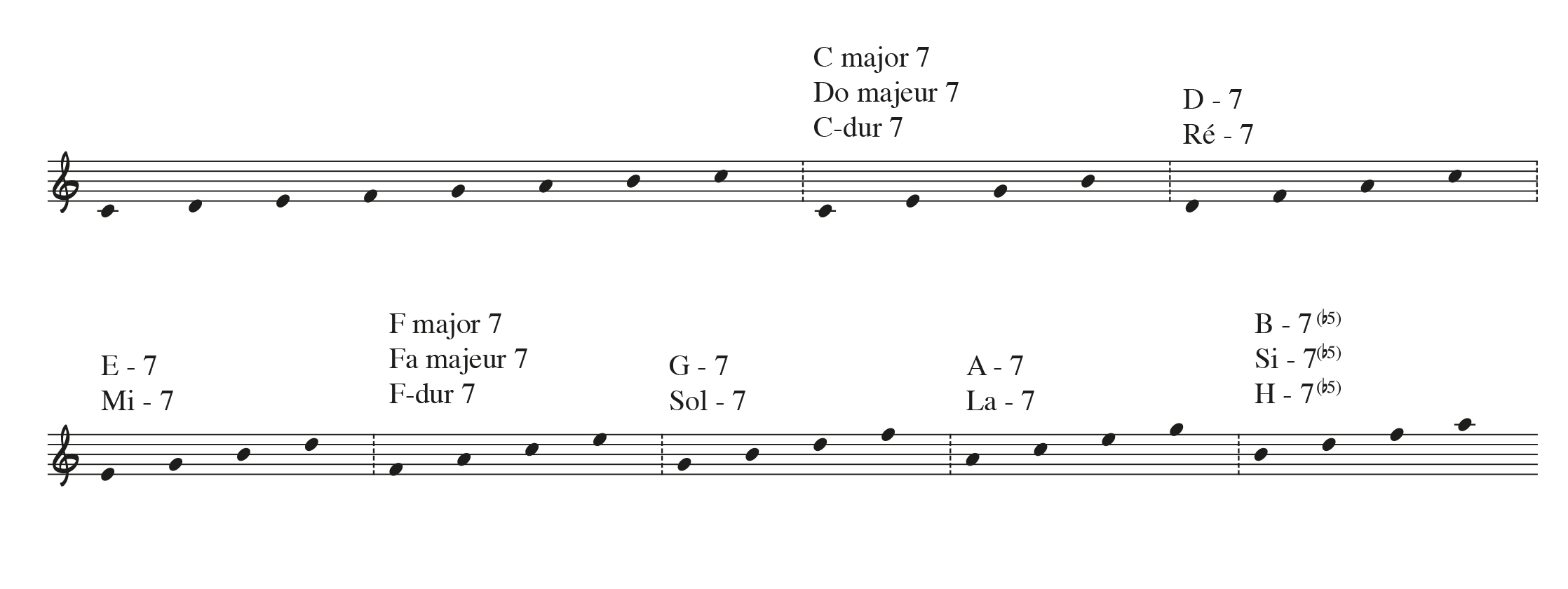
There are twelve major scales, each containing seven pitches. Four pitch chords can be formed by ascending the scale diatonically, using each diatonic scale pitch as the “root” of a chord (Example 1).

Example 1Key of C major

Example 1

Key of C major

The student should write out this example, transposing it into all major keys. The resultant types of chords are four in number, as follows: the major seventh chord (maj 7) consisting, always counting from the bottom pitch, or “root”, of a major third, minor third, major third; the minor seventh (−7) made up of minor third, major third, minor third; the dominant seventh (written simply 7) consisting of major third, minor third, minor third; and the minor seventh with flatted fifth (−7♭5) which some musicians call a half diminished chord (Ø). One should note that the types of four pitch chords will always occupy similar numerical positions in each key (I=major seventh (maj 7th) II=minor 7 (−7), etc.) (Example 2).

Example 2

Example 2

Interval exercise

Now that we understand how the basic four pitch chords are formed, we can see how important a working knowledge of intervals is. I have devised an exercise that should be helpful in this area (Example 3).

Tonality

A C F B♭ E♭ A♭ D♭ G♭ B E A D G

Pitch numbers

B 1 ♯1 ♭2 2 ♯2 ♭3 3 4 ♯4 ♭5 5 ♯5 ♭6 6 ♭7 7 (1)

The student should place his thumb on any number from group B (pitch numbers). Then place a finger on a letter from group A (tonality). The idea is to determine the correct pitch as quickly as possible. For example, if the thumb is placed on the number six, and the finger on “C” in the group above, the correct pitch would be “A” since it is the sixth pitch in the key of “C”. If the thumb is placed on the number four and the finger on “F”, the correct pitch would be “B♭” since it is the fourth interval up from “F”. One can also reverse the process. For example, place the finger on “B♭”, and the thumb on number flat seven (♭7) from the group below. The correct pitch would be “A♭”. This exercise should be practiced until there is no hesitation in recognizing any interval from any of the twelve keys listed in the group.

Chord-scale relationship

There are no chords, either simple or complex, which are not formed from some type of scale. Consequently, the ability to look at any type of chord and know which scale corresponds to it is of enormous importance.

I have spoken of the four different types of basic chords found in the major scale, and the positions they occupy therein. One should memorize the basic chord positions as a first step in the knowledge of harmony needed for improvisation (Chart).

  
C major 7(1st chord of C major scale; 4th chord of G major scale)
F major 7(1st chord of F major scale; 4th chord of C major scale)
B♭ major 7(1st chord of B♭ major scale; 4th chord of F major scale)
E♭ major 7(1st chord of E♭ major scale; 4th chord of B♭ major scale)
A♭ major 7(1st chord of A♭ major scale; 4th chord of E♭ major scale)
D♭ major 7(1st chord of D♭ major scale; 4th chord of A♭ major scale)
G♭ major 7(1st chord of G♭ major scale; 4th chord of D♭ major scale)
B major 7(1st chord of B major scale; 4th chord of G♭ major scale)
E major 7(1st chord of E major scale; 4th chord of B major scale)
A major 7(1st chord of A major scale; 4th chord of E major scale)
D major 7(1st chord of D major scale; 4th chord of A major scale)
G major 7(1st chord of G major scale; 4th chord of D major scale)

What the above means is that when you see a major seventh chord in any piece of music you have a choice of two correct major scales from which to create your improvised melodies. I have included two examples by two well-known Jazz performers, Art Farmer and Phil Woods, which illustrate how this works (Example 4). Farmer treats the D♭ maj 7 as the IV chord in “A♭”. Woods uses notes that come from both the “G” and “D” major scales over the G maj 7th.
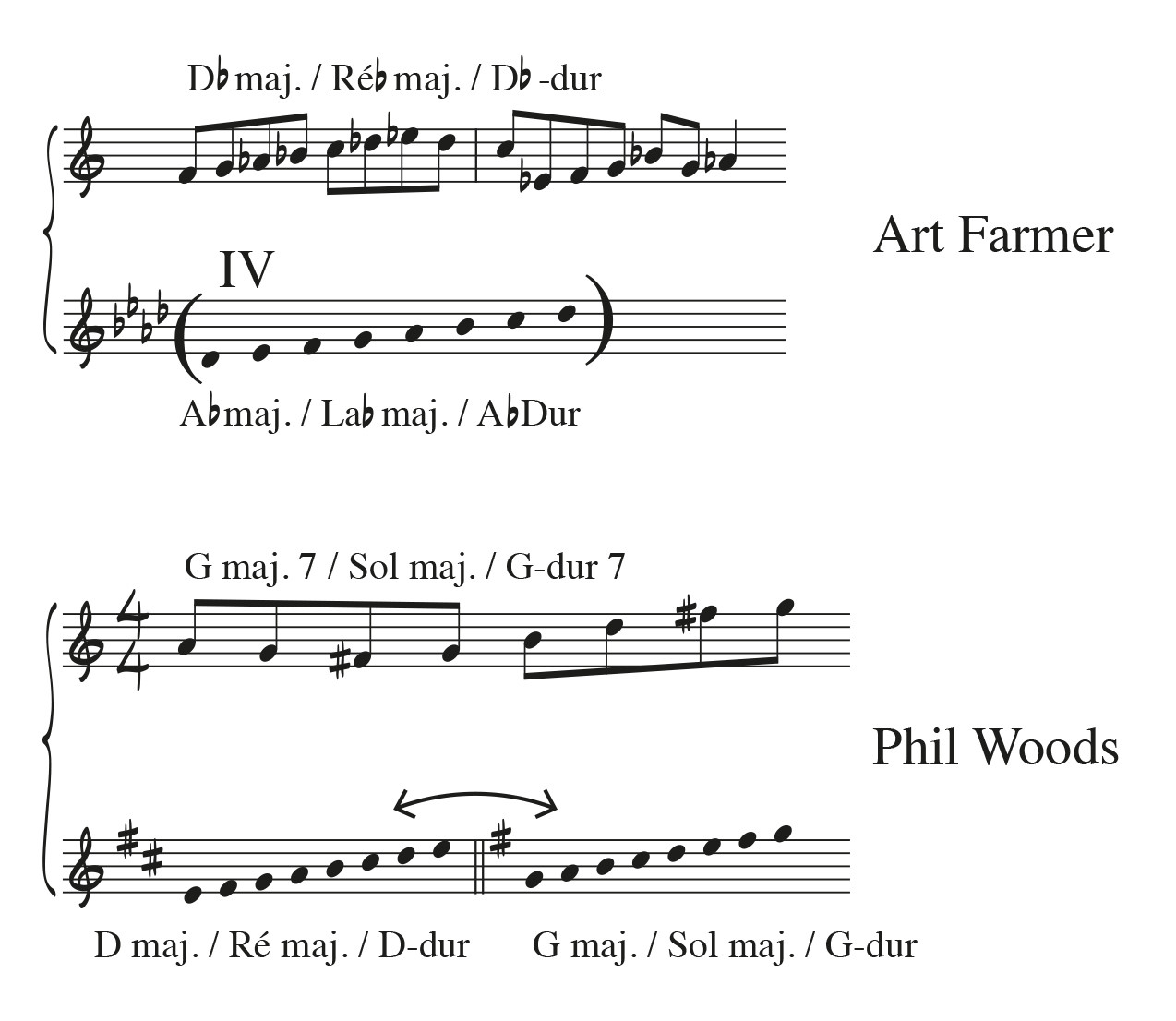
Example 4

Example 4

At this point, some of this must appear to be slightly abstract, but things will hopefully become clearer as the series develops. Who knows? Maybe it will become more confusing! It is extremely difficult for me to put in writing a system which relies so much on the interaction between the student and the teacher, but I’m going to try my best!

(to be continued)

Brass Bulletin 58, II / 1987 páginas 13–16

Todo el contenido está protegido por derechos de autor © Brass Bulletin 1987–2026

Compartir este artículo

Facebook LinkedIn
Cargando…

Preguntas y respuestas

Cómo funciona la edición digital

¿Qué incluye la edición digital?

La edición digital reúne los artículos ya digitalizados como textos legibles y consultables en línea —no simplemente como escaneos o archivos PDF— junto con sus ilustraciones originales, notas, autoría, información del número y traducciones disponibles. Las sugerencias de artículos relacionados incluyen actualmente solo este material digitalizado.

¿Los artículos digitales son idénticos a los originales?

Conservamos con la mayor fidelidad posible el texto original, el idioma, las ilustraciones, los pies de imagen, las notas y el contexto editorial. La presentación se adapta para facilitar la lectura en línea y pueden corregirse errores evidentes de transcripción o escaneado. El contenido y el carácter del artículo publicado permanecen inalterados.

¿Qué idiomas están disponibles?

Brass Bulletin se publicó en inglés, francés y alemán a lo largo de toda su historia. Las traducciones al italiano y al español se añadieron a partir del número 60. Por este motivo, en los sitios italiano y español los artículos de los números 1 a 59 se muestran en inglés de forma predeterminada.

¿Con qué frecuencia se añaden nuevos artículos?

Se añaden nuevos artículos casi a diario, con aproximadamente un número completo digitalizado cada semana. El ritmo puede variar según el trabajo de preparación, tratamiento de imágenes y revisión editorial necesario.

¿Por qué no están disponibles todos los artículos en formato digital?

La colección completa de Brass Bulletin contiene 1.246 artículos publicados entre 1971 y 2003. El índice completo ya está disponible en línea y permite descubrir todos los artículos de la colección, incluidos aquellos cuyo texto íntegro todavía no ha sido digitalizado.

La digitalización comenzó en febrero de 2026. Cada artículo se prepara cuidadosamente para la lectura en línea, se revisa y se vincula con su número, sus autores, sus temas y sus ilustraciones. Al ritmo actual de digitalización, se prevé que la colección completa esté disponible en línea en febrero de 2028.

¿Por qué algunas referencias mencionan artículos que todavía no están disponibles?

Las referencias de los artículos originales se conservan aunque el material al que remiten aún no haya sido digitalizado. De este modo se mantiene intacto el contexto histórico y editorial. A medida que se incorporen más números a la edición digital, un número creciente de estas referencias conducirá a artículos que podrán leerse en línea.

¿Puedo sugerir un artículo o informar de un error de transcripción?

Sí. Si hay algún artículo que le gustaría especialmente ver digitalizado, o si detecta un posible error de transcripción o algún dato que falta, póngase en contacto con nosotros. Los comentarios de los lectores nos ayudan a mejorar la edición digital y a establecer prioridades útiles dentro del archivo.

¿Cómo puedo apoyar a Brass Bulletin?

Su apoyo ayuda a financiar la preparación, verificación y publicación en línea de la colección completa.

Suscríbase a la Edición Digital

¿Prefiere apoyarnos sin suscribirse?

Haga una donación

¿Cómo avanza la digitalización?

Estamos poniendo Brass Bulletin a disposición de los lectores en línea, artículo por artículo. Pueden leer los artículos recién digitalizados en cuanto estén listos, incluso antes de que se complete un número entero.

Consulten nuestro calendario de digitalización para descubrir las últimas novedades y las fechas estimadas de disponibilidad de los próximos números. Estas estimaciones se basan en nuestro ritmo reciente y pueden cambiar.

Busca en Brass Bulletin.