Discoveries for brass players, once a month. Join our free newsletter →
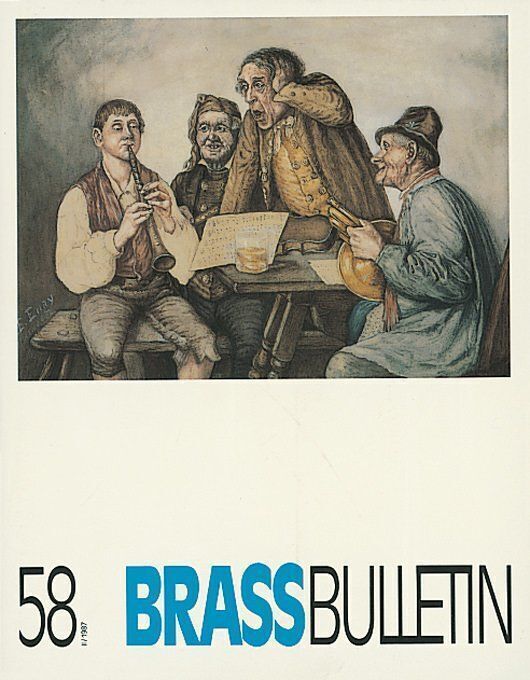
Brass Bulletin 58 - 2 / 1987
Issue
Brass Bulletin No. 58
Date
II / 1987
Pages
108
Contents
9 articles

Original inserts

World News Journal

Out of print

All issues

Brass Bulletin No. 58

II / 1987

Contents

9 articles
Free

Editorial

Jean-Pierre Mathez

pp. 7–8

Brass Bulletin’s summer editorial pairs a pause after the concert season with an appeal for new subscribers to support colour pages and an overworked team.

Free
Part 1

Jazz Improvisation

Major scales

Charlie Shoemake

pp. 13–16 Repertoire Teaching

Major scales, seventh chords and interval exercises provide the foundations for a systematic approach to jazz improvisation based on chord-scale relationships.

Reminiscences of modified rotary valves

Patented curiosities or missed opportunities?*

Günter Dullat

pp. 18–28 Equipment History

German patents from 1877 to 1919 document alternative brass valve mechanisms, reflecting makers’ attempts to shorten valve travel and offer players new technical aids.

Brass Techniques Series • Part 5

The Lips

Jean-Pierre Mathez

pp. 30–33 Technique

Lip function in brass playing depends on a delicate balance of muscular tension and breath, developed through flexible control rather than excessive mouthpiece pressure.

Free

One step for intonation: one giant step for the serpent

Craig Kridel

pp. 36–39 Serpent Report

The 1986 Amherst serpent gathering combined Christopher Monk’s teaching with the premiere of Simon Proctor’s eight-part suite, expanding the instrument’s repertoire.

Fats' Heirs

Clifford Brown, Freddie Hubbard, Wynton Marsalis

Michel Laplace

pp. 42–48 Trumpet History

Fats Navarro’s full trumpet sound shaped a jazz lineage through Clifford Brown and Booker Little to Wynton Marsalis, uniting early maturity with technical mastery.

Free

17th- and 18th-century Brass Instruments at the Shrine to Music Museum

Margaret Downie Banks

pp. 50–59 History

The Shrine to Music Museum’s early brass collection includes a tenor cornett, a slide trombone, trumpets and hunting horns made in Germany and France.

Part 3 – End

Did Bach write the "corne da caccia" part in the B minor Mass for Gottfried Reiche?

Peter Damm

pp. 63–69 Horn History Repertoire

Baroque horn symbolism and Bach’s cantata writing underpin Peter Damm’s case for a low D horn in the Quoniam of the B minor Mass, intended for Dresden.

Free

David Monette

Profile

Thomas Stevens

pp. 71 Trumpet Instrument Makers

Chicago trumpet maker David Monette won leading players as customers in under two years, building instruments for individual musicians and their performance needs.

Loading…

Questions & Answers

How the Digital Edition works

What does the Digital Edition include?

The Digital Edition brings together the articles already digitized as searchable online texts—not simply as scans or PDF files—along with their original illustrations, notes, authorship, issue information, and available translations. Related-article suggestions currently include only this digitized material.

Are the digital articles identical to the originals?

We preserve the original text, language, illustrations, captions, footnotes, and editorial context as faithfully as possible. The presentation is adapted for comfortable online reading, and obvious transcription or scanning errors may be corrected. The substance and character of the published article remain unchanged.

Which languages are available?

Brass Bulletin was published in English, French, and German throughout its history. Italian and Spanish translations were added from issue No. 60 onward.

On the Italian and Spanish sites, articles from issues 1–59 are therefore shown in English by default.

How often are new articles added?

New articles are added almost daily, with approximately one complete issue digitized each week. The pace may vary depending on the preparation, image work, and editorial checking required.

Why aren’t all articles available digitally?

The complete Brass Bulletin collection contains 1,246 articles published between 1971 and 2003. The full index is already available online, allowing readers to discover every article in the collection, including those whose complete text has not yet been digitized.

Digitization began in February 2026. Each article is carefully prepared for online reading, checked, and connected to its issue, authors, subjects, and illustrations. At the current pace of digitization, the complete collection is expected to be available online by February 2028.

Why do some references mention articles that are not available yet?

References in the original articles are preserved even when the material they point to has not yet been digitized. This keeps the historical and editorial record intact. As more issues are added to the Digital Edition, an increasing number of these references will lead to articles that can be read online.

Can I suggest an article or report a transcription error?

Yes. If there is an article you would particularly like to see digitized, or if you notice a possible transcription error or missing detail, please contact us. Reader feedback helps us improve the Digital Edition and prioritize useful connections within the archive.

How can I support Brass Bulletin?

Your support helps fund the preparation, verification, and online publication of the complete collection.

Subscribe to the Digital Edition

Prefer to support us without subscribing?

Make a donation

How is the digitization progressing?

We’re gradually making the Brass Bulletin available online, article by article. You can read newly digitized articles as soon as they’re ready, even before an entire issue is complete.

Visit our Digitization Roadmap to browse recent additions and see estimated availability for upcoming issues. These estimates follow our recent pace and may change.

Search Brass Bulletin.