Rendete Brass Bulletin disponibile nella vostra università, nel vostro conservatorio o nella vostra biblioteca Scoprite l’accesso istituzionale

4 min di lettura

Parte 1

Jazz Improvisation

Major scales

Jazz Improvisation

Prefatory Notes

Thomas Stevens: In my introductory article on your work as a teacher of Jazz improvisation (BRASS BULLETIN 57) the readers were informed that they would need a basic knowledge of music theory (major and minor scales, intervals and chords) as a prerequisite for studying your method. Is there anything else you wish to say before beginning what we hope will be an informative series of articles?

Charles Shoemake: The student should understand there are two basic ways to play Jazz. One is to play “by ear” without a working knowledge of scales and chords while the other is to play “by ear” with such knowledge. Both of these approaches have produced successful performers, but I prefer the second method because in the long term it provides a more solid basis for the musician’s creations, and although it may take longer to learn and require a more disciplined approach, the knowledge derived from such a course of study will better prepare the student to be able to adjust to new and sometimes more sophisticated developments in this art form as they occur.

T.S.: That being said, BRASS BULLETIN would like you to begin your series using the agreed upon format, which is to present the subject of Jazz improvisation in the same way you would if a student were to begin studies with you having absolutely no prior knowledge or experience in Jazz.

Part 1

We begin our studies with a very elementary diatonic approach. (Advanced scales and chords will follow later.)

The major scale

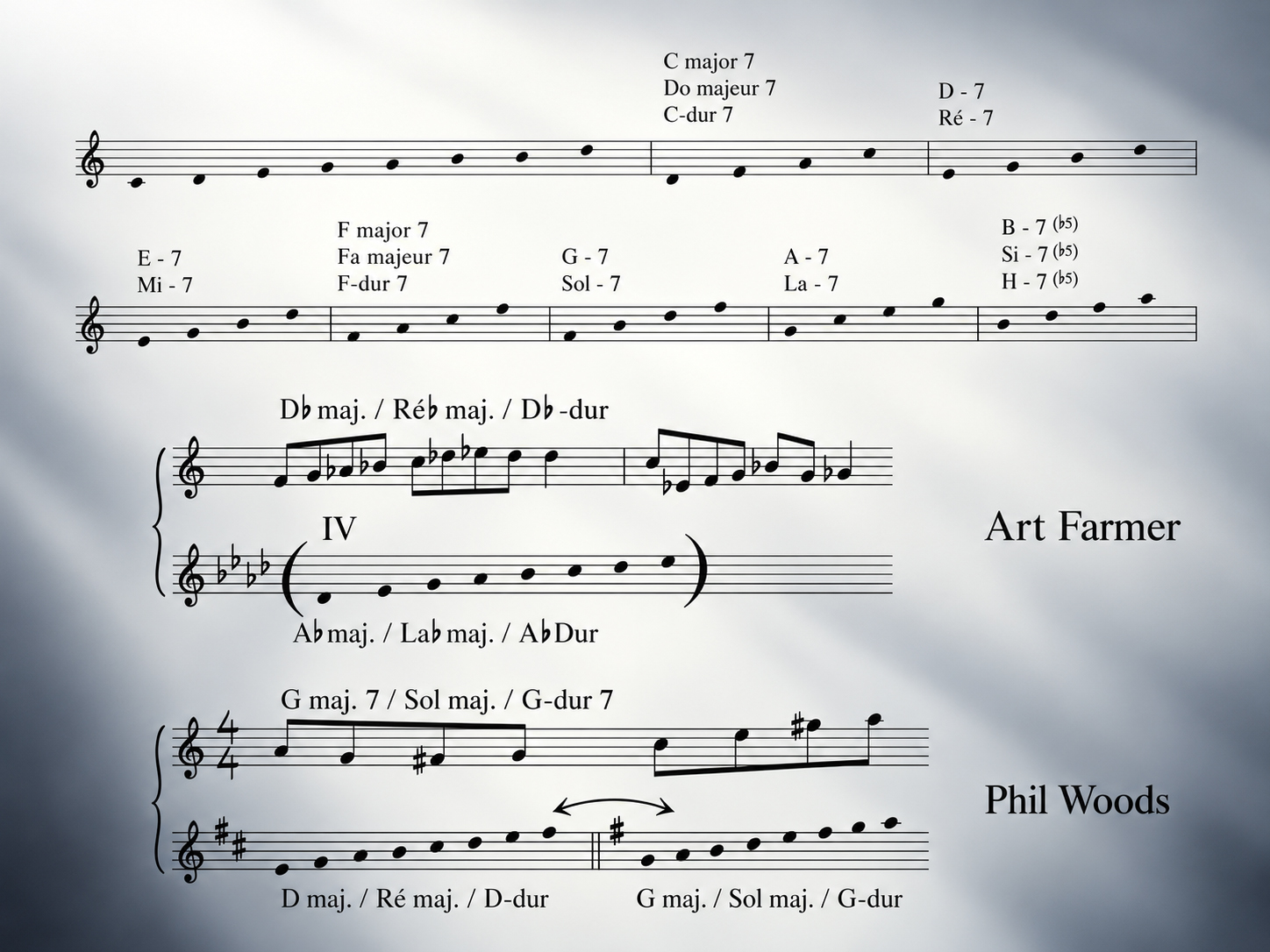
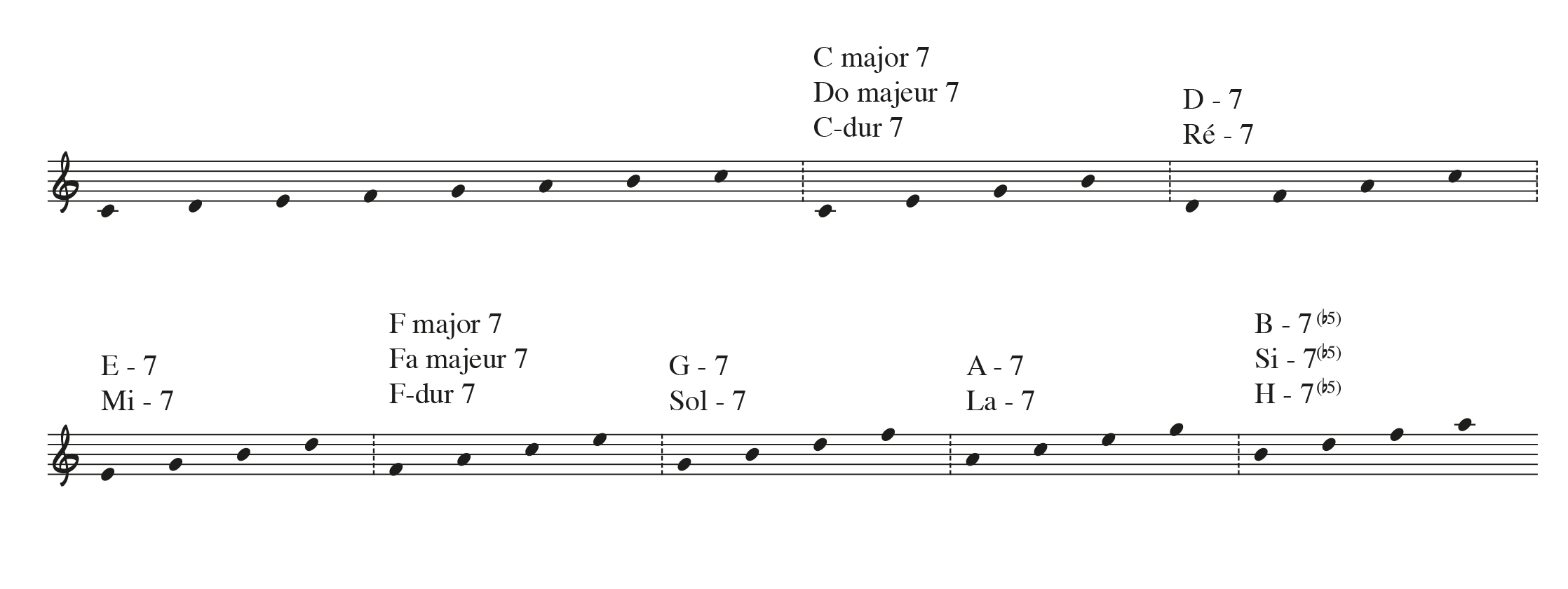
There are twelve major scales, each containing seven pitches. Four pitch chords can be formed by ascending the scale diatonically, using each diatonic scale pitch as the “root” of a chord (Example 1).

Example 1Key of C major

Example 1

Key of C major

The student should write out this example, transposing it into all major keys. The resultant types of chords are four in number, as follows: the major seventh chord (maj 7) consisting, always counting from the bottom pitch, or “root”, of a major third, minor third, major third; the minor seventh (−7) made up of minor third, major third, minor third; the dominant seventh (written simply 7) consisting of major third, minor third, minor third; and the minor seventh with flatted fifth (−7♭5) which some musicians call a half diminished chord (Ø). One should note that the types of four pitch chords will always occupy similar numerical positions in each key (I=major seventh (maj 7th) II=minor 7 (−7), etc.) (Example 2).

Example 2

Example 2

Interval exercise

Now that we understand how the basic four pitch chords are formed, we can see how important a working knowledge of intervals is. I have devised an exercise that should be helpful in this area (Example 3).

Tonality

A C F B♭ E♭ A♭ D♭ G♭ B E A D G

Pitch numbers

B 1 ♯1 ♭2 2 ♯2 ♭3 3 4 ♯4 ♭5 5 ♯5 ♭6 6 ♭7 7 (1)

The student should place his thumb on any number from group B (pitch numbers). Then place a finger on a letter from group A (tonality). The idea is to determine the correct pitch as quickly as possible. For example, if the thumb is placed on the number six, and the finger on “C” in the group above, the correct pitch would be “A” since it is the sixth pitch in the key of “C”. If the thumb is placed on the number four and the finger on “F”, the correct pitch would be “B♭” since it is the fourth interval up from “F”. One can also reverse the process. For example, place the finger on “B♭”, and the thumb on number flat seven (♭7) from the group below. The correct pitch would be “A♭”. This exercise should be practiced until there is no hesitation in recognizing any interval from any of the twelve keys listed in the group.

Chord-scale relationship

There are no chords, either simple or complex, which are not formed from some type of scale. Consequently, the ability to look at any type of chord and know which scale corresponds to it is of enormous importance.

I have spoken of the four different types of basic chords found in the major scale, and the positions they occupy therein. One should memorize the basic chord positions as a first step in the knowledge of harmony needed for improvisation (Chart).

  
C major 7(1st chord of C major scale; 4th chord of G major scale)
F major 7(1st chord of F major scale; 4th chord of C major scale)
B♭ major 7(1st chord of B♭ major scale; 4th chord of F major scale)
E♭ major 7(1st chord of E♭ major scale; 4th chord of B♭ major scale)
A♭ major 7(1st chord of A♭ major scale; 4th chord of E♭ major scale)
D♭ major 7(1st chord of D♭ major scale; 4th chord of A♭ major scale)
G♭ major 7(1st chord of G♭ major scale; 4th chord of D♭ major scale)
B major 7(1st chord of B major scale; 4th chord of G♭ major scale)
E major 7(1st chord of E major scale; 4th chord of B major scale)
A major 7(1st chord of A major scale; 4th chord of E major scale)
D major 7(1st chord of D major scale; 4th chord of A major scale)
G major 7(1st chord of G major scale; 4th chord of D major scale)

What the above means is that when you see a major seventh chord in any piece of music you have a choice of two correct major scales from which to create your improvised melodies. I have included two examples by two well-known Jazz performers, Art Farmer and Phil Woods, which illustrate how this works (Example 4). Farmer treats the D♭ maj 7 as the IV chord in “A♭”. Woods uses notes that come from both the “G” and “D” major scales over the G maj 7th.
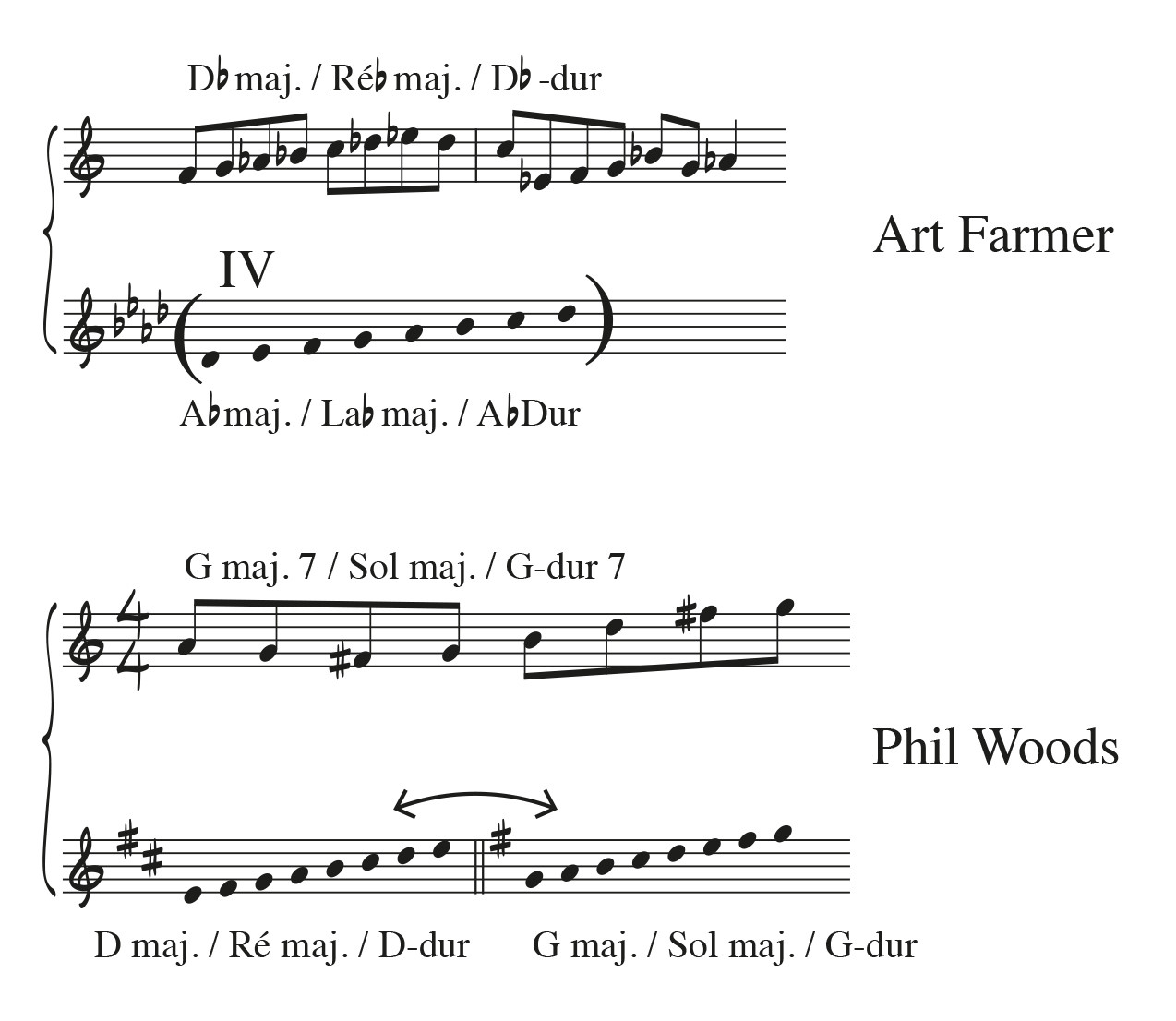
Example 4

Example 4

At this point, some of this must appear to be slightly abstract, but things will hopefully become clearer as the series develops. Who knows? Maybe it will become more confusing! It is extremely difficult for me to put in writing a system which relies so much on the interaction between the student and the teacher, but I’m going to try my best!

(to be continued)

Brass Bulletin 58, II / 1987 pagine 13–16

Tutti i contenuti sono protetti dal diritto d’autore © Brass Bulletin 1987–2026

Condividi questo articolo

Facebook LinkedIn
Loading…

Domande e risposte

Come funziona l’edizione digitale

Che cosa comprende l’edizione digitale?

L’edizione digitale riunisce gli articoli già digitalizzati sotto forma di testi leggibili e ricercabili online — non semplicemente come scansioni o file PDF — insieme alle illustrazioni originali, alle note, agli autori, alle informazioni sul numero della rivista e alle traduzioni disponibili. I suggerimenti di articoli correlati comprendono attualmente solo questo materiale digitalizzato.

Gli articoli digitali sono identici agli originali?

Conserviamo il più fedelmente possibile il testo originale, la lingua, le illustrazioni, le didascalie, le note e il contesto editoriale. La presentazione viene adattata per una lettura confortevole online e gli evidenti errori di trascrizione o scansione possono essere corretti. Il contenuto e il carattere dell’articolo pubblicato rimangono invariati.

Quali lingue sono disponibili?

Brass Bulletin è stato pubblicato in inglese, francese e tedesco nel corso di tutta la sua storia. Le traduzioni italiane e spagnole sono state aggiunte a partire dal numero 60. Sui siti italiano e spagnolo, gli articoli dei numeri da 1 a 59 vengono quindi mostrati in inglese per impostazione predefinita.

Con quale frequenza vengono aggiunti nuovi articoli?

Nuovi articoli vengono aggiunti quasi ogni giorno, con circa un numero completo digitalizzato ogni settimana. Il ritmo può variare in base al lavoro di preparazione, elaborazione delle immagini e verifica editoriale necessario.

Perché non tutti gli articoli sono disponibili in formato digitale?

La collezione completa di Brass Bulletin comprende 1.246 articoli pubblicati tra il 1971 e il 2003. L’indice completo è già disponibile online e consente di scoprire tutti gli articoli della collezione, compresi quelli il cui testo integrale non è ancora stato digitalizzato.

La digitalizzazione è iniziata nel febbraio 2026. Ogni articolo viene accuratamente preparato per la lettura online, verificato e collegato al relativo numero, agli autori, agli argomenti e alle illustrazioni. Al ritmo attuale di digitalizzazione, la collezione completa dovrebbe essere disponibile online entro febbraio 2028.

Perché alcuni riferimenti citano articoli che non sono ancora disponibili?

I riferimenti presenti negli articoli originali vengono conservati anche quando il materiale a cui rimandano non è ancora stato digitalizzato. In questo modo si preserva l’integrità storica ed editoriale della rivista. Man mano che nuovi numeri vengono aggiunti all’edizione digitale, un numero crescente di questi riferimenti condurrà ad articoli leggibili online.

Posso suggerire un articolo o segnalare un errore di trascrizione?

Sì. Se desiderate che un determinato articolo venga digitalizzato, oppure se notate un possibile errore di trascrizione o un’informazione mancante, contattateci. I riscontri dei lettori ci aiutano a migliorare l’edizione digitale e a stabilire priorità utili all’interno dell’archivio.

Come posso sostenere Brass Bulletin?

Il vostro sostegno contribuisce a finanziare la preparazione, la verifica e la pubblicazione online dell’intera collezione.

Abbonati all’Edizione digitale

Preferite sostenerci senza abbonarvi?

Fate una donazione

Come procede la digitalizzazione?

Stiamo rendendo Brass Bulletin disponibile online gradualmente, articolo per articolo. Potete leggere gli articoli appena digitalizzati non appena sono pronti, anche prima che un intero numero sia completato.

Consultate il nostro calendario di digitalizzazione per scoprire le ultime aggiunte e le date di disponibilità stimate dei prossimi numeri. Le stime si basano sul nostro ritmo recente e possono cambiare.

Cerca in Brass Bulletin.