9 min. read
This article is for subscribers.
Reminiscences of modified rotary valves
Patented curiosities or missed opportunities?*
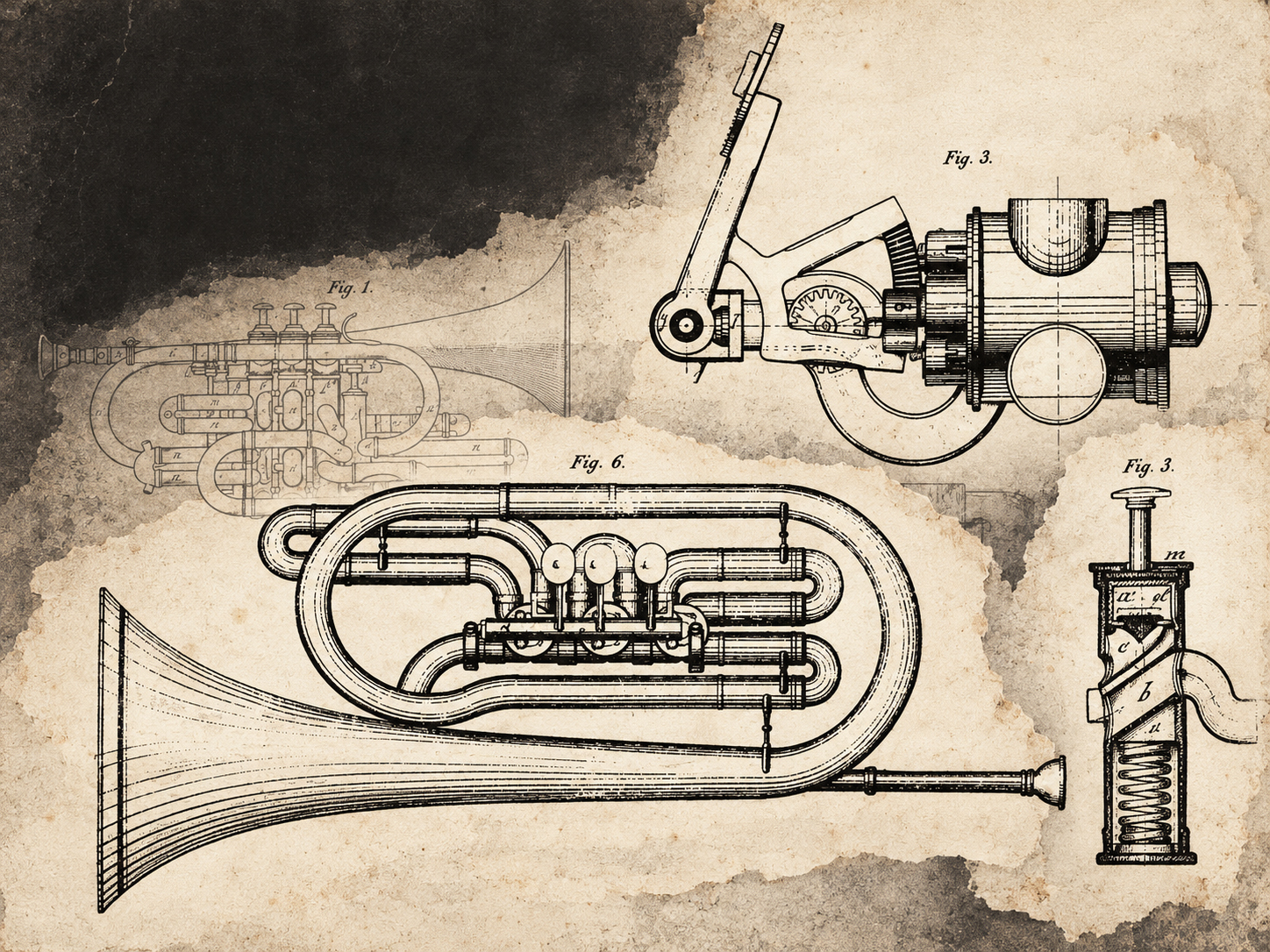
In connection with the preparation of a book on brass instrument making² I have had to study many domestic and foreign patents. From the many documents available on wind instrument making I have for these articles selected some which differ considerably from the usual innovations. Although none of these inventions was introduced into brass instrument making, they show the ideas produced by instrument makers, soloists and amateurs in order to help the player. I will limit myself to valve mechanisms occurring in German patents.
C.W. Moritz
Device on rotary valves for brass instruments
Pat. 176 - (1877)
This patent specification is the first for wind instruments after the opening of the Imperial Patent Office on 1st July 1877.
The essence of this innovation is a driving mechanism different from normal valve mechanisms. While previous examples had had a connecting rod between the touchpiece and the rotor, here the valve is operated by a toothed segment.
The illustrations show, in particular:
fig. 1 a section through the valve
fig. 2 plan view
fig. 3 side elevation with complete valve casing, touchpiece and toothed segment
fig. 4 plan view of a touchpiece with spring
figs. 5+6 a trumpet with the new mechanism
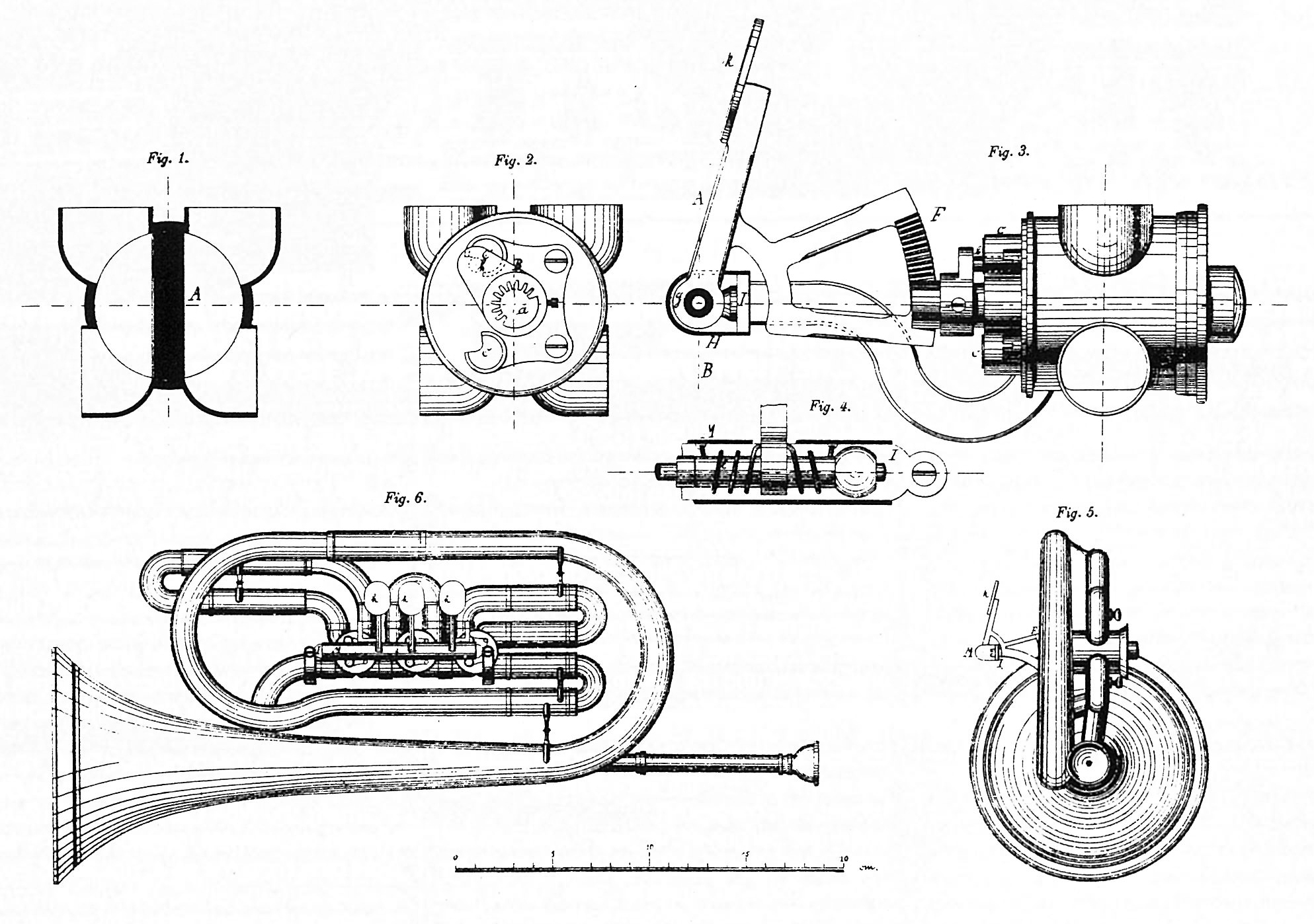
C.W. Moritz, Device on rotary valves for brass instruments, Pat. 176 - (1877)
Among other things it is said of the invention:
In comparison with previous designs using levers and rods this design offers the substantial advantage that the travel of the arm k is considerably shorter than before and in consequence of the small number of moving parts the ease of operation results in less maintenance being necessary.
C.W. Moritz
Improvement in rotary valves for brass instruments
Pat. 11511 - (1880)
This document offers an alternative answer to the desire, still expressed today, to keep the valve (rotor) travel short while keeping the pressure required to activate it as low as possible. This innovation, like the previous one, does without the now ubiquitous connecting rod. The whole mechanism thus had to be mounted directly above the valves and equipped with a so-called angle lever.
Figs. 1-3 and 4-5 shows two suggestions. Figs 6 and 7 show the new mechanism applied to piston valves.
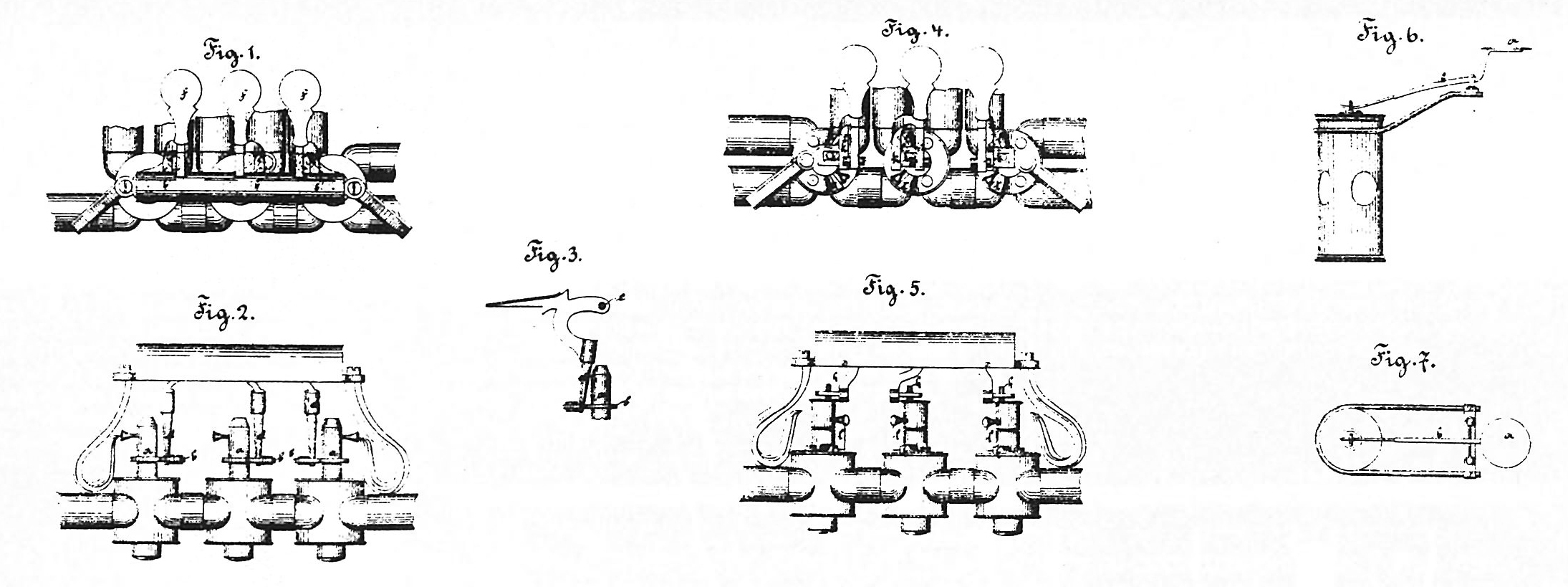
C.W. Moritz, Improvement in rotary valves for brass instruments, Pat. 11511 - (1880)
While, in the mechanisms of this kind normal hitherto, the valve always sought to maintain the high position and, in order to change the airways, pressure had to be applied directly to the valve, figs. 6 and 7 show a mechanism in which the valve normally maintains the low position. To change the airways the valve is raised by pressing the touchpiece a of the lever b. Of course the valve bores must here be reversed by comparison with what was previously normal.
M.C.R. Andorff
Rotary valve for wind instruments
Pat. 51630 - (1889)
This innovation is virtually a cross between piston and rotary valve. The basic form of the latter is maintained but with a kind of screw axle for its turning movement. When the touchpiece is pressed, this moves downwards and simultaneously turns the valve through 90°. A spring returns the valve when the touchpiece is released.
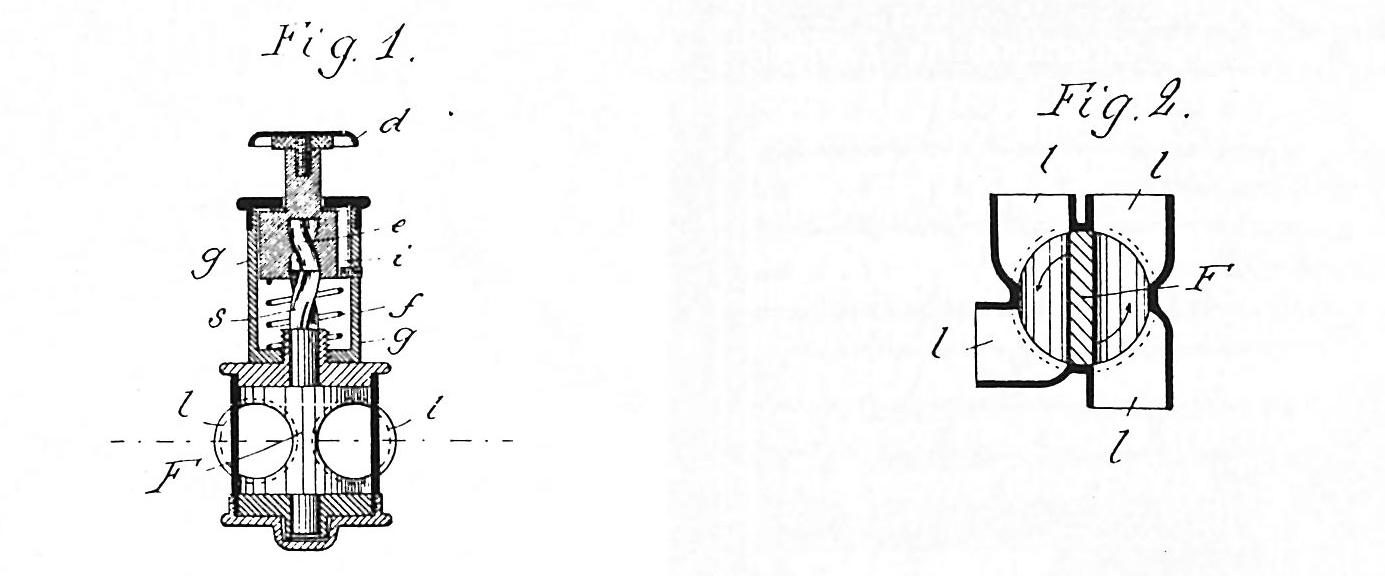
M.C.R. Andorff, Rotary valve for wind instruments, Pat. 51630 - (1889)
Claim of the patent:
a rotary valve for wind instruments, characterised by a screw thread (s) along the axis of the valve together with a non-turning valve cap (d), also threaded (e), which is raised by a spring (f) and which, when depressed, causes the valve to turn.
This article is for subscribers.
CHF 5.00 per month · Cancel auto-renewal anytime.
Enjoy unlimited access to all digitized Brass Bulletin articles.
Brass Bulletin 58, II / 1987 pages 18–28
All content is protected by copyright © Brass Bulletin 1987–2026